In today's edition: Quick Fire 🔥 with Ibukun Adedeji || Wise secures regulatory approval from Nigeria || Luno launches prediction markets || Who secured the bagIn today's edition: Quick Fire 🔥 with Ibukun Adedeji || Wise secures regulatory approval from Nigeria || Luno launches prediction markets || Who secured the bag

👨🏿‍🚀TechCabal Daily – A Wise move to Nigeria

2026/03/20 14:10
9 min read
For feedback or concerns regarding this content, please contact us at crypto.news@mexc.com

Happy holidays. 🇳🇬

We have an appeal. If you keep receiving TC Daily in your Spam or Promotions folder, kindly move today’s edition to your Primary inbox, so you don’t miss the most important daily analysis of African tech.

Make sure you enjoy your weekend. We know what will help: binge every episode of our show, Headlines by TechCabal, and anticipate episode 10 airing this Saturday, March 21.

Want to advertise your brand on Headlines? Speak to the team.

Let’s dive in.

  • Quick Fire 🔥 with Ibukun Adedeji
  • Wise secures regulatory approval from Nigeria
  • Luno launches prediction markets
  • Who secured the bag? 💰
  • World Wide Web 3
  • Job Openings

Features

Quick Fire 🔥 with Ibukun Adedeji

Image: Ibukun Adedeji, Product Manager, Moniepoint

Ibukun Adedeji is a technologist and product leader working on large-scale financial and operational systems across Africa. He is currently a Product Manager at Moniepoint, where he contributes to products that power millions of businesses through payments and financial infrastructure.

Over the past several years, Ibukun has worked across lending, payments, commerce, and investments business areas, building and scaling digital products in complex, high-volume environments. Before Moniepoint, he held product leadership roles at companies including Flutterwave, Sabi, and Lupiya in Zambia, where he worked on credit, payments, and investment products serving emerging markets. 

  • Explain what you do to a 5-year-old.

Imagine you have a piggy bank where you keep your money. Now, imagine there’s a magical piggy bank on your parents’ phone that can do really cool things like send money to grandma, pay for your snacks at the store, or even help your parents save money for your birthday party. 

My job is to think about what would make that magical piggy bank work really well for other adults. I talk to lots of people to understand what they need, then I work with the people who build the magical piggy bank to make sure it’s easy to use and helps everyone with their money. I make sure the magical piggy bank is safe, easy to understand, and does exactly what people need it to do.

  • What’s one rookie mistake you made while working in product, and what did that teach you?

In hindsight, I focused a lot on my output as a product manager rather than pursuing business outcomes. The lesson there is for product managers to reduce their involvement in activities that drain energy without pushing the needle or making an impact on the metrics that really matter. As a product person, the priority should be to shape business outcomes while giving your customers a super experience.

  • What’s one thing about user behaviour in emerging markets that still surprises you?

Resilience and creativity in how people adapt technology to their realities. When you design a product, you imagine a fairly clean flow of how it should be used. But users in emerging markets often bend the system in ways you never anticipated because they are solving real problems in their day-to-day lives.

For instance, a payment product might be designed for simple transfers, but merchants start using it as an informal accounting system. Or people begin routing money through multiple wallets just to manage liquidity across different networks. What you thought was a feature becomes infrastructure for behaviours you didn’t originally plan for.

Fincra is now licenced in Canada.
Fincra has secured a PSP licence in Canada, adding a regulated connection between Africa and one of the world’s most trusted financial systems. See what this means for your business.

Fintech

UK fintech Wise secures regulatory approval to enter Nigeria

Image Source: Tenor

While the timeline of its entry into the country is still unknown, Wise, a UK remittance fintech company, has received regulatory approval to launch its services in Nigeria. The announcement came tucked inside a UK government communiqué following the UK–Nigeria Enhanced Trade and Investment Partnership dialogue on March 16.

This was a long time coming: Nigerians have been interacting with Wise through cross-border corridors, albeit indirectly. Diaspora users could send money into Nigeria through Wise-linked accounts or third-party integrations, while freelancers and remote workers have also used Wise to receive payments in foreign accounts. The fintech just didn’t have a full local presence, but this regulatory approval changes that.

The crowded airspace: Wise will be stepping into Nigeria’s crowded remittance market with local fintechs and other foreign players, such as NALA, that are fighting for cross-border cash flow. On one end, there are Western Union and MoneyGram, and on the other are fintech challengers like Flutterwave and LemFi. Yes, Wise has been operating in the market underground, but it will need a more competitive edge.

Why this entry matters: Wise has been circling Africa. In December 2025, it received conditional approval from the South African Reserve Bank (SARB) to operate as a Category 2 Authorised Dealer in Foreign Exchange with Limited Authority (ADLA). For years, companies like Wise served African users from the outside, supporting corridors without fully entering the ecosystem. Regulatory approvals show that these companies are ready for on-ground participation, which raises the stakes for local players and signals a growing market.

Find your next role at Paga. Join the team building best-in-class infrastructure for African fintech.

Paga Engine is transforming Africa’s payment ecosystem with best-in-class infrastructure, empowering top businesses to scale faster. Join us to build. Find your next role.

Cryptocurrency

Luno’s South African and Nigerian users can now predict crypto prices and earn money

Image Source: TechCabal Memes

Luno, the Africa-focused crypto firm, has a new feature for users addicted to shiny tech.

Its new prediction markets feature is trying to turn every crypto watcher into a paid forecaster. With as little as $5, for example, a user in South Africa or Nigeria can take a view on whether Bitcoin, Ether, Solana, Dogecoin, or XRP will end the day above or below a certain price, and, if they are right, walk away with a quick $2 or more in a few hours, depending on the odds and their stake. 

The product sits between trading and entertainment: You do not need to own the coin or understand leverage, you just fund a separate USDC wallet, pick a side, and let the clock run.

Who is this really for? Beyond futures traders and degens already used to complex crypto products, the army of unsolicited “analysts” in WhatsApp groups who call tops and bottoms every day for free will find this useful. 

If you are convinced that something US President Trump said will nudge Bitcoin price up or down, Luno is asking why you are not putting your money where your mouth is. Prediction markets carry trading risk, but what is a little risk to experience maximum upside? Luno wants you to think exactly that and lean into the feature.

Is this gambling? It depends on who you ask. There is a genuine morality question here. The product has a clear risk‑reward structure and looks a lot like gaming, but under the hood, prediction markets are built as a set of short‑term financial contracts, made up of many small positions that collectively form a kind of crowd intelligence on where prices might land.

Operators will insist it is not gambling because there is so much maths, pricing, and probability engineering involved. Regulators, who tend to judge technology by how people use it rather than its self-description, may see things differently. For them, the question will be whether this helps retail users express informed views or simply gives them a sleeker way to lose money faster. 

More importantly, the protection guardrails will matter to regulators when evaluating prediction markets in the future. At the rate of its hype, that future is not very far.

Insights

Funding Tracker
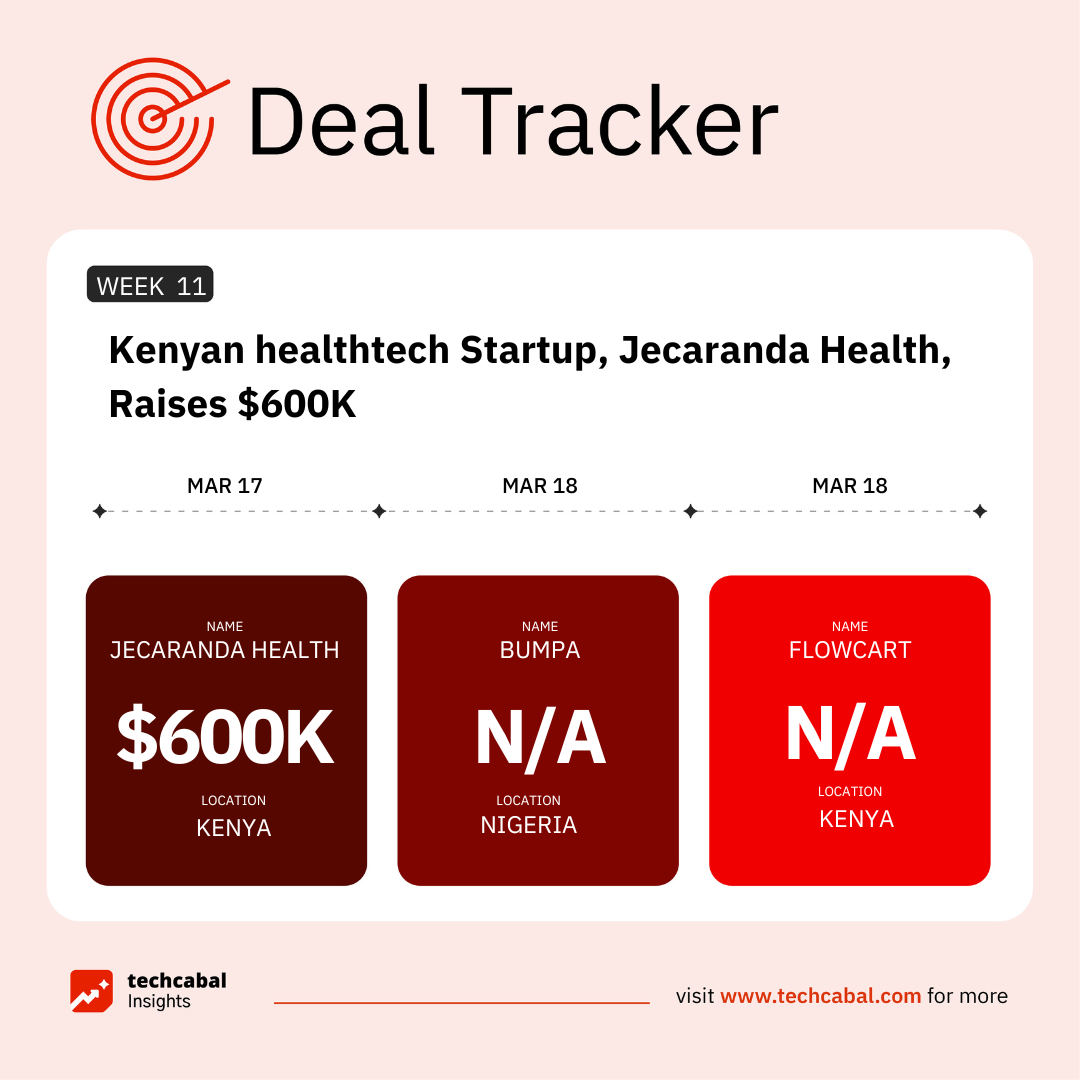
Image Source: Success Sotonwa for TechCabal Insights

Jacaranda Health, a Kenyan healthtech startup, secured $600 thousand in funding from Swedfund. (Mar 17)

Here are the other deals for the week:

  • Bumpa, a Nigerian e-commerce startup, raised an undisclosed amount in funding from Jobtech Allice. (Mar 18)
  • Flowcart, a Kenyan e-commerce startup, raised an undisclosed amount in funding from Jobtech Alliance. (Mar 18)

Follow us on Twitter, Instagram, and LinkedIn for more funding announcements. Before you go, what does it mean to be an AI startup in Africa?. Find out more here.

CRYPTO TRACKER

The World Wide Web3

Source:

CoinMarketCap logo

Coin Name

Current Value

Day

Month

Bitcoin $70,714

– 0.11%

+ 4.20%

Ether $2,147

– 2.16%

+ 7.34%

Zebec Network $0.002626

+ 23.39%

+ 22.51%

Solana $89.31

– 0.81%

+ 4.89%

* Data as of 06.30 AM WAT, March 20, 2026.

Job Openings

  • Big Cabal Media — Senior Motion Designer, YouTube Growth Strategist, Quality Assurance Engineer, Editor-in-Chief (TechCabal) — Lagos, Nigeria 
  • Fincra — Country Manager, Kenya — Remote (Kenya)
  • Fincra — Country Manager, Mozambique — Remote (Mozambique)
  • Fincra — Country Manager, South Africa — Remote (South Africa)
  • Fincra — Senior Product Engineer, Senior Marketing Specialist, and several other roles — Remote (anywhere in the world)
  • Paga — Strategic Partnership Executive, Software Architect, Senior Sales Executive, Doroki Growth Marketing Manager, and several other roles — Lagos, Nigeria

There are more jobs on TechCabal’s job board. If you have job opportunities to share, please submit them at bit.ly/tcxjobs.

  • Prediction markets are trying to lure journalists with partnership deals
  • Paramount’s $110 billion Warner Bros. gamble
  • Marc Andreessen is a philosophical zombie
  • What riding Bolt’s electric tricycle in Lagos actually feels like
  • Delve Into AI: Why African countries are using data protection laws as backdoor to regulate AI

Written by: Opeyemi Kareem, Emmanuel Nwosu, and Success Sotonwa

Edited by: Emmanuel Nwosu & Ganiu Oloruntade

Want more of TechCabal?

Sign up for our insightful newsletters on the business and economy of tech in Africa.

  • The Next Wave: futuristic analysis of the business of tech in Africa.
  • Francophone Weekly by TechCabal: insider insights and analysis of Francophone’s tech ecosystem

P:S If you’re often missing TC Daily in your inbox, check your Promotions folder and move any edition of TC Daily from “Promotions” to your “Main” or “Primary” folder and TC Daily will always come to you.

Email Us
Market Opportunity
Movement Logo
Movement Price(MOVE)
$0.02061
$0.02061$0.02061
+0.43%
USD
Movement (MOVE) Live Price Chart
Disclaimer: The articles reposted on this site are sourced from public platforms and are provided for informational purposes only. They do not necessarily reflect the views of MEXC. All rights remain with the original authors. If you believe any content infringes on third-party rights, please contact crypto.news@mexc.com for removal. MEXC makes no guarantees regarding the accuracy, completeness, or timeliness of the content and is not responsible for any actions taken based on the information provided. The content does not constitute financial, legal, or other professional advice, nor should it be considered a recommendation or endorsement by MEXC.

You May Also Like

Trump-backed WLFI  launches AgentPay SDK open-source payment toolkit for AI agents

Trump-backed WLFI  launches AgentPay SDK open-source payment toolkit for AI agents

The Trump family has expanded its presence in the crypto community with a major development for artificial intelligence (AI) agents. According to reports, World
Share
Cryptopolitan2026/03/20 19:03
Summarize Any Stock’s Earnings Call in Seconds Using FMP API

Summarize Any Stock’s Earnings Call in Seconds Using FMP API

Turn lengthy earnings call transcripts into one-page insights using the Financial Modeling Prep APIPhoto by Bich Tran Earnings calls are packed with insights. They tell you how a company performed, what management expects in the future, and what analysts are worried about. The challenge is that these transcripts often stretch across dozens of pages, making it tough to separate the key takeaways from the noise. With the right tools, you don’t need to spend hours reading every line. By combining the Financial Modeling Prep (FMP) API with Groq’s lightning-fast LLMs, you can transform any earnings call into a concise summary in seconds. The FMP API provides reliable access to complete transcripts, while Groq handles the heavy lifting of distilling them into clear, actionable highlights. In this article, we’ll build a Python workflow that brings these two together. You’ll see how to fetch transcripts for any stock, prepare the text, and instantly generate a one-page summary. Whether you’re tracking Apple, NVIDIA, or your favorite growth stock, the process works the same — fast, accurate, and ready whenever you are. Fetching Earnings Transcripts with FMP API The first step is to pull the raw transcript data. FMP makes this simple with dedicated endpoints for earnings calls. If you want the latest transcripts across the market, you can use the stable endpoint /stable/earning-call-transcript-latest. For a specific stock, the v3 endpoint lets you request transcripts by symbol, quarter, and year using the pattern: https://financialmodelingprep.com/api/v3/earning_call_transcript/{symbol}?quarter={q}&year={y}&apikey=YOUR_API_KEY here’s how you can fetch NVIDIA’s transcript for a given quarter: import requestsAPI_KEY = "your_api_key"symbol = "NVDA"quarter = 2year = 2024url = f"https://financialmodelingprep.com/api/v3/earning_call_transcript/{symbol}?quarter={quarter}&year={year}&apikey={API_KEY}"response = requests.get(url)data = response.json()# Inspect the keysprint(data.keys())# Access transcript contentif "content" in data[0]: transcript_text = data[0]["content"] print(transcript_text[:500]) # preview first 500 characters The response typically includes details like the company symbol, quarter, year, and the full transcript text. If you aren’t sure which quarter to query, the “latest transcripts” endpoint is the quickest way to always stay up to date. Cleaning and Preparing Transcript Data Raw transcripts from the API often include long paragraphs, speaker tags, and formatting artifacts. Before sending them to an LLM, it helps to organize the text into a cleaner structure. Most transcripts follow a pattern: prepared remarks from executives first, followed by a Q&A session with analysts. Separating these sections gives better control when prompting the model. In Python, you can parse the transcript and strip out unnecessary characters. A simple way is to split by markers such as “Operator” or “Question-and-Answer.” Once separated, you can create two blocks — Prepared Remarks and Q&A — that will later be summarized independently. This ensures the model handles each section within context and avoids missing important details. Here’s a small example of how you might start preparing the data: import re# Example: using the transcript_text we fetched earliertext = transcript_text# Remove extra spaces and line breaksclean_text = re.sub(r'\s+', ' ', text).strip()# Split sections (this is a heuristic; real-world transcripts vary slightly)if "Question-and-Answer" in clean_text: prepared, qna = clean_text.split("Question-and-Answer", 1)else: prepared, qna = clean_text, ""print("Prepared Remarks Preview:\n", prepared[:500])print("\nQ&A Preview:\n", qna[:500]) With the transcript cleaned and divided, you’re ready to feed it into Groq’s LLM. Chunking may be necessary if the text is very long. A good approach is to break it into segments of a few thousand tokens, summarize each part, and then merge the summaries in a final pass. Summarizing with Groq LLM Now that the transcript is clean and split into Prepared Remarks and Q&A, we’ll use Groq to generate a crisp one-pager. The idea is simple: summarize each section separately (for focus and accuracy), then synthesize a final brief. Prompt design (concise and factual) Use a short, repeatable template that pushes for neutral, investor-ready language: You are an equity research analyst. Summarize the following earnings call sectionfor {symbol} ({quarter} {year}). Be factual and concise.Return:1) TL;DR (3–5 bullets)2) Results vs. guidance (what improved/worsened)3) Forward outlook (specific statements)4) Risks / watch-outs5) Q&A takeaways (if present)Text:<<<{section_text}>>> Python: calling Groq and getting a clean summary Groq provides an OpenAI-compatible API. Set your GROQ_API_KEY and pick a fast, high-quality model (e.g., a Llama-3.1 70B variant). We’ll write a helper to summarize any text block, then run it for both sections and merge. import osimport textwrapimport requestsGROQ_API_KEY = os.environ.get("GROQ_API_KEY") or "your_groq_api_key"GROQ_BASE_URL = "https://api.groq.com/openai/v1" # OpenAI-compatibleMODEL = "llama-3.1-70b" # choose your preferred Groq modeldef call_groq(prompt, temperature=0.2, max_tokens=1200): url = f"{GROQ_BASE_URL}/chat/completions" headers = { "Authorization": f"Bearer {GROQ_API_KEY}", "Content-Type": "application/json", } payload = { "model": MODEL, "messages": [ {"role": "system", "content": "You are a precise, neutral equity research analyst."}, {"role": "user", "content": prompt}, ], "temperature": temperature, "max_tokens": max_tokens, } r = requests.post(url, headers=headers, json=payload, timeout=60) r.raise_for_status() return r.json()["choices"][0]["message"]["content"].strip()def build_prompt(section_text, symbol, quarter, year): template = """ You are an equity research analyst. Summarize the following earnings call section for {symbol} ({quarter} {year}). Be factual and concise. Return: 1) TL;DR (3–5 bullets) 2) Results vs. guidance (what improved/worsened) 3) Forward outlook (specific statements) 4) Risks / watch-outs 5) Q&A takeaways (if present) Text: <<< {section_text} >>> """ return textwrap.dedent(template).format( symbol=symbol, quarter=quarter, year=year, section_text=section_text )def summarize_section(section_text, symbol="NVDA", quarter="Q2", year="2024"): if not section_text or section_text.strip() == "": return "(No content found for this section.)" prompt = build_prompt(section_text, symbol, quarter, year) return call_groq(prompt)# Example usage with the cleaned splits from Section 3prepared_summary = summarize_section(prepared, symbol="NVDA", quarter="Q2", year="2024")qna_summary = summarize_section(qna, symbol="NVDA", quarter="Q2", year="2024")final_one_pager = f"""# {symbol} Earnings One-Pager — {quarter} {year}## Prepared Remarks — Key Points{prepared_summary}## Q&A Highlights{qna_summary}""".strip()print(final_one_pager[:1200]) # preview Tips that keep quality high: Keep temperature low (≈0.2) for factual tone. If a section is extremely long, chunk at ~5–8k tokens, summarize each chunk with the same prompt, then ask the model to merge chunk summaries into one section summary before producing the final one-pager. If you also fetched headline numbers (EPS/revenue, guidance) earlier, prepend them to the prompt as brief context to help the model anchor on the right outcomes. Building the End-to-End Pipeline At this point, we have all the building blocks: the FMP API to fetch transcripts, a cleaning step to structure the data, and Groq LLM to generate concise summaries. The final step is to connect everything into a single workflow that can take any ticker and return a one-page earnings call summary. The flow looks like this: Input a stock ticker (for example, NVDA). Use FMP to fetch the latest transcript. Clean and split the text into Prepared Remarks and Q&A. Send each section to Groq for summarization. Merge the outputs into a neatly formatted earnings one-pager. Here’s how it comes together in Python: def summarize_earnings_call(symbol, quarter, year, api_key, groq_key): # Step 1: Fetch transcript from FMP url = f"https://financialmodelingprep.com/api/v3/earning_call_transcript/{symbol}?quarter={quarter}&year={year}&apikey={api_key}" resp = requests.get(url) resp.raise_for_status() data = resp.json() if not data or "content" not in data[0]: return f"No transcript found for {symbol} {quarter} {year}" text = data[0]["content"] # Step 2: Clean and split clean_text = re.sub(r'\s+', ' ', text).strip() if "Question-and-Answer" in clean_text: prepared, qna = clean_text.split("Question-and-Answer", 1) else: prepared, qna = clean_text, "" # Step 3: Summarize with Groq prepared_summary = summarize_section(prepared, symbol, quarter, year) qna_summary = summarize_section(qna, symbol, quarter, year) # Step 4: Merge into final one-pager return f"""# {symbol} Earnings One-Pager — {quarter} {year}## Prepared Remarks{prepared_summary}## Q&A Highlights{qna_summary}""".strip()# Example runprint(summarize_earnings_call("NVDA", 2, 2024, API_KEY, GROQ_API_KEY)) With this setup, generating a summary becomes as simple as calling one function with a ticker and date. You can run it inside a notebook, integrate it into a research workflow, or even schedule it to trigger after each new earnings release. Free Stock Market API and Financial Statements API... Conclusion Earnings calls no longer need to feel overwhelming. With the Financial Modeling Prep API, you can instantly access any company’s transcript, and with Groq LLM, you can turn that raw text into a sharp, actionable summary in seconds. This pipeline saves hours of reading and ensures you never miss the key results, guidance, or risks hidden in lengthy remarks. Whether you track tech giants like NVIDIA or smaller growth stocks, the process is the same — fast, reliable, and powered by the flexibility of FMP’s data. Summarize Any Stock’s Earnings Call in Seconds Using FMP API was originally published in Coinmonks on Medium, where people are continuing the conversation by highlighting and responding to this story
Share
Medium2025/09/18 14:40
Tom Lee Declares That Ethereum Has Bottomed Out

Tom Lee Declares That Ethereum Has Bottomed Out

Experienced analyst Tom Lee conducted an in-depth analysis of the Ethereum price. Here are some of the highlights from Lee's findings. Continue Reading: Tom Lee
Share
Bitcoinsistemi2026/03/20 19:05