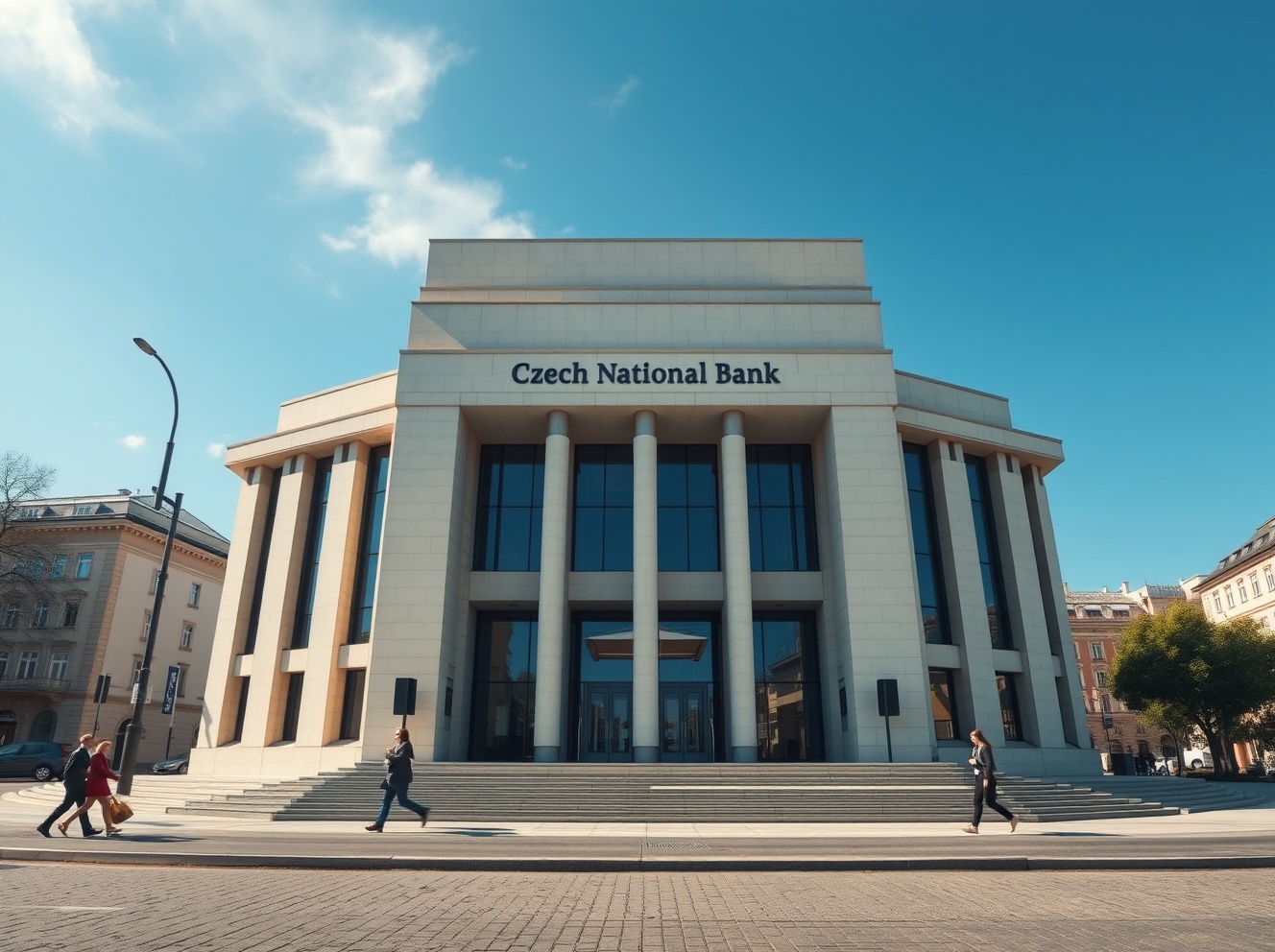
BitcoinWorld CZK Stability: CNB Policy Pause Crucially Reinforces Koruna Floor – Commerzbank Analysis PRAGUE, January 2025 – The Czech National Bank’s decisionBitcoinWorld CZK Stability: CNB Policy Pause Crucially Reinforces Koruna Floor – Commerzbank Analysis PRAGUE, January 2025 – The Czech National Bank’s decision

CZK Stability: CNB Policy Pause Crucially Reinforces Koruna Floor – Commerzbank Analysis

2026/03/19 19:35
7 min read
For feedback or concerns regarding this content, please contact us at crypto.news@mexc.com

BitcoinWorld
BitcoinWorld
CZK Stability: CNB Policy Pause Crucially Reinforces Koruna Floor – Commerzbank Analysis

PRAGUE, January 2025 – The Czech National Bank’s decision to maintain its current monetary policy stance is reinforcing the koruna’s exchange rate floor, according to fresh analysis from Commerzbank. This development comes amid evolving European economic conditions and provides crucial stability for the CZK currency market. Market participants now closely monitor how this policy continuity affects regional currency dynamics and investor confidence throughout Central Europe.

CZK Exchange Rate Stability Amid Policy Continuity

The Czech koruna maintains its position against the euro following the CNB’s latest policy announcement. Consequently, analysts observe sustained support for the currency’s established trading range. Commerzbank’s foreign exchange strategists highlight the central bank’s consistent approach to inflation targeting and currency management. Furthermore, this stability occurs despite shifting macroeconomic indicators across the European Union.

Historical data reveals the koruna’s performance over recent quarters. For instance, the currency demonstrated remarkable resilience during previous global financial uncertainties. Additionally, the CNB’s transparent communication strategy contributes significantly to market predictability. Regular policy meetings provide clear guidance to international investors and domestic businesses alike.

Commerzbank’s Analytical Perspective

Commerzbank economists present detailed reasoning behind their assessment. Specifically, they reference the CNB’s inflation forecasts and growth projections. These documents outline the bank’s expectations for price stability in coming months. Moreover, the analysis considers external factors including European Central Bank policies and regional trade flows.

The following table summarizes key monetary policy indicators:

Indicator Current Level Previous Level Market Expectation
Two-Week Repo Rate 7.00% 7.00% 7.00%
Discount Rate 6.00% 6.00% 6.00%
Lombard Rate 8.00% 8.00% 8.00%

Monetary Policy Framework and Currency Management

The Czech National Bank operates within a well-defined inflation targeting regime. This framework prioritizes price stability while supporting sustainable economic growth. Importantly, the bank maintains flexibility to address unexpected economic developments. Regular policy assessments ensure alignment with evolving domestic and international conditions.

Key elements of the CNB’s approach include:

  • Transparent communication through regular forecasts and press conferences
  • Data-dependent decision making based on comprehensive economic indicators
  • Gradual policy adjustments to minimize market disruption
  • International coordination with other central banking institutions

Historical Context of Koruna Management

The CNB previously intervened in currency markets during periods of excessive volatility. These interventions aimed to prevent disruptive exchange rate movements. However, current policy emphasizes interest rate tools over direct market operations. This evolution reflects growing confidence in conventional monetary policy effectiveness.

Market participants recall the 2013-2017 exchange rate commitment period. During that time, the bank maintained a floor against the euro to combat deflationary pressures. Subsequently, the CNB transitioned to a more conventional policy framework. Today’s approach builds upon lessons learned during that experimental period.

European Economic Integration and Currency Implications

The Czech Republic’s economic integration with the European Union creates specific currency dynamics. Trade relationships with Germany and other eurozone members influence koruna valuation. Additionally, foreign direct investment flows affect currency demand patterns. Commerzbank’s analysis considers these interconnected relationships thoroughly.

Recent European Central Bank decisions create important context for CNB policy. For example, ECB interest rate adjustments influence capital flows across European borders. Consequently, Czech monetary authorities must consider these external developments carefully. Policy coordination, while not formalized, occurs through regular central banking dialogues.

Inflation Dynamics and Policy Response

Czech inflation rates have moderated from previous highs but remain above historical averages. The CNB’s latest forecasts project gradual normalization toward target levels. This projection assumes stable energy prices and contained wage growth. However, the bank maintains readiness to adjust policy if inflation expectations become unanchored.

Core inflation indicators receive particular attention from policymakers. These measures exclude volatile food and energy components. Currently, services inflation presents the most persistent challenge. Therefore, the CNB monitors labor market developments and productivity trends closely.

Market Reactions and Investor Sentiment

Financial markets responded calmly to the latest policy announcement. Currency volatility measures remain within normal ranges. Meanwhile, government bond yields reflect confidence in policy continuity. International investors continue allocating capital to Czech assets, demonstrating trust in economic management.

Foreign exchange trading volumes indicate sustained interest in koruna-denominated instruments. Hedge funds and institutional investors maintain active positions in CZK markets. Moreover, corporate hedging activity suggests businesses anticipate continued exchange rate stability. These market behaviors reinforce the policy’s credibility.

Comparative Analysis with Regional Currencies

The koruna’s performance compares favorably with other Central European currencies. For instance, the Polish zloty and Hungarian forint experienced greater volatility recently. This relative stability enhances the Czech Republic’s investment appeal. Additionally, it supports the country’s credit ratings and borrowing costs.

Regional economic divergences explain some currency performance differences. Specifically, varying inflation trajectories and fiscal policies create distinct monetary conditions. The CNB’s consistent approach provides a benchmark for regional policy discussions. Neighboring central banks observe Czech policy outcomes with interest.

Future Policy Trajectory and Economic Projections

Commerzbank analysts anticipate gradual policy normalization in coming quarters. However, the timing remains data-dependent and uncertain. The CNB’s next forecast publication will provide crucial guidance. Market participants await these projections to adjust their positioning accordingly.

Economic growth projections suggest moderate expansion through 2025. Consumer spending and investment activity support this outlook. Export performance depends on European demand conditions. Meanwhile, labor market tightness may influence wage pressures and inflation persistence.

Risk Factors and Scenario Analysis

Several risk factors could alter the policy trajectory significantly. Geopolitical developments represent the most substantial uncertainty. Additionally, energy price shocks could re-emerge despite recent stability. Global financial conditions remain another important variable beyond domestic control.

The CNB regularly conducts scenario analyses to prepare for potential disruptions. These exercises test policy responses under various economic conditions. Consequently, the bank maintains flexibility to address unexpected developments. This preparedness contributes to market confidence during turbulent periods.

Conclusion

The Czech National Bank’s policy pause reinforces the CZK exchange rate floor according to Commerzbank analysis. This stability supports economic planning and investment decisions throughout the Czech Republic. Furthermore, it demonstrates effective monetary policy management amid complex international conditions. The koruna’s resilience reflects both domestic policy credibility and broader economic fundamentals. Market participants will monitor upcoming data releases for signals about future policy adjustments. Ultimately, the CNB’s consistent approach provides valuable stability in uncertain global financial markets.

FAQs

Q1: What does the CNB policy pause mean for the Czech koruna?
The policy pause indicates the central bank’s satisfaction with current economic conditions and supports exchange rate stability. It suggests officials see no immediate need for interest rate adjustments, which reinforces the koruna’s trading range against major currencies.

Q2: How does Commerzbank analyze central bank policies?
Commerzbank economists examine official statements, economic forecasts, and historical data patterns. They consider inflation projections, growth indicators, and external factors to assess policy implications for currency markets and broader financial conditions.

Q3: What factors influence the Czech National Bank’s decisions?
The CNB primarily focuses on inflation trends, economic growth, labor market conditions, and exchange rate developments. Additionally, they consider international factors including European Central Bank policies and global financial market conditions.

Q4: How does the koruna compare to other Central European currencies?
The Czech koruna has demonstrated relative stability compared to the Polish zloty and Hungarian forint recently. This performance reflects differences in inflation trajectories, fiscal policies, and economic structures across the region.

Q5: What risks could change the CNB’s policy stance?
Significant changes in inflation dynamics, unexpected economic shocks, major geopolitical developments, or substantial shifts in global financial conditions could prompt policy adjustments. The bank maintains flexibility to respond to emerging risks as needed.

This post CZK Stability: CNB Policy Pause Crucially Reinforces Koruna Floor – Commerzbank Analysis first appeared on BitcoinWorld.


Market Opportunity
Lorenzo Protocol Logo
Lorenzo Protocol Price(BANK)
$0.03679
$0.03679$0.03679
+3.22%
USD
Lorenzo Protocol (BANK) Live Price Chart
Disclaimer: The articles reposted on this site are sourced from public platforms and are provided for informational purposes only. They do not necessarily reflect the views of MEXC. All rights remain with the original authors. If you believe any content infringes on third-party rights, please contact crypto.news@mexc.com for removal. MEXC makes no guarantees regarding the accuracy, completeness, or timeliness of the content and is not responsible for any actions taken based on the information provided. The content does not constitute financial, legal, or other professional advice, nor should it be considered a recommendation or endorsement by MEXC.
Tags:

You May Also Like

Trump-backed WLFI  launches AgentPay SDK open-source payment toolkit for AI agents

Trump-backed WLFI  launches AgentPay SDK open-source payment toolkit for AI agents

The Trump family has expanded its presence in the crypto community with a major development for artificial intelligence (AI) agents. According to reports, World
Share
Cryptopolitan2026/03/20 19:03
Summarize Any Stock’s Earnings Call in Seconds Using FMP API

Summarize Any Stock’s Earnings Call in Seconds Using FMP API

Turn lengthy earnings call transcripts into one-page insights using the Financial Modeling Prep APIPhoto by Bich Tran Earnings calls are packed with insights. They tell you how a company performed, what management expects in the future, and what analysts are worried about. The challenge is that these transcripts often stretch across dozens of pages, making it tough to separate the key takeaways from the noise. With the right tools, you don’t need to spend hours reading every line. By combining the Financial Modeling Prep (FMP) API with Groq’s lightning-fast LLMs, you can transform any earnings call into a concise summary in seconds. The FMP API provides reliable access to complete transcripts, while Groq handles the heavy lifting of distilling them into clear, actionable highlights. In this article, we’ll build a Python workflow that brings these two together. You’ll see how to fetch transcripts for any stock, prepare the text, and instantly generate a one-page summary. Whether you’re tracking Apple, NVIDIA, or your favorite growth stock, the process works the same — fast, accurate, and ready whenever you are. Fetching Earnings Transcripts with FMP API The first step is to pull the raw transcript data. FMP makes this simple with dedicated endpoints for earnings calls. If you want the latest transcripts across the market, you can use the stable endpoint /stable/earning-call-transcript-latest. For a specific stock, the v3 endpoint lets you request transcripts by symbol, quarter, and year using the pattern: https://financialmodelingprep.com/api/v3/earning_call_transcript/{symbol}?quarter={q}&year={y}&apikey=YOUR_API_KEY here’s how you can fetch NVIDIA’s transcript for a given quarter: import requestsAPI_KEY = "your_api_key"symbol = "NVDA"quarter = 2year = 2024url = f"https://financialmodelingprep.com/api/v3/earning_call_transcript/{symbol}?quarter={quarter}&year={year}&apikey={API_KEY}"response = requests.get(url)data = response.json()# Inspect the keysprint(data.keys())# Access transcript contentif "content" in data[0]: transcript_text = data[0]["content"] print(transcript_text[:500]) # preview first 500 characters The response typically includes details like the company symbol, quarter, year, and the full transcript text. If you aren’t sure which quarter to query, the “latest transcripts” endpoint is the quickest way to always stay up to date. Cleaning and Preparing Transcript Data Raw transcripts from the API often include long paragraphs, speaker tags, and formatting artifacts. Before sending them to an LLM, it helps to organize the text into a cleaner structure. Most transcripts follow a pattern: prepared remarks from executives first, followed by a Q&A session with analysts. Separating these sections gives better control when prompting the model. In Python, you can parse the transcript and strip out unnecessary characters. A simple way is to split by markers such as “Operator” or “Question-and-Answer.” Once separated, you can create two blocks — Prepared Remarks and Q&A — that will later be summarized independently. This ensures the model handles each section within context and avoids missing important details. Here’s a small example of how you might start preparing the data: import re# Example: using the transcript_text we fetched earliertext = transcript_text# Remove extra spaces and line breaksclean_text = re.sub(r'\s+', ' ', text).strip()# Split sections (this is a heuristic; real-world transcripts vary slightly)if "Question-and-Answer" in clean_text: prepared, qna = clean_text.split("Question-and-Answer", 1)else: prepared, qna = clean_text, ""print("Prepared Remarks Preview:\n", prepared[:500])print("\nQ&A Preview:\n", qna[:500]) With the transcript cleaned and divided, you’re ready to feed it into Groq’s LLM. Chunking may be necessary if the text is very long. A good approach is to break it into segments of a few thousand tokens, summarize each part, and then merge the summaries in a final pass. Summarizing with Groq LLM Now that the transcript is clean and split into Prepared Remarks and Q&A, we’ll use Groq to generate a crisp one-pager. The idea is simple: summarize each section separately (for focus and accuracy), then synthesize a final brief. Prompt design (concise and factual) Use a short, repeatable template that pushes for neutral, investor-ready language: You are an equity research analyst. Summarize the following earnings call sectionfor {symbol} ({quarter} {year}). Be factual and concise.Return:1) TL;DR (3–5 bullets)2) Results vs. guidance (what improved/worsened)3) Forward outlook (specific statements)4) Risks / watch-outs5) Q&A takeaways (if present)Text:<<<{section_text}>>> Python: calling Groq and getting a clean summary Groq provides an OpenAI-compatible API. Set your GROQ_API_KEY and pick a fast, high-quality model (e.g., a Llama-3.1 70B variant). We’ll write a helper to summarize any text block, then run it for both sections and merge. import osimport textwrapimport requestsGROQ_API_KEY = os.environ.get("GROQ_API_KEY") or "your_groq_api_key"GROQ_BASE_URL = "https://api.groq.com/openai/v1" # OpenAI-compatibleMODEL = "llama-3.1-70b" # choose your preferred Groq modeldef call_groq(prompt, temperature=0.2, max_tokens=1200): url = f"{GROQ_BASE_URL}/chat/completions" headers = { "Authorization": f"Bearer {GROQ_API_KEY}", "Content-Type": "application/json", } payload = { "model": MODEL, "messages": [ {"role": "system", "content": "You are a precise, neutral equity research analyst."}, {"role": "user", "content": prompt}, ], "temperature": temperature, "max_tokens": max_tokens, } r = requests.post(url, headers=headers, json=payload, timeout=60) r.raise_for_status() return r.json()["choices"][0]["message"]["content"].strip()def build_prompt(section_text, symbol, quarter, year): template = """ You are an equity research analyst. Summarize the following earnings call section for {symbol} ({quarter} {year}). Be factual and concise. Return: 1) TL;DR (3–5 bullets) 2) Results vs. guidance (what improved/worsened) 3) Forward outlook (specific statements) 4) Risks / watch-outs 5) Q&A takeaways (if present) Text: <<< {section_text} >>> """ return textwrap.dedent(template).format( symbol=symbol, quarter=quarter, year=year, section_text=section_text )def summarize_section(section_text, symbol="NVDA", quarter="Q2", year="2024"): if not section_text or section_text.strip() == "": return "(No content found for this section.)" prompt = build_prompt(section_text, symbol, quarter, year) return call_groq(prompt)# Example usage with the cleaned splits from Section 3prepared_summary = summarize_section(prepared, symbol="NVDA", quarter="Q2", year="2024")qna_summary = summarize_section(qna, symbol="NVDA", quarter="Q2", year="2024")final_one_pager = f"""# {symbol} Earnings One-Pager — {quarter} {year}## Prepared Remarks — Key Points{prepared_summary}## Q&A Highlights{qna_summary}""".strip()print(final_one_pager[:1200]) # preview Tips that keep quality high: Keep temperature low (≈0.2) for factual tone. If a section is extremely long, chunk at ~5–8k tokens, summarize each chunk with the same prompt, then ask the model to merge chunk summaries into one section summary before producing the final one-pager. If you also fetched headline numbers (EPS/revenue, guidance) earlier, prepend them to the prompt as brief context to help the model anchor on the right outcomes. Building the End-to-End Pipeline At this point, we have all the building blocks: the FMP API to fetch transcripts, a cleaning step to structure the data, and Groq LLM to generate concise summaries. The final step is to connect everything into a single workflow that can take any ticker and return a one-page earnings call summary. The flow looks like this: Input a stock ticker (for example, NVDA). Use FMP to fetch the latest transcript. Clean and split the text into Prepared Remarks and Q&A. Send each section to Groq for summarization. Merge the outputs into a neatly formatted earnings one-pager. Here’s how it comes together in Python: def summarize_earnings_call(symbol, quarter, year, api_key, groq_key): # Step 1: Fetch transcript from FMP url = f"https://financialmodelingprep.com/api/v3/earning_call_transcript/{symbol}?quarter={quarter}&year={year}&apikey={api_key}" resp = requests.get(url) resp.raise_for_status() data = resp.json() if not data or "content" not in data[0]: return f"No transcript found for {symbol} {quarter} {year}" text = data[0]["content"] # Step 2: Clean and split clean_text = re.sub(r'\s+', ' ', text).strip() if "Question-and-Answer" in clean_text: prepared, qna = clean_text.split("Question-and-Answer", 1) else: prepared, qna = clean_text, "" # Step 3: Summarize with Groq prepared_summary = summarize_section(prepared, symbol, quarter, year) qna_summary = summarize_section(qna, symbol, quarter, year) # Step 4: Merge into final one-pager return f"""# {symbol} Earnings One-Pager — {quarter} {year}## Prepared Remarks{prepared_summary}## Q&A Highlights{qna_summary}""".strip()# Example runprint(summarize_earnings_call("NVDA", 2, 2024, API_KEY, GROQ_API_KEY)) With this setup, generating a summary becomes as simple as calling one function with a ticker and date. You can run it inside a notebook, integrate it into a research workflow, or even schedule it to trigger after each new earnings release. Free Stock Market API and Financial Statements API... Conclusion Earnings calls no longer need to feel overwhelming. With the Financial Modeling Prep API, you can instantly access any company’s transcript, and with Groq LLM, you can turn that raw text into a sharp, actionable summary in seconds. This pipeline saves hours of reading and ensures you never miss the key results, guidance, or risks hidden in lengthy remarks. Whether you track tech giants like NVIDIA or smaller growth stocks, the process is the same — fast, reliable, and powered by the flexibility of FMP’s data. Summarize Any Stock’s Earnings Call in Seconds Using FMP API was originally published in Coinmonks on Medium, where people are continuing the conversation by highlighting and responding to this story
Share
Medium2025/09/18 14:40
Tom Lee Declares That Ethereum Has Bottomed Out

Tom Lee Declares That Ethereum Has Bottomed Out

Experienced analyst Tom Lee conducted an in-depth analysis of the Ethereum price. Here are some of the highlights from Lee's findings. Continue Reading: Tom Lee
Share
Bitcoinsistemi2026/03/20 19:05