This article defines the concept of a free and fair economy by formalizing four core principles of market justice: Anonymity, Local Efficiency, Unproductivity, and Marginality (ALUM).This article defines the concept of a free and fair economy by formalizing four core principles of market justice: Anonymity, Local Efficiency, Unproductivity, and Marginality (ALUM).

The ALUM Principles: How Fairness Shapes a Free Economy

Abstract and 1. Introduction

  1. A free and fair economy: definition, existence and uniqueness

    2.1 A free economy

    2.2 A free and fair economy

  2. Equilibrium existence in a free and fair economy

    3.1 A free and fair economy as a strategic form game

    3.2 Existence of an equilibrium

  3. Equilibrium efficiency in a free and fair economy

  4. A free economy with social justice and inclusion

    5.1 Equilibrium existence and efficiency in a free economy with social justice

    5.2 Choosing a reference point to achieve equilibrium efficiency

  5. Some applications

    6.1 Teamwork: surplus distribution in a firm

    6.2 Contagion and self-enforcing lockdown in a networked economy

    6.3 Bias in academic publishing

    6.4 Exchange economies

  6. Contributions to the closely related literature

  7. Conclusion and References

Appendix

2 A free and fair economy: definition, existence and uniqueness

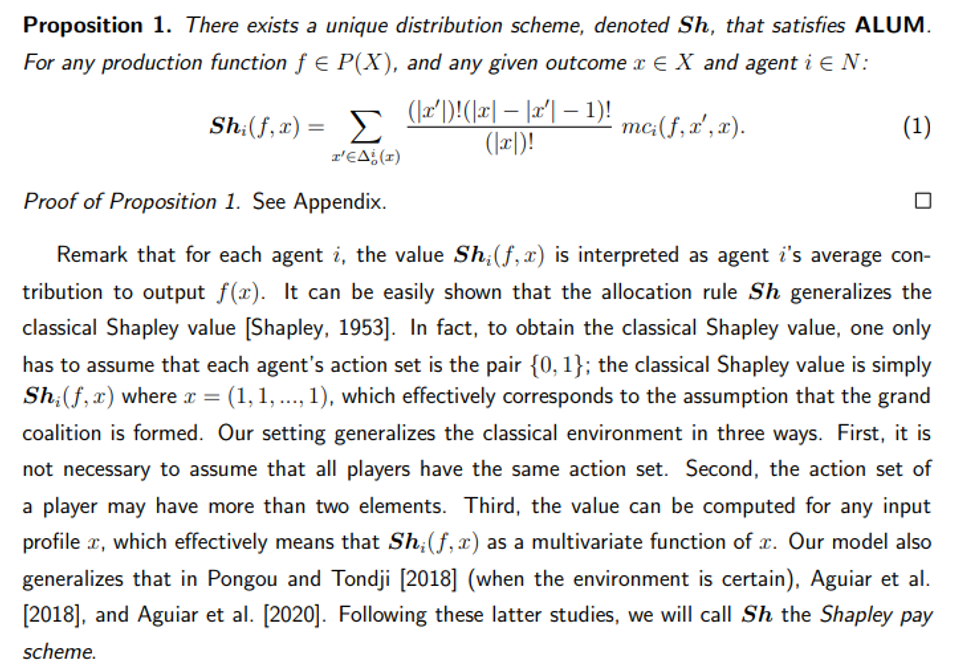
In this section, we introduce preliminary definitions and the key concepts of the paper. We then show that there exists a unique economy that is free and fair.

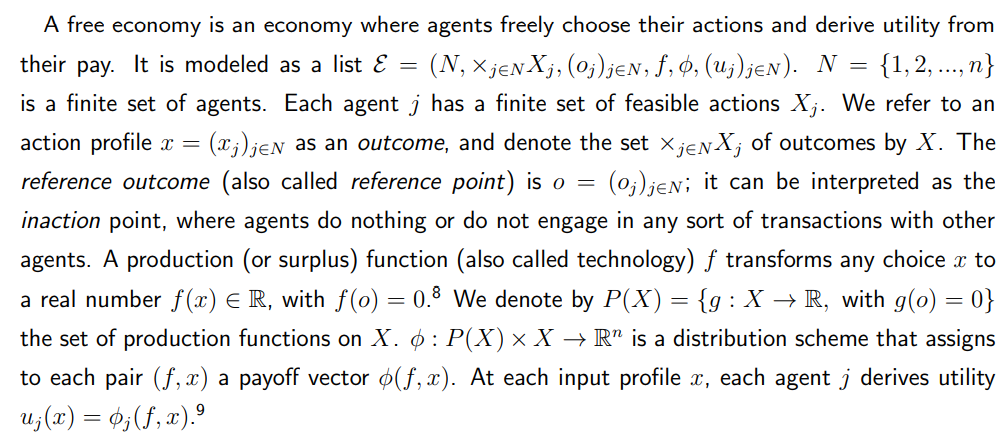
2.1 A free economy
2.2 A free and fair economy

\
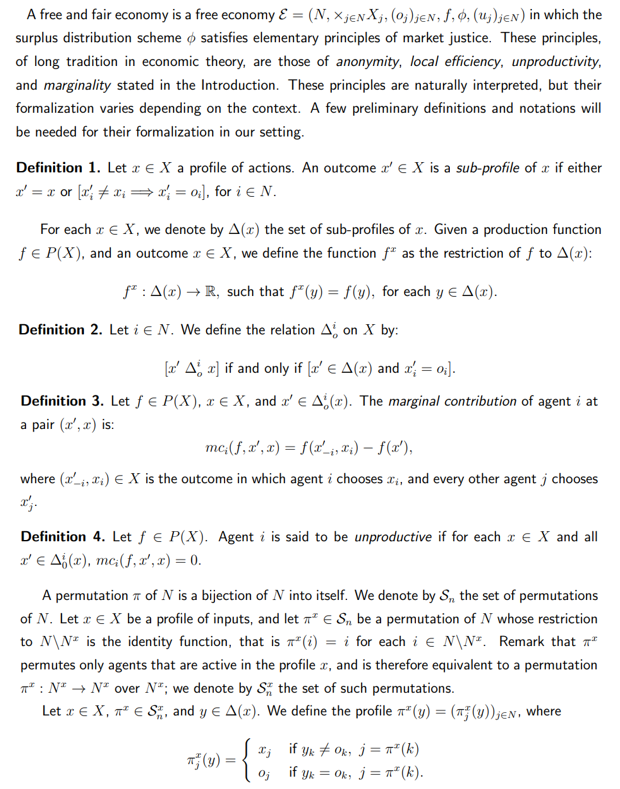
\ \ We now formalize the principles of market justice below.

\ \
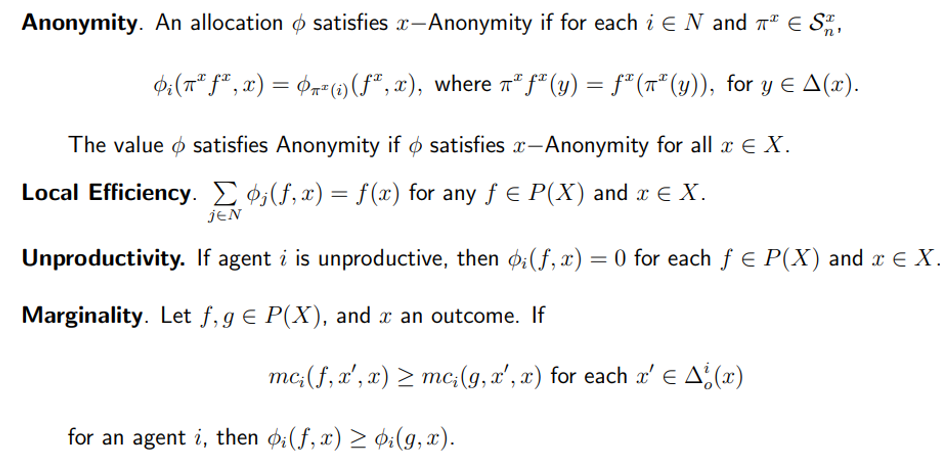
\ \ These axioms are interpreted naturally. Anonymity means that an agent’s pay does not depend on their name. It states that every agent is treated the same way by the allocation rule: if two agents exchange their identities, their payoffs will remain unchanged. An important property that is implied by anonymity is symmetry (or non-favoritism), which means that equally productive agents should receive the same pay. Local efficiency simply requires that the surplus resulting from any input choice be fully shared among productive agents participating in the economy. Unproductivity means that an agent whose marginal contribution is zero at an input profile should get nothing at that profile. Marginality means that, if the adoption of a new technology increases the marginal contribution of an agent, that agent’s pay should not be lower under this new technology relative to the old technology. In other words, more productive agents should not earn less compared to less productive agents. Throughout the paper, we abbreviate the four principles as ALUM.

\ \
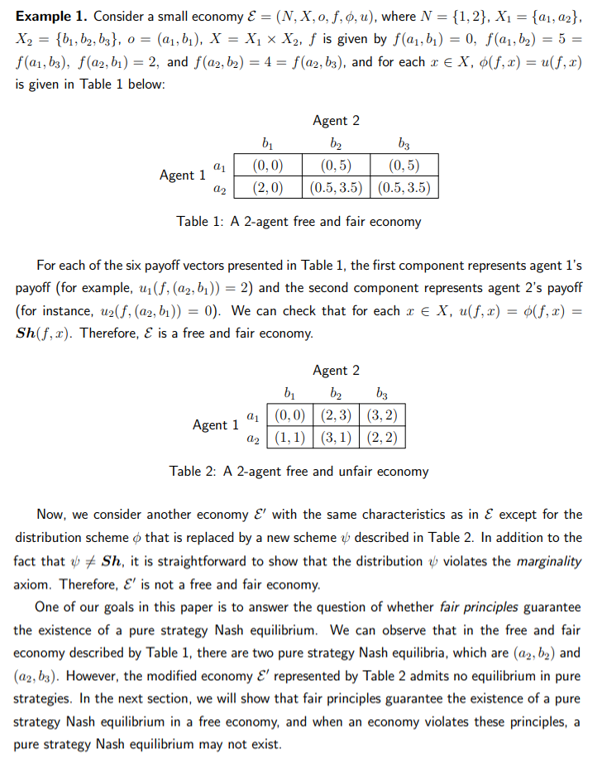
\ \ Below, we illustrate the notion of a free and fair economy, and provide an example of a free economy that is unfair.

\ \
\ \ \

:::info Authors:

(1) Ghislain H. Demeze-Jouatsa, Center for Mathematical Economics, University of Bielefeld (demeze jouatsa@uni-bielefeld.de);

(2) Roland Pongou, Department of Economics, University of Ottawa (rpongou@uottawa.ca);

(3) Jean-Baptiste Tondji, Department of Economics and Finance, The University of Texas Rio Grande Valley (jeanbaptiste.tondji@utrgv.edu).

:::


:::info This paper is available on arxiv under CC BY 4.0 DEED license.

:::

[8] We normalize the surplus at the reference point to 0 for expositional purposes. It is possible that the surplus realized at o is not zero, and in this case, f(x) should be interpreted as net surplus at x, that is, the realized surplus at x minus the realized surplus at o. We assume the reference o to be exogenously determined.


Market Opportunity
AssangeDAO Logo
AssangeDAO Price(JUSTICE)
$0.00002391
$0.00002391$0.00002391
+0.12%
USD
AssangeDAO (JUSTICE) Live Price Chart
Disclaimer: The articles reposted on this site are sourced from public platforms and are provided for informational purposes only. They do not necessarily reflect the views of MEXC. All rights remain with the original authors. If you believe any content infringes on third-party rights, please contact service@support.mexc.com for removal. MEXC makes no guarantees regarding the accuracy, completeness, or timeliness of the content and is not responsible for any actions taken based on the information provided. The content does not constitute financial, legal, or other professional advice, nor should it be considered a recommendation or endorsement by MEXC.

You May Also Like

Why It Could Outperform Pepe Coin And Tron With Over $7m Already Raised

Why It Could Outperform Pepe Coin And Tron With Over $7m Already Raised

The post Why It Could Outperform Pepe Coin And Tron With Over $7m Already Raised appeared on BitcoinEthereumNews.com. Crypto News 17 September 2025 | 20:26 While meme tokens like Pepe Coin and established networks such as Tron attract headlines, many investors are now searching for projects that combine innovation, revenue-sharing and real-world utility. BlockchainFX ($BFX), currently in presale at $0.024 ahead of an expected $0.05 launch, is quickly becoming one of the best cryptos to buy today. With $7m already secured and a unique model spanning multiple asset classes, it is positioning itself as a decentralised super app and a contender to surpass older altcoins. Early Presale Pricing Creates A Rare Entry Point BlockchainFX’s presale pricing structure has been designed to reward early participants. At $0.024, buyers secure a lower entry price than later rounds, locking in a cost basis more than 50% below the projected $0.05 launch price. As sales continue to climb beyond $7m, each new stage automatically increases the token price. This built-in mechanism creates a clear advantage for early investors and explains why the project is increasingly cited in “best presales to buy now” discussions across the crypto space. High-Yield Staking Model Shares Platform Revenue Beyond its presale appeal, BlockchainFX is creating a high-yield staking model that gives holders a direct share of platform revenue. Every time a trade occurs on its platform, 70% of trading fees flow back into the $BFX ecosystem: 50% of collected fees are automatically distributed to stakers in both BFX and USDT. 20% is allocated to daily buybacks of $BFX, adding demand and price support. Half of the bought-back tokens are permanently burned, steadily reducing supply. Rewards are based on the size of each member’s BFX holdings and capped at $25,000 USDT per day to ensure sustainability. This structure transforms token ownership from a speculative bet into an income-generating position, a rare feature among today’s altcoins. A Multi-Asset Platform…
Share
BitcoinEthereumNews2025/09/18 03:35
Tesla (TSLA) Stock; Slips Slightly Despite Accelerated Nine-Month Roadmap for AI5–AI9 Chips

Tesla (TSLA) Stock; Slips Slightly Despite Accelerated Nine-Month Roadmap for AI5–AI9 Chips

TLDRs; Tesla stock slipped slightly even as Musk unveiled a faster nine-month development cycle for future in-house AI processors. The AI5 chip is nearing final
Share
Coincentral2026/01/19 14:40
Ethereum transactions hit record as staking exit queue drops to zero

Ethereum transactions hit record as staking exit queue drops to zero

The record jump comes as Ethereum’s validator exit queue has dropped to zero while entry queues remain long.
Share
Coinstats2026/01/19 13:50