The post Researchers uncover new malware targeting crypto wallets appeared on BitcoinEthereumNews.com. Mosyle security firm has discovered a malware strain capable of bypassing antivirus software detection and stealing information from crypto browser wallets. The malware spreads via fake recruiter ads online. Major antivirus software did not detect ModStealer malware for almost a month before reporting it. It targeted developers already working with Node.js environments. ModStealer scans for browser-based crypto wallet extensions, system credentials, and digital certificates before sending the stolen information to a command and control (C2) server. The C2 server acts as a central hub for scammers to manage compromised devices.  ModStealer exploits Node.js to steal private keys According to research by 9to5Mac, ModStealer malware disguised itself on macOS systems as a background helper program to achieve persistence, ensuring it ran automatically every time the computer restarted. The infected systems had a file labeled sysupdater.dat and unusual connections to suspicious servers.  Shan Zhang, chief information security officer at SlowMist, a blockchain security company, revealed that ModStealer evades detection by mainstream antivirus software and poses a significant risk to the digital asset ecosystem. He added that the malware has multi-platform support and stealth execution, which differentiates it from traditional malware.  Charles Guillemet, Ledger CTO, revealed another similar attack that allowed attackers to compromise a Node Package Manager (npm) developer account in an attempt to spread malicious code, which may silently replace wallet addresses during transactions. He cautioned that such incidents show how vulnerable blockchain-related code libraries can be. “The attackers’ mistakes caused crashes in CI/CD pipelines, which led to early detection and limited impact. Still, this is a clear reminder: if your funds sit in a software wallet or on an exchange, you’re one code execution away from losing everything. Supply chain compromises remain a powerful malware delivery vector, and we’re also seeing more targeted attacks emerge.” –Charles Guillemet, Ledger CTO Zhang… The post Researchers uncover new malware targeting crypto wallets appeared on BitcoinEthereumNews.com. Mosyle security firm has discovered a malware strain capable of bypassing antivirus software detection and stealing information from crypto browser wallets. The malware spreads via fake recruiter ads online. Major antivirus software did not detect ModStealer malware for almost a month before reporting it. It targeted developers already working with Node.js environments. ModStealer scans for browser-based crypto wallet extensions, system credentials, and digital certificates before sending the stolen information to a command and control (C2) server. The C2 server acts as a central hub for scammers to manage compromised devices.  ModStealer exploits Node.js to steal private keys According to research by 9to5Mac, ModStealer malware disguised itself on macOS systems as a background helper program to achieve persistence, ensuring it ran automatically every time the computer restarted. The infected systems had a file labeled sysupdater.dat and unusual connections to suspicious servers.  Shan Zhang, chief information security officer at SlowMist, a blockchain security company, revealed that ModStealer evades detection by mainstream antivirus software and poses a significant risk to the digital asset ecosystem. He added that the malware has multi-platform support and stealth execution, which differentiates it from traditional malware.  Charles Guillemet, Ledger CTO, revealed another similar attack that allowed attackers to compromise a Node Package Manager (npm) developer account in an attempt to spread malicious code, which may silently replace wallet addresses during transactions. He cautioned that such incidents show how vulnerable blockchain-related code libraries can be. “The attackers’ mistakes caused crashes in CI/CD pipelines, which led to early detection and limited impact. Still, this is a clear reminder: if your funds sit in a software wallet or on an exchange, you’re one code execution away from losing everything. Supply chain compromises remain a powerful malware delivery vector, and we’re also seeing more targeted attacks emerge.” –Charles Guillemet, Ledger CTO Zhang…

Researchers uncover new malware targeting crypto wallets

For feedback or concerns regarding this content, please contact us at crypto.news@mexc.com

Mosyle security firm has discovered a malware strain capable of bypassing antivirus software detection and stealing information from crypto browser wallets. The malware spreads via fake recruiter ads online.

Major antivirus software did not detect ModStealer malware for almost a month before reporting it. It targeted developers already working with Node.js environments. ModStealer scans for browser-based crypto wallet extensions, system credentials, and digital certificates before sending the stolen information to a command and control (C2) server. The C2 server acts as a central hub for scammers to manage compromised devices. 

ModStealer exploits Node.js to steal private keys

According to research by 9to5Mac, ModStealer malware disguised itself on macOS systems as a background helper program to achieve persistence, ensuring it ran automatically every time the computer restarted. The infected systems had a file labeled sysupdater.dat and unusual connections to suspicious servers. 

Shan Zhang, chief information security officer at SlowMist, a blockchain security company, revealed that ModStealer evades detection by mainstream antivirus software and poses a significant risk to the digital asset ecosystem. He added that the malware has multi-platform support and stealth execution, which differentiates it from traditional malware. 

Charles Guillemet, Ledger CTO, revealed another similar attack that allowed attackers to compromise a Node Package Manager (npm) developer account in an attempt to spread malicious code, which may silently replace wallet addresses during transactions. He cautioned that such incidents show how vulnerable blockchain-related code libraries can be.

Zhang warned that the ModStealer malware presents a direct threat to crypto users and platforms, adding that for individual users, the compromise of private keys, seed phrases, and exchange API keys may lead to immediate losses. He also noted that mass theft of browser extension wallet data could fuel large-scale on-chain exploits and weaken user trust while increasing risks across crypto supply chains. 

New cyber exploits target crypto wallets data

Guillemet discovered that the JavaScript ecosystem was compromised by a massive supply chain attack targeting libraries such as chalk, strip-ansi, color-convert, and error-ex. The affected packages have been downloaded more than one billion times a week, which presents a severe threat to the blockchain ecosystem. 

The malicious software worked as a crypto-clipper, meaning it could replace wallet addresses in network requests or modify transactions initiated via MetaMask and other wallets. The attack was discovered via a minor CI/CD pipeline build failure. The researchers later found that the malware used two strategies. The first strategy was passive address swapping, which monitored outgoing traffic requests and replaced wallet addresses with the hijacker’s controlled ones. It used the Levenshtein distance algorithm, which selects lookalike addresses, making it visually difficult to detect changes.

Another method the attackers utilized was active transaction hijacking, which modifies pending transactions in memory before forwarding them for user approval once a crypto wallet is detected. This tricked users into signing transfers directly to the attacker’s wallet.

Similar incidents have been reported on Cryptopolitan recently, where ReversingLabs’ research revealed another malware concealed on Ethereum smart contracts. The attack was downloaded via npm packages, including colortoolv2 and mimelib2, which acted as second-stage agents, fetching the malicious software stored on the Ethereum blockchain. 

ReversingLabs revealed that the malicious software bypassed security scans by hiding the malicious URLs within the Ethereum smart contracts. It was later downloaded through fake GitHub repositories, which posed as cryptocurrency trading bots. The operation was linked to Stargazer’s Ghost Network, a system of coordinated attacks that boost the legitimacy of malicious repositories.

KEY Difference Wire helps crypto brands break through and dominate headlines fast

Source: https://www.cryptopolitan.com/malware-targeting-crypto-wallets/

Disclaimer: The articles reposted on this site are sourced from public platforms and are provided for informational purposes only. They do not necessarily reflect the views of MEXC. All rights remain with the original authors. If you believe any content infringes on third-party rights, please contact crypto.news@mexc.com for removal. MEXC makes no guarantees regarding the accuracy, completeness, or timeliness of the content and is not responsible for any actions taken based on the information provided. The content does not constitute financial, legal, or other professional advice, nor should it be considered a recommendation or endorsement by MEXC.

You May Also Like

This week, NFT transaction volume rebounded by 1.27% to US$108.6 million, and the number of buyers and sellers increased by more than 50%.

This week, NFT transaction volume rebounded by 1.27% to US$108.6 million, and the number of buyers and sellers increased by more than 50%.

PANews reported on September 21st that Crypto.news reported that CryptoSlam data showed that NFT market transaction volume increased by 1.27% over the past week, reaching $108.6 million. Market participation has rebounded, with the number of NFT buyers increasing by 53.24% to 276,735 and the number of NFT sellers increasing by 67.19% to 206,669. However, the number of NFT transactions decreased by 6.65% to 1,630,579. Ethereum network transaction volume reached $46.7 million, a 42.85% surge from the previous week. Mythos Chain network transaction volume reached $12.15 million, down 21.91%. Bitcoin network transaction volume reached $9.82 million, down 2.17%. This week's high-value transactions include: BOOGLE sold for 1,380 SOL ($324,846 USD) CryptoPunks #8521 sold for 55.48 ETH ($255,288 USD) CryptoPunks #4420 sold for 56.388 ETH ($254,250) CryptoPunks #2642 sold for 52.1 ETH ($239,735) CryptoPunks #1180 sold for 49.89 ETH ($232,394)
Share
PANews2025/09/21 09:01
XRP’s ‘True Value’ Could Be $32, Says BlackRock Executive

XRP’s ‘True Value’ Could Be $32, Says BlackRock Executive

Robert Mitchnick and Susan Athey’s 2018 study valued XRP up to $32 under adoption scenarios. Bitcoin is trading above the modeled fair value of $93,000 at $112,800, while XRP has remained stagnant around $3. A resurfaced research paper co-authored in 2018 by Robert Mitchnick, now Head of Digital Assets at BlackRock, has drawn fresh attention [...]]]>
Share
Crypto News Flash2025/09/22 16:40
Grayscale’s ‘first multi-crypto asset ETP’ in the works: Will BTC, ETH win?

Grayscale’s ‘first multi-crypto asset ETP’ in the works: Will BTC, ETH win?

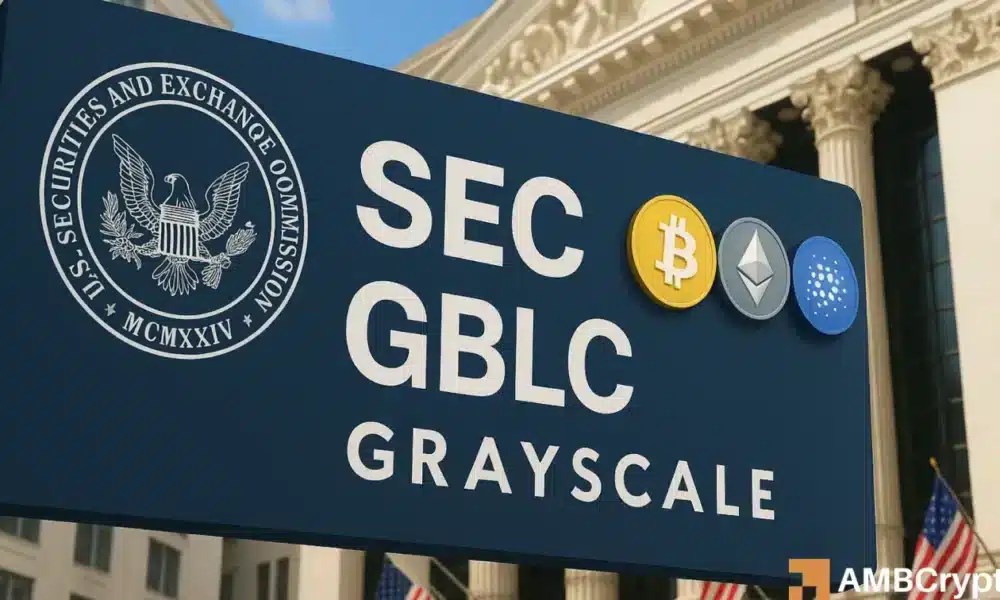
The post Grayscale’s ‘first multi-crypto asset ETP’ in the works: Will BTC, ETH win? appeared on BitcoinEthereumNews.com. Key Takeaways What does this approval mean for investors? It allows traditional investors to access diversified exposure to major cryptocurrencies without buying tokens directly. Which cryptocurrencies are included in GDLC? Bitcoin, Ether, XRP, Solana, and Cardano. The U.S. Securities and Exchange Commission (SEC) has greenlit the Grayscale Digital Large Cap Fund (GDLC) for stock exchange trading.  The approval, coinciding with relaxed ETF listing standards, opens the door for traditional investors to access the crypto market more easily and signals growing institutional support. Grayscale CEO Peter Mintzberg weighs in Grayscale CEO Peter Mintzberg confirmed the development on X (formerly Twitter), praising the SEC’s Crypto Task Force for providing much-needed clarity to the sector. He said,  “The Grayscale team is working expeditiously to bring the FIRST multi #crypto asset ETP to market with Bitcoin, Ethereum, XRP, Solana, and Cardano.” He further added,  “Thank you to the SEC #Crypto Task Force for their continued, unmatched efforts in bringing the regulatory clarity our industry deserves.” The newly approved Grayscale Digital Large Cap Fund (GDLC) offers investors exposure to five of the world’s largest cryptocurrencies: Bitcoin [BTC], Ethereum [ETH], Ripple [XRP], Solana [SOL], and Cardano [ADA]. Impact on included tokens Following the announcement, markets reacted positively. BTC traded at $117,153.61 after a 0.69% rise in the past 24 hours, Ether climbed 2.02% to $4,579.73, XRP at $3.10 up by 3.07%, Solana at $245.94 up by 4.78%, and Cardano reached $0.9130 up by 4.85%, per CoinMarketCap. By packaging multiple cryptocurrencies into a single ETP, GDLC allows traditional investors to gain diversified crypto exposure without the need to open exchange accounts or purchase individual tokens. This green light comes just months after the SEC had delayed Grayscale’s plan to convert GDLC from an over-the-counter fund to an ETP listed on NYSE Arca. With approval now granted, the fund is…
Share
BitcoinEthereumNews2025/09/19 12:53

Trade GOLD, Share 1,000,000 USDT

Trade GOLD, Share 1,000,000 USDTTrade GOLD, Share 1,000,000 USDT

0 fees, up to 1,000x leverage, deep liquidity