Born in ’88, I remember life before constant connectivity. I love tech, I use it every day, and I push it forward in my work—but lately, convenience feels less like progress and more like control. Every app, device, and “agree to terms” chips away at our privacy, patience, and independence. We’re building a digital cage, and the scary part is how comfortable it feels inside. The question isn’t whether tech will define the next twenty years—it will. The question is whether we’ll recognize ourselves when it does.Born in ’88, I remember life before constant connectivity. I love tech, I use it every day, and I push it forward in my work—but lately, convenience feels less like progress and more like control. Every app, device, and “agree to terms” chips away at our privacy, patience, and independence. We’re building a digital cage, and the scary part is how comfortable it feels inside. The question isn’t whether tech will define the next twenty years—it will. The question is whether we’ll recognize ourselves when it does.

Convenience: The Leading Cause of Death in 2045?

I was born in '88, back when phones had cords and patience was mandatory. You wanted to talk to someone? Pick up the receiver, listen to the dial tone, carefully twist the rotary dial, and hope you didn't misdial. The pinnacle of tech back then was borrowing change for a payphone or memorizing a neighbor's number. Thrilling stuff.

I remember life before computers and cell phones—barely, but I do. A time when convenience meant knowing your neighbor, keeping a paper map in the glove box, or flipping through thick paper phone books. It was slower, imperfect, human.

Fast-forward a decade or so, and cell phones appeared. Big, brick-like miracles that somehow made life feel smaller, faster, and, honestly, slightly terrifying. Then came smartphones, apps, notifications, and the endless ping of connection. Now convenience means tapping a screen. Groceries at the door, directions recalculated in real time, answers from a glowing rectangle before you even finish the question.

And I'll be honest: I like it. I use it. I push it. My work depends on tech, and I get a kick out of new gadgets and digital tools. Almost every industry—from healthcare to grocery stores—relies on systems I helped learn to love. I'm not just a consumer; I'm part of the machine. And yet, the more I embrace it, the more surreal it all feels.

Digital systems in healthcare to grocery stores

\ \ But lately, it's started to feel different. More sinister. Like a charming but sly roommate who rearranges your furniture while you sleep. Less like innovation and more like control dressed up as progress. Every app, every device, every "agree to terms" isn't just about making life easier—it's about collecting pieces of us. Our habits, our movements, our relationships, our desires. Convenience is the bait. Data is the catch. Convenience has become the leash.

The deeper I got into cryptocurrency, decentralized finance, and governance, the more clearly I saw it. Tech isn't just neutral infrastructure. It's shaping power, shaping society, shaping what it even means to be free. And the trade we're making for comfort is bigger than most people realize.

And here's the kicker: I think I might be the exact generation historians will blame. One day, future humans will squint at the past and mutter, "Wait, what were y'all doing? Did you not see this coming?" We grew up analog, built the digital, and loved it so much we barely noticed the trade-offs: patience, privacy, independence, the occasional "just sitting and thinking" moment.

Ten, twenty years down this road, what does life look like? Maybe we won't own our devices—maybe they'll own us. Maybe we'll forget how to function without being connected. Maybe algorithms won't just recommend what we watch or buy, but quietly nudge how we think, who we trust, and what we believe. Convenience will have become dependency. Dependency will have become obedience.

That's what keeps me uneasy. Kids growing up now may never know what it's like to be unreachable. To sit in boredom long enough to create something. To solve a problem without googling it. To have privacy that isn't conditional. Those muscles—patience, resilience, curiosity—atrophy fast when every need is instantly answered.

And here I am, stuck in the contradiction. I love tech. I need it. I build with it. But I also feel the bars closing in, disguised as sleek updates and seamless integrations. Every gadget I use, every workflow I streamline, every convenience I celebrate comes with a tiny pang of guilt. It's not yet a dystopia; it's a slow creep. The hum of progress is seductive. I push tech forward, I work with it, I marvel at it—but sometimes I swear I can feel it eyeing me like, "Soon…"

We're walking into a digital cage, and the scariest part is how comfortable it feels inside. The digital cage isn't coming; it's here, one seamless integration at a time. And the humor—or maybe tragedy—is that I'm helping build it, probably while laughing at a meme about someone else trapped inside it.
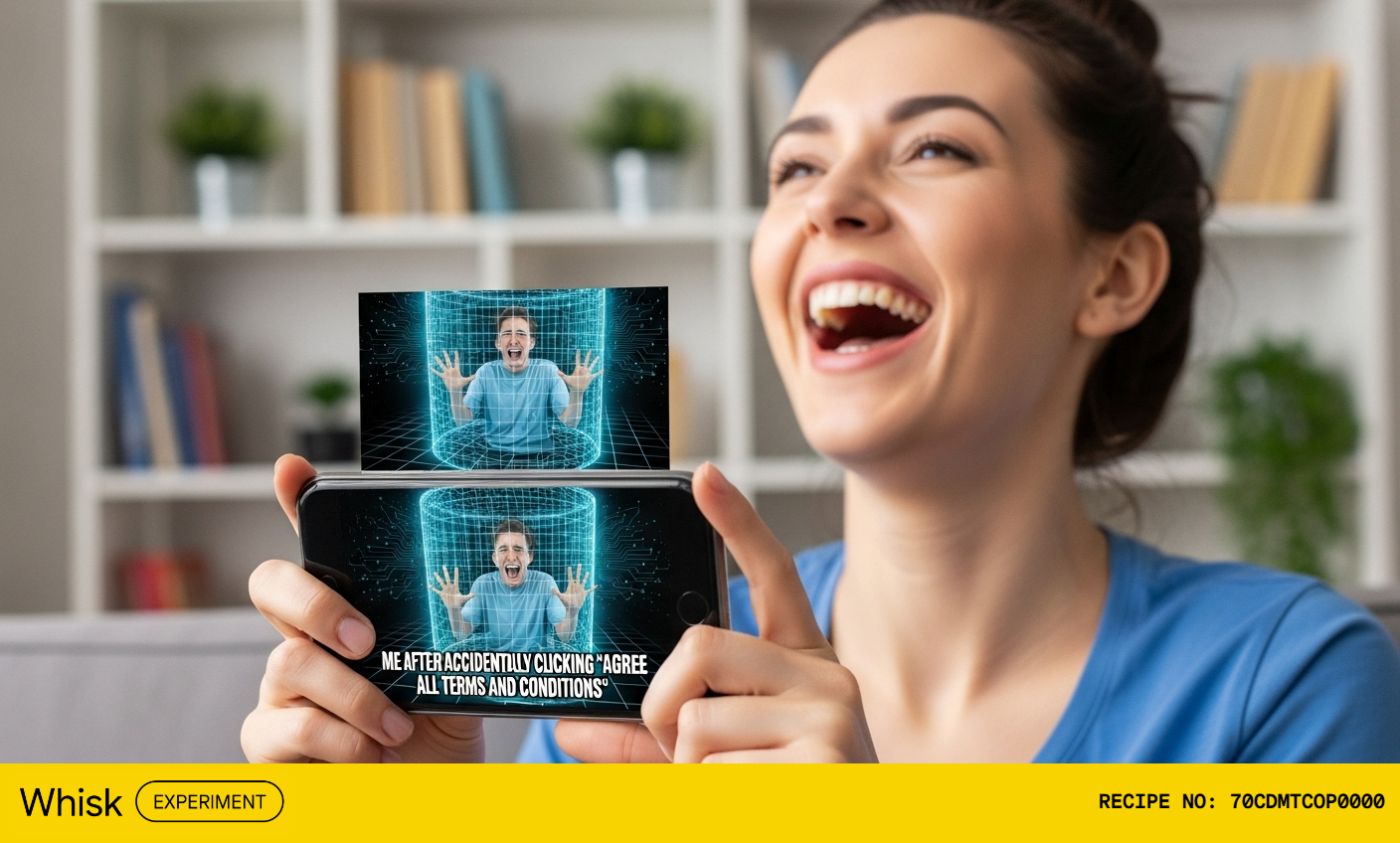
Woman laugh at a meme of someone else trapped in a digital cage

\ The future doesn't arrive all at once. It creeps in through convenience. The question isn't whether tech will define the next twenty years—it will. The question is whether we'll still recognize ourselves when it does.

Market Opportunity
Threshold Logo
Threshold Price(T)
$0.010067
$0.010067$0.010067
+0.21%
USD
Threshold (T) Live Price Chart
Disclaimer: The articles reposted on this site are sourced from public platforms and are provided for informational purposes only. They do not necessarily reflect the views of MEXC. All rights remain with the original authors. If you believe any content infringes on third-party rights, please contact service@support.mexc.com for removal. MEXC makes no guarantees regarding the accuracy, completeness, or timeliness of the content and is not responsible for any actions taken based on the information provided. The content does not constitute financial, legal, or other professional advice, nor should it be considered a recommendation or endorsement by MEXC.

You May Also Like

Is Doge Still The Best Crypto Investment, Or Will Pepeto Make You Rich In 2025

Is Doge Still The Best Crypto Investment, Or Will Pepeto Make You Rich In 2025

The post Is Doge Still The Best Crypto Investment, Or Will Pepeto Make You Rich In 2025 appeared on BitcoinEthereumNews.com. Crypto News 18 September 2025 | 13:39 Is Dogecoin actually running out of gas, after making people millionaires overnight? As investors hunt for the best crypto to buy now and the best crypto to invest in 2025, Dogecoin still owns the meme spotlight, yet its upside looks capped according to today’s Dogecoin price prediction. Focus is shifting toward projects that marry community with real on chain utility. People searching best crypto to buy now want shipped products, audits, and transparent tokenomics. That frames the honest matchup for this cycle, Dogecoin versus Pepeto. Meet Pepeto, an Ethereum based meme coin built with live rails, PepetoSwap for zero fee trading and Pepeto Bridge for smooth cross chain moves. By blending story with tools people can touch today, and speaking directly to crypto presale 2025 demand, Pepeto puts utility, clarity, and distribution first. In a market where older meme coins risk drifting on sentiment, Pepeto’s delivery gives it a credible seat in the best crypto investment debate. First, here is why Dogecoin may be fading. Dogecoin Price Prediction Is Dogecoin Losing Momentum Remember when Dogecoin made crypto feel effortless. In 2013, Doge turned an internet joke into money and a movement that welcomed everyone. A decade later the market is tougher and the relentless tailwind is gone, sentiment is choppier and patience matters. With Doge near $0.268, the setup reads bearish to neutral for the next few weeks. If the $0.26 shelf holds on daily closes, expect choppy range trading toward $0.29 to $0.30 where rallies keep stalling. Lose $0.26 and momentum often slides into $0.245 with risk of a deeper probe toward $0.22 to $0.21. Close back above $0.30 and the downside bias is likely neutralized, opening room for a squeeze into the low $0.30s. Beyond the price view, Dogecoin still centers…
Share
BitcoinEthereumNews2025/09/18 18:56
One Of Frank Sinatra’s Most Famous Albums Is Back In The Spotlight

One Of Frank Sinatra’s Most Famous Albums Is Back In The Spotlight

The post One Of Frank Sinatra’s Most Famous Albums Is Back In The Spotlight appeared on BitcoinEthereumNews.com. Frank Sinatra’s The World We Knew returns to the Jazz Albums and Traditional Jazz Albums charts, showing continued demand for his timeless music. Frank Sinatra performs on his TV special Frank Sinatra: A Man and his Music Bettmann Archive These days on the Billboard charts, Frank Sinatra’s music can always be found on the jazz-specific rankings. While the art he created when he was still working was pop at the time, and later classified as traditional pop, there is no such list for the latter format in America, and so his throwback projects and cuts appear on jazz lists instead. It’s on those charts where Sinatra rebounds this week, and one of his popular projects returns not to one, but two tallies at the same time, helping him increase the total amount of real estate he owns at the moment. Frank Sinatra’s The World We Knew Returns Sinatra’s The World We Knew is a top performer again, if only on the jazz lists. That set rebounds to No. 15 on the Traditional Jazz Albums chart and comes in at No. 20 on the all-encompassing Jazz Albums ranking after not appearing on either roster just last frame. The World We Knew’s All-Time Highs The World We Knew returns close to its all-time peak on both of those rosters. Sinatra’s classic has peaked at No. 11 on the Traditional Jazz Albums chart, just missing out on becoming another top 10 for the crooner. The set climbed all the way to No. 15 on the Jazz Albums tally and has now spent just under two months on the rosters. Frank Sinatra’s Album With Classic Hits Sinatra released The World We Knew in the summer of 1967. The title track, which on the album is actually known as “The World We Knew (Over and…
Share
BitcoinEthereumNews2025/09/18 00:02
Exclusive interview with Smokey The Bera, co-founder of Berachain: How the innovative PoL public chain solves the liquidity problem and may be launched in a few months

Exclusive interview with Smokey The Bera, co-founder of Berachain: How the innovative PoL public chain solves the liquidity problem and may be launched in a few months

Recently, PANews interviewed Smokey The Bera, co-founder of Berachain, to unravel the background of the establishment of this anonymous project, Berachain's PoL mechanism, the latest developments, and answered widely concerned topics such as airdrop expectations and new opportunities in the DeFi field.
Share
PANews2024/07/03 13:00