The global stablecoin market has crossed $333 billion in total supply, and the distribution of that capital is more concentrated than at any point in the asset The global stablecoin market has crossed $333 billion in total supply, and the distribution of that capital is more concentrated than at any point in the asset

Two Tokens Control 86% of the Stablecoin Market and the Gap Is Not Closing

2026/03/14 08:13
3 min read
For feedback or concerns regarding this content, please contact us at crypto.news@mexc.com

The global stablecoin market has crossed $333 billion in total supply, and the distribution of that capital is more concentrated than at any point in the asset class’s history.

The numbers leave little room for interpretation. According to Dune data published on March 8, USDT holds $202 billion representing 61% of total supply, USDC holds $82 billion at 25%, and every other stablecoin combined accounts for just $49 billion or 14%. Two tokens control 86% of a $333 billion market. As Dune stated directly, the stablecoin market is a duopoly, and it is not even close.

The supply picture becomes more revealing when layered against how that capital is distributed across chains. Rand Group noted this week that Ethereum alone is sitting on $179 billion in stablecoin balances, a figure The Block’s data confirms has grown from near zero in 2018 to its current level in a curve that has steepened dramatically since mid-2024. Institutions clearly trust Ethereum for settlement, Rand Group observed, while high-frequency trading activity continues to operate on faster and cheaper chains where transaction costs and confirmation times are more favorable for active strategies. The $179 billion parked on Ethereum is not trading capital. It is settlement capital, held by entities that prioritize finality, security, and counterparty trust over execution speed.

The Infrastructure Filling the Gap

The separation between Ethereum as a settlement layer and other chains as trading venues has created a structural gap that new infrastructure is beginning to address. Rand Group flagged Reya’s launch of a dedicated trading layer built on top of Ethereum as a meaningful step in that direction, with the protocol already generating $1.5 billion in daily volume at launch. The approach attempts to bring trading-grade performance to Ethereum’s settlement-grade security, which if successful would reduce the fragmentation between where institutions hold stablecoin balances and where active trading actually occurs.

The $179 billion stablecoin balance on Ethereum also has implications for how the broader USDT and USDC duopoly is likely to evolve. Both tokens are heavily represented in that figure, and Ethereum’s institutional trust advantage means that any new stablecoin attempting to build meaningful supply faces the challenge of not just competing on product but on the chain credibility that institutional allocators have already assigned. Displacing $179 billion in institutional stablecoin preference is not a product problem. It is a trust problem, and trust of that kind accumulates over years rather than quarters.

XRP Gains 5% on the Day but Faces the Compression Zone That Will Determine Its Next Major Move

What the Duopoly Means for the Market

The 14% share held by everything outside USDT and USDC represents approximately $49 billion spread across hundreds of stablecoins of varying quality, compliance status, and liquidity depth. That $49 billion is not evenly distributed. A handful of assets including DAI, USDe, PYUSD, and RLUSD account for the majority of it, leaving the long tail of smaller stablecoins competing for a fraction of the remaining market. The competitive moat that USDT and USDC have built through liquidity depth, exchange integration, and in USDC’s case regulatory compliance, creates compounding advantages that are structurally difficult for newer entrants to overcome at scale.

Whether the duopoly hardens further or faces meaningful erosion over the next two years depends largely on whether the institutional issuer wave, with PayPal, BlackRock, Ripple, and Stripe all building proprietary stablecoin infrastructure, generates enough captive demand to shift market share in ways that open market competition has so far failed to achieve.

The post Two Tokens Control 86% of the Stablecoin Market and the Gap Is Not Closing appeared first on ETHNews.

Market Opportunity
Notcoin Logo
Notcoin Price(NOT)
$0,0003934
$0,0003934$0,0003934
-4,83%
USD
Notcoin (NOT) Live Price Chart
Disclaimer: The articles reposted on this site are sourced from public platforms and are provided for informational purposes only. They do not necessarily reflect the views of MEXC. All rights remain with the original authors. If you believe any content infringes on third-party rights, please contact crypto.news@mexc.com for removal. MEXC makes no guarantees regarding the accuracy, completeness, or timeliness of the content and is not responsible for any actions taken based on the information provided. The content does not constitute financial, legal, or other professional advice, nor should it be considered a recommendation or endorsement by MEXC.

You May Also Like

Top Low-Cost Cryptocurrencies Analysts Are Watching for 2027

Top Low-Cost Cryptocurrencies Analysts Are Watching for 2027

Investors are now hunting for projects that combine affordability with actual utility. While famous names still hold the spotlight, a new crypto era of decentralized
Share
Techbullion2026/03/14 10:49
Google Cloud taps EigenLayer to bring trust to agentic payments
Google Cloud taps EigenLayer to bring trust to agentic payments

The post Google Cloud taps EigenLayer to bring trust to agentic payments appeared on BitcoinEthereumNews.com. Two days after unveiling AP2 — a universal payment layer for AI agents that supports everything from credit cards to stablecoins — Google and EigenLayer have released details of their partnership to bring verifiability and restaking security to the stack, using Ethereum. In addition to enabling verifiable compute and slashing-backed payment coordination, EigenCloud will support insured and sovereign AI agents, which introduce consequences for failure or deviation from specified behavior. Sovereign agents are positioned as autonomous actors that can own property, make decisions, and execute actions independently — think smart contracts with embedded intelligence. From demos to dollars AP2 extends Google’s agent-to-agent (A2A) protocol using the HTTP 402 status code — long reserved for “payment required” — to standardize payment requests between agents across different networks. It already supports stablecoins like USDC, and Coinbase has demoed an agent checkout using its Wallet-as-a-Service. Paired with a system like Lit Protocol’s Vincent — which enforces per-action policies and key custody at signing — Google’s AP2 with EigenCloud’s verifiability and cross-chain settlement could form an end-to-end trust loop. Payments between agents aren’t as simple as they are often made to sound by “Crypto x AI” LARPs. When an AI agent requests a payment in USDC on Base and the payer’s funds are locked in ETH on Arbitrum, the transaction stalls — unless something abstracts the bridging, swapping and delivery. That’s where EigenCloud comes in. Sreeram Kannan, founder of EigenLayer, said the integration will create agents that not only run on-chain verifiable compute, but are also economically incentivized to behave within programmable bounds. Through restaked operators, EigenCloud powers a verifiable payment service that handles asset routing and chain abstraction, with dishonest behavior subject to slashing. It also introduces cryptographic accountability to the agents themselves, enabling proofs that an agent actually executed the task it…
Share
BitcoinEthereumNews2025/09/19 03:52
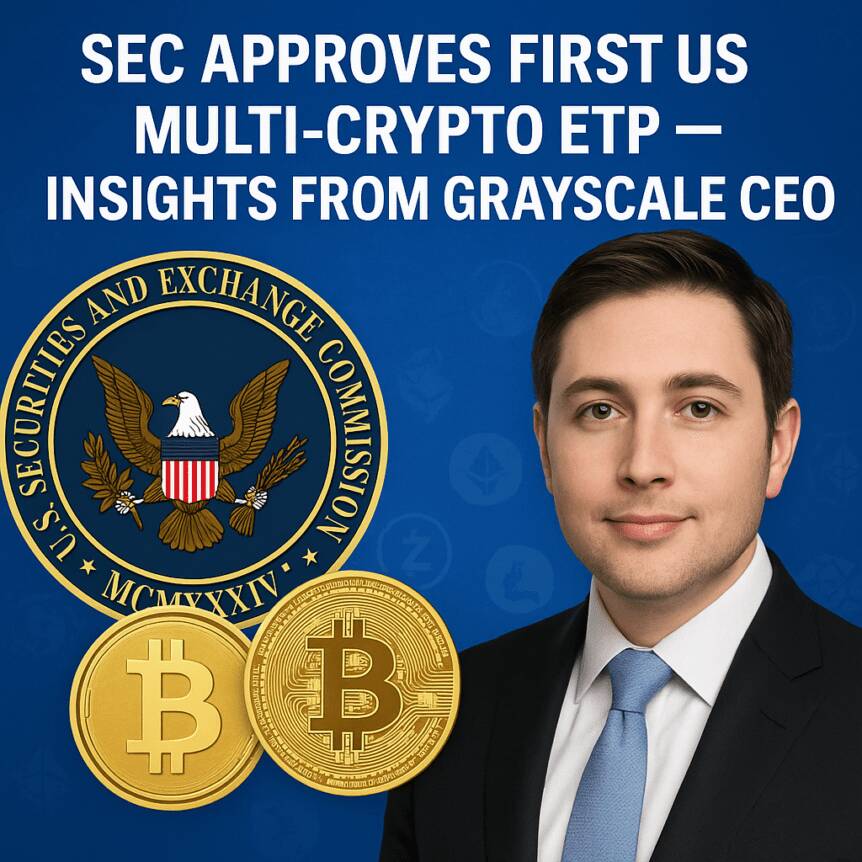
SEC Approves First US Multi-Crypto ETP — Insights from Grayscale CEO

SEC Approves First US Multi-Crypto ETP — Insights from Grayscale CEO

The U.S. Securities and Exchange Commission (SEC) has greenlit the first multi-asset cryptocurrency exchange-traded product (ETP) in the United States, authorizing Grayscale’s Digital Large Cap Fund (GLDC) for public listing. This groundbreaking development offers investors exposure to five leading cryptocurrencies: Bitcoin (BTC), Ethereum (ETH), XRP (XRP), Solana (SOL), and Cardano (ADA). The approval, disclosed in [...]
Share
Crypto Breaking News2025/09/18 17:26