

The RWA track is heating up: Tether and Visa are competing for layout, and BlackRock CEO and a16z are optimistic about the future of tokenization
Author: Weilin, PANews
Recently, as Trump won the US election, the crypto market has become more popular, and the RWA track has frequently seen new developments. For example, on November 14, Tether announced the launch of the asset tokenization platform Hadron by Tether, and Visa also launched the tokenized asset issuance and management platform Visa Tokenized Asset Platform (VTAP) in early October.
As regulatory policies become clearer, the industry is also increasingly optimistic about the future of tokenization. Jesse Knutson, head of operations at Bitfinex Securities, recently pointed out that large financial institutions will become the main driving force for the growth of the tokenization industry. Larry Fink, CEO of BlackRock, sees the tokenization of financial assets as "the next step in future development."
Tether, Visa and other giants and platforms are competing to launch tokenized platforms
The core concept of RWA tokenization is to cast financial assets and other tangible assets onto an immutable blockchain ledger, thereby increasing investor accessibility, improving liquidity for these assets, creating more trading opportunities, while saving transaction costs and improving security.
According to data from rwa.xyz, as of November 18, the top five issuers in the RWA track by total value (excluding stablecoins) were BlackRock ($542 million), Paxos ($506 million), Tether ($501 million), Ondo ($452 million), and Franklin Templeton ($410 million).
The RWA track is heating up with the overall rise of the crypto market. On November 14, Tether, the issuer of the stablecoin USDT, announced the launch of Hadron by Tether, an asset tokenization platform that simplifies the process of converting various assets into digital tokens. The platform allows users to easily tokenize stocks, bonds, commodities, funds, and reward points. According to the official introduction, Hadron aims to open up new opportunities for individuals, businesses, and even cyber countries to raise funds using tokenized collateral. Hadroon not only provides risk control, asset issuance and destruction, KYC and anti-money laundering compliance guidance, but also supports blockchain reporting and capital market management.
Technically, Hadron supports Ethereum, Avalanche, and Blockstream’s Bitcoin scaling network Liquid, and will soon add the TON network and other smart contract chains.
At the same time, giants in the traditional financial sector are not far behind. Visa launched the Visa Tokenized Asset Platform (VTAP) on October 3, aiming to simplify the issuance and management of tokenized assets, including tokenized deposits, stablecoins, and central bank digital currencies (CBDCs). Through VTAP, financial institutions can use the sandbox environment provided by the Visa developer platform to create and test their own fiat-backed tokens.
While providing support to institutions, some projects have also begun to pay attention to the potential of the retail market. On October 8, the EU tokenization protocol Midas opened mTBILL and mBASIS tokens to retail traders. It is reported that the tokenization company has obtained regulatory approval from the Liechtenstein Financial Market Authority to open these funds to retail traders, making Midas' Real World Assets (RWA) tokens the only regulated crypto tool in Europe that is not subject to a minimum investment limit of $100,000.
On the other hand, tokenization of specific asset types is also attracting the attention of professional investors. At the end of October, Elmnts, a tokenized fund platform backed by oil and gas concessions, announced on X that it has launched a public beta on Solana. Elmnts is a compliant investment fund tokenization platform. These funds are supported by mineral rights royalties, that is, the revenue generated by companies that extract oil and gas on land owned by the fund. The platform is currently mainly aimed at institutions and high net worth individuals.
In addition, participants in the DeFi field are also trying to explore more innovative paths by cooperating with traditional financial giants. Earlier this year, the DeFi protocol Ondo also began to use the BlackRock USD Institutional Digital Liquidity Fund (BUIDL) tokenized money market fund to develop its derivative products.
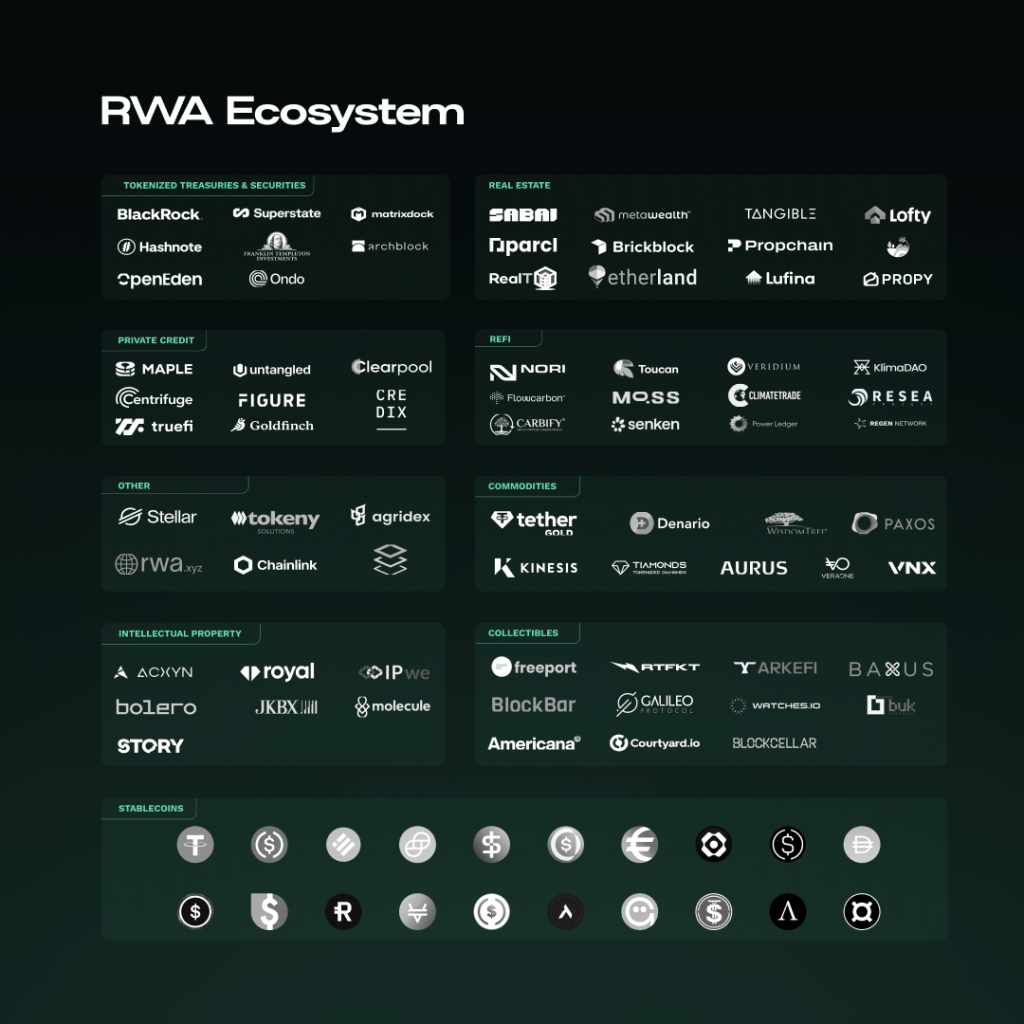 RWA Ecosystem Image Source: Tren Finance
Supervision is expected to become clearer, and the third revolution of asset management is coming
Global consulting firm Boston Consulting Group (BCG) called RWA tokenization "the third revolution in asset management" in a paper on October 29. Some people believe that ETFs are the core of asset management 2.0, and tokenization may be the era of asset management 3.0. BCG believes that in just seven years, the assets under management of tokenized funds may reach 1% of the assets under management of global mutual funds and ETFs, which means that by 2030, the assets under management will exceed US$600 billion; this trend is expected to continue for some time to come, especially when regulated on-chain currencies (such as regulated stablecoins, tokenized deposits, and CBDC) projects are realized.
According to the forecast of Tren Finance in October, the scale of the real-world asset (RWA) tokenization industry may exceed 30 trillion US dollars by 2030, which is expected to grow more than 50 times. Behind its rapid development, it is not only driven by flexible financial institutions and mainstream financial institutions, but also by the progress of blockchain technology and the gradual clarification of supervision.
Against the backdrop of the continued rise in the crypto market, the improvement in regulatory clarity has injected new confidence into the industry. Venture capital firm a16z Crypto pointed out in a recent official website post to crypto founders: "The good news is that there is now a way to engage constructively with regulators and legislation to bring regulatory clarity, and you should all feel empowered to explore all the breakthrough products and services supported by blockchain, including tokens."
The post specifically calls out token issuance as an activity founders can feel more confident in: “For many of you who have been put off using tokens to distribute project control and build community due to concerns about overregulation, now you should feel more confident that projects can use tokens as a legal, compliant tool.”
Meanwhile, Jesse Knutson, head of operations at Bitfinex Securities, said that large financial institutions will be the main driving force behind the significant growth of the tokenization industry. Knutson said that institutions are already driving significant growth in the crypto industry, and this influence may extend further to the tokenization field.
The positive expectations for RWA tokenization have also been responded to by more professional practitioners. Larry Fink, CEO of BlackRock, the world's largest asset management company, recently said that "the tokenization of financial assets will be the next step in future development." He pointed out that in the future, every stock and bond will have a unique identification code (similar to CUSIP), all transactions will be recorded on a unified ledger, and investors will also receive exclusive identity recognition. Fink said that tokenization can not only effectively prevent illegal activities, but more importantly, it can achieve instant liquidation and significantly reduce the settlement costs of stocks and bonds. In addition, tokenization will also bring the possibility of personalized investment strategies and improve corporate governance efficiency, ensuring that every shareholder can exercise voting rights in a timely and accurate manner. Tokenizing real-world assets such as real estate, commodities, wine or art means creating blockchain tokens that represent ownership, making it easier to trade these traditionally difficult-to-sell assets.
Specifically, according to a paper by State Street Global Advisors, bonds are expected to lead the mass adoption of tokenized real-world assets due to their structural characteristics. The report states that the bond market is ripe for tokenization; the complexity of these instruments, the repetitive nature of issuance costs, and the high level of competition among intermediaries support both rapid adoption and room for significant impact; blockchain technology can play an important role in markets that value transaction speed, such as repurchases and swaps.


You May Also Like

Covéa Chooses Shift Technology as Strategic Partner for Fraud and Risk Management
Liventus Acquires Tamarack to Become the Most Comprehensive Technology Partner for Equipment Finance Organizations

Bitcoin Liquidations Dethroned? A Tokenized Bet Just Posted Crypto’s Biggest Loss



