On-chain data from CryptoQuant shows Bitcoin’s market cap growth rate falling below its realized cap growth rate, a divergence that has historically preceded periodsOn-chain data from CryptoQuant shows Bitcoin’s market cap growth rate falling below its realized cap growth rate, a divergence that has historically preceded periods

Bitcoin’s Market Cap Is Growing Slower Than Its Realized Cap: Here Is What That Gap Means

2026/03/08 01:49
3 min read
For feedback or concerns regarding this content, please contact us at crypto.news@mexc.com

On-chain data from CryptoQuant shows Bitcoin’s market cap growth rate falling below its realized cap growth rate, a divergence that has historically preceded periods of increased selling pressure.

What These Two Metrics Actually Measure

Market cap is simple: current price multiplied by circulating supply. Realized cap is different. It values each Bitcoin at the price it last moved on-chain, essentially the aggregate cost basis of the entire network. When market cap grows faster than realized cap, speculative demand is outpacing actual capital inflows. Buyers are pushing price above what coins are collectively worth at their entry points.
The relationship between the two is what matters. Not the levels. The gap.

What the First Chart Shows

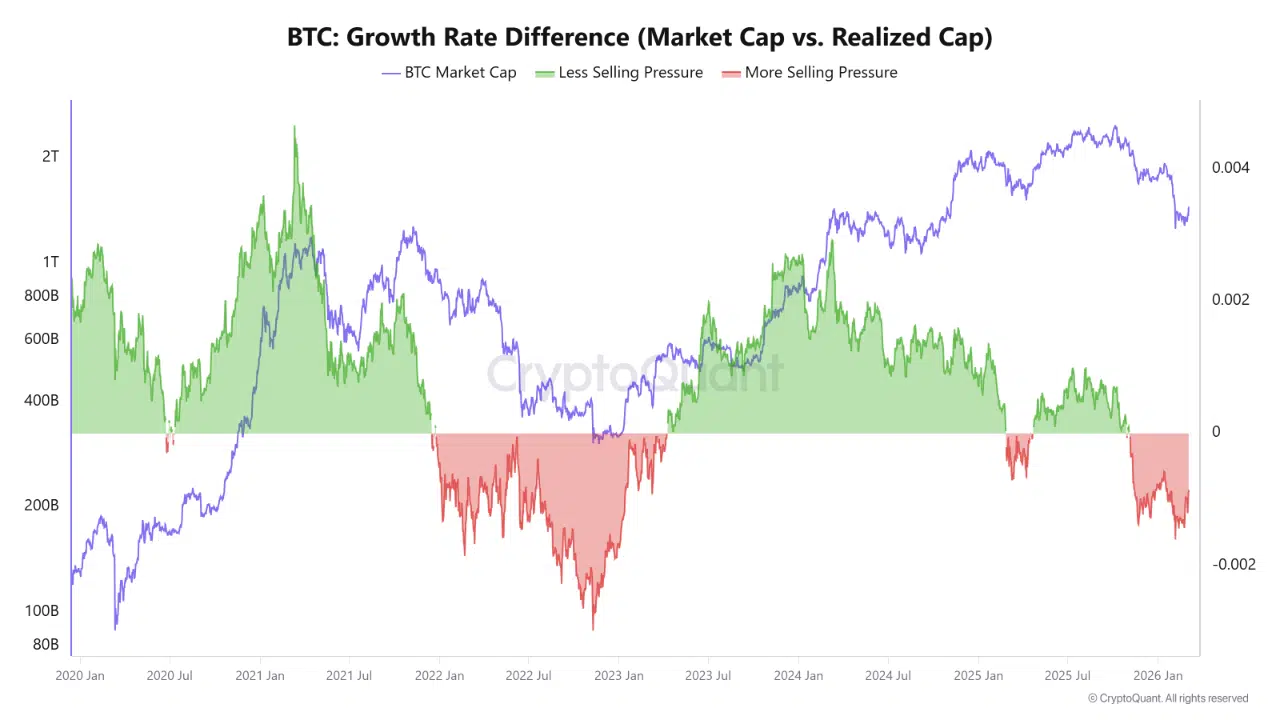
The growth rate difference chart covers January 2020 through early 2026. Green shading indicates periods when market cap is growing faster than realized cap, meaning less selling pressure. Red shading marks the opposite, when realized cap growth outpaces market cap, meaning more selling pressure is present.

The 2021 bull run produced the largest green spike on the chart, peaking well above the zero line as speculative demand drove price well ahead of cost basis. Then 2022 flipped it entirely. The red zone deepened through mid-2022 and into early 2023, the worst reading on the chart, coinciding with Bitcoin’s drop toward $15,000.

The recovery from late 2023 through 2024 brought the reading back into green. Market cap was leading again. But the chart shows that relationship reversing again heading into early 2026, with red shading returning and the differential dropping back below zero.

What the Second Chart Confirms

The 365-day simple moving average chart smooths out the noise. The orange line tracks market cap growth rate on a rolling annual basis. The blue line tracks realized cap growth rate the same way.

During the 2021 peak, orange ran far above blue. During the 2022 bear market, orange collapsed below zero while blue followed more slowly. The two lines converged around mid-2023 before orange recovered sharply through 2024. Into early 2026, the orange line has crossed back below the blue line and is now dipping toward negative territory. The blue line remains modestly positive.

That crossover is the signal. Realized cap is expanding steadily, meaning capital is still entering the network. But market cap growth has slowed faster. Price is not keeping pace with the cost basis expansion happening on-chain.

Solana Payment Volume Up 755%: The Ecosystem Map Shows Why

What the Divergence Suggests

This pattern is consistent with a distribution phase, where holders are moving coins at profit, raising the realized cap, while price momentum slows or stalls. It does not confirm a market top. It signals that additional demand is needed to sustain upside from here.

If market cap growth recovers relative to realized cap growth, the structure turns constructive again. If it does not, the current reading suggests the market is gradually absorbing elevated sell-side pressure without enough fresh demand to overcome it.

The data points in one direction. It does not predict how far that direction runs.

The post Bitcoin’s Market Cap Is Growing Slower Than Its Realized Cap: Here Is What That Gap Means appeared first on ETHNews.


Market Opportunity
Capverse Logo
Capverse Price(CAP)
$0.10239
$0.10239$0.10239
+1.76%
USD
Capverse (CAP) Live Price Chart
Disclaimer: The articles reposted on this site are sourced from public platforms and are provided for informational purposes only. They do not necessarily reflect the views of MEXC. All rights remain with the original authors. If you believe any content infringes on third-party rights, please contact crypto.news@mexc.com for removal. MEXC makes no guarantees regarding the accuracy, completeness, or timeliness of the content and is not responsible for any actions taken based on the information provided. The content does not constitute financial, legal, or other professional advice, nor should it be considered a recommendation or endorsement by MEXC.

You May Also Like

Bitcoin ETFs Surge with 20,685 BTC Inflows, Marking Strongest Week

Bitcoin ETFs Surge with 20,685 BTC Inflows, Marking Strongest Week

TLDR Bitcoin ETFs recorded their strongest weekly inflows since July, reaching 20,685 BTC. U.S. Bitcoin ETFs contributed nearly 97% of the total inflows last week. The surge in Bitcoin ETF inflows pushed holdings to a new high of 1.32 million BTC. Fidelity’s FBTC product accounted for 36% of the total inflows, marking an 18-month high. [...] The post Bitcoin ETFs Surge with 20,685 BTC Inflows, Marking Strongest Week appeared first on CoinCentral.
Share
Coincentral2025/09/18 02:30
Kalshi debuts ecosystem hub with Solana and Base

Kalshi debuts ecosystem hub with Solana and Base

The post Kalshi debuts ecosystem hub with Solana and Base appeared on BitcoinEthereumNews.com. Kalshi, the US-regulated prediction market exchange, rolled out a new program on Wednesday called KalshiEco Hub. The initiative, developed in partnership with Solana and Coinbase-backed Base, is designed to attract builders, traders, and content creators to a growing ecosystem around prediction markets. By combining its regulatory footing with crypto-native infrastructure, Kalshi said it is aiming to become a bridge between traditional finance and onchain innovation. The hub offers grants, technical assistance, and marketing support to selected projects. Kalshi also announced that it will support native deposits of Solana’s SOL token and USDC stablecoin, making it easier for users already active in crypto to participate directly. Early collaborators include Kalshinomics, a dashboard for market analytics, and Verso, which is building professional-grade tools for market discovery and execution. Other partners, such as Caddy, are exploring ways to expand retail-facing trading experiences. Kalshi’s move to embrace blockchain partnerships comes at a time when prediction markets are drawing fresh attention for their ability to capture sentiment around elections, economic policy, and cultural events. Competitor Polymarket recently acquired QCEX — a derivatives exchange with a CFTC license — to pave its way back into US operations under regulatory compliance. At the same time, platforms like PredictIt continue to push for a clearer regulatory footing. The legal terrain remains complex, with some states issuing cease-and-desist orders over whether these event contracts count as gambling, not finance. This is a developing story. This article was generated with the assistance of AI and reviewed by editor Jeffrey Albus before publication. Get the news in your inbox. Explore Blockworks newsletters: Source: https://blockworks.co/news/kalshi-ecosystem-hub-solana-base
Share
BitcoinEthereumNews2025/09/18 04:40
Urgent Warning For US Banks To Avoid Payments Market Collapse

Urgent Warning For US Banks To Avoid Payments Market Collapse

The post Urgent Warning For US Banks To Avoid Payments Market Collapse appeared on BitcoinEthereumNews.com. Crypto Regulatory Clarity: Urgent Warning For US Banks
Share
BitcoinEthereumNews2026/03/09 12:02