

FL Senate Passes State Stablecoin Bill, DeSantis’ Signature Pending
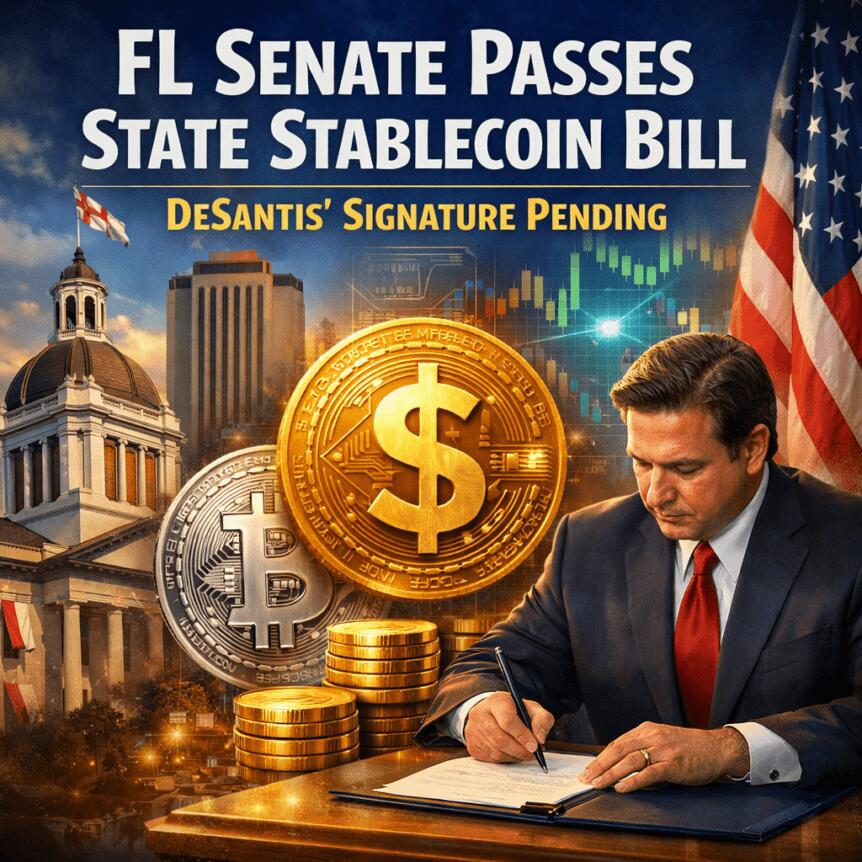
Florida advanced a state-level framework for regulating payment stablecoins, moving SB 314 to Governor DeSantis’ desk for final approval. The bill, which passed the Florida Senate unanimously, would introduce consumer protections and financial oversight for stablecoin issuers operating within the state, aligning with a broader federal trend toward clearer rules for digital assets. The development comes as Florida looks to codify safeguards around payments and digital holdings while contemplating broader crypto exposure in public portfolios. The signing window is anticipated to run roughly a month, per statements from stakeholders involved in the process.
Key takeaways
- SB 314 cleared the Florida Senate with unanimous support and is headed to Governor DeSantis for signature, with a public timeline suggesting approval within about 30 days.
- The package amends Florida’s money-laundering framework to explicitly cover stablecoins, requiring issuers to comply with applicable regulations and operate under licensure, while clarifying that certain payment stablecoins are not securities.
- Issuers with activity in Florida must notify the state’s Office of Financial Regulation (OFR) before operating; oversight may fall solely to the OFR or involve joint supervision with the federal Office of the Comptroller of the Currency (OCC), depending on issuer structure.
- Incentive structures are addressed: issuers would be barred from offering interest or yields if federal rules prohibit such payments, aiming to prevent regulatory arbitrage or misleading incentives.
- Separately, Florida revisits its crypto investment posture through House Bill 183, seeking to allow up to 10% of state funds to be allocated to digital assets and crypto-related instruments, expanding beyond Bitcoin to include a wider range of assets. HB 183 is a revised form of HB 487, which was withdrawn after previous committee inaction.
Tickers mentioned: $BTC
Market context: The Florida move sits within a broader wave of state-level efforts to regulate digital assets with tailored frameworks. As federal regulatory considerations such as the GENIUS Act progress, states are actively shaping rules that balance consumer protections, financial stability, and innovation in payments and asset classes.
Why it matters
The proposed stablecoin framework marks a shift from broader, generalized crypto regulation to a state-tailored regime that can provide clearer operating parameters for issuers and clearer protection for consumers and businesses using these tokens for payments. By explicitly including stablecoins in the Money Laundering Act and defining the regulatory overlay, Florida seeks to reduce illicit use while enabling legitimate fintech activity within its borders. For issuers, the new regime points to a defined licensure pathway and a risk-management scaffold that can lower regulatory uncertainty compared with jurisdictions where rules are still evolving.
From a consumer perspective, the creation of explicit standards—such as licensing requirements, oversight responsibilities, and anti-yield incentives—offers a more predictable environment for using stablecoins in everyday payments and commerce. Meanwhile, the framework’s alignment with federal tenets, like those embedded in the GENIUS Act, signals a coordinated approach to digital-assets oversight across different levels of government. Investors in Florida-based digital assets or funds tied to state programs may eventually benefit from more transparent governance, even as issuers adapt to a more formal regulatory environment.
For Florida’s public institutions, the HB 183 plan adds another layer of potential exposure to digital assets, but with guardrails: a cap on allocations, risk parameters, and diversification considerations that could shape how state and municipal funds participate in the crypto economy. The proposal broadens the asset classes that could be included, moving beyond a BTC-centric approach to embrace a wider spectrum of crypto instruments and blockchain-enabled assets. The evolution of HB 183—being a revised version of a previous bill that stalled—will be a critical indicator of how quickly the state intends to operationalize digital-asset investments within its treasury and related entities.
What to watch next
- Governor DeSantis’ signing decision and any accompanying regulatory guidelines within the next 30 days.
- Implementation details from the OFR and any joint supervisory arrangements with the OCC, including licensure processes for stablecoin issuers and reporting requirements.
- Final language and progress of HB 183, including the scope of permissible digital-asset allocations and the timeline for any implementation.
- Federal regulatory movement around the GENIUS Act and how federal rules may influence state-by-state interpretations of stability, yields, and securities classification.
- Any subsequent clarifications or amendments as Florida regulators publish guidance on stablecoins and crypto investments.
Sources & verification
- SB 314 — Florida Senate bill history and status: https://www.flsenate.gov/Session/Bill/2026/314/?Tab=BillHistory
- Samuel Armes’ X post confirming passage and anticipated signing: https://x.com/samuelarmes/status/2029971078341067249
- GENIUS Act context and impact on stablecoins: https://cointelegraph.com/explained/what-does-the-us-genius-act-mean-for-stablecoins
- HB 487 withdrawal and related Florida stablecoin discussions: https://cointelegraph.com/news/florida-takes-strategic-bitcoin-reserve-bills-off-the-table
- Bitcoin price coverage referenced in the broader regulatory context: https://cointelegraph.com/bitcoin-price
Florida moves to regulate stablecoins and crypto investments
Florida’s legislative activity reflects a broader push to bring stablecoins into a formal regulatory framework while exploring the strategic use of digital assets within state portfolios. The consensus on SB 314—unanimous support in the Senate—underscores a bipartisan drive to codify consumer protections, licensing standards, and supervisory responsibilities that aim to prevent misuse while enabling legitimate financial innovation. At the heart of the proposal is a pragmatic recognition that stablecoins operate as a bridge between traditional payments and digital finance, requiring a robust state-level apparatus to monitor risk, ensure compliance, and preserve financial integrity.
As the bill moves toward the Governor’s desk, the interplay between state and federal rules will be critical. The GENIUS Act’s recent enactment provides a federal frame that Florida appears to be aligning with, particularly in areas touching consumer protection and oversight. Yet state-level rules also must navigate the complexities of cross-border issuance and the practicalities of supervision across multiple financial-regulatory bodies. Florida’s approach—defining licensure for issuers, clarifying which instruments are securities, and establishing oversight pathways—offers a model for how states might tailor regulation without stifling innovation.
In parallel, HB 183’s revisitation signals a broader ambition: to assess the role digital assets could play in state-managed portfolios and public funds. By contemplating a qualified exposure cap and a broader asset class slate, Florida is probing how governance, risk, and liquidity constraints can be balanced in a way that respects prudent fiduciary standards while maintaining the flexibility needed for dynamic asset classes. The evolving language and potential implementation timeline will determine whether Florida becomes a more active participant in the crypto economy or a cautious regulator that seeks to chart a measured future for public entitlements and digital finance.
This article was originally published as FL Senate Passes State Stablecoin Bill, DeSantis’ Signature Pending on Crypto Breaking News – your trusted source for crypto news, Bitcoin news, and blockchain updates.


You May Also Like

Is Europe preparing to rewrite MiCA crypto rules?
What Is A Decentralized Exchange (DEX) And Why Are They So Important To The Future Of Crypto?
Official probe launched into Trump's most 'brazen act of public corruption'



