

How M-KOPA unlocked N231bn in Nigeria’s credit economy despite endemic default culture
While traditional banking logic dictates caution in a volatile market, the asset-financing giant M-KOPA is betting big on the everyday earner and winning with the lowest default rates in its portfolio.
In the notoriously unforgiving terrain of emerging market finance, the prevailing wisdom is remarkably simple: when macroeconomic indicators flash red, you tighten the purse strings. For the past few years, Nigeria has been a textbook case of economic volatility, severely battered by currency fluctuations, aggressive inflation, and a relentless cost-of-living crisis.
Yet, against this turbulent backdrop, asset-financing company M-KOPA has scripted a brilliantly counterintuitive success story. Nigeria has not only emerged as the company’s fastest-growing market but has also seen a staggering 231 billion unlocked in credit, according to its recently released 2025 Impact Report.
How does a digital financing platform achieve unprecedented scale in an environment where disposable income is actively shrinking?
Babajide Duroshola, M-KOPA Nigeria’s general manager, in an exclusive interview with Technext, says the answer lies not in exploiting economic desperation but in betting on the sheer, unyielding resilience of the everyday earner.
When rapid credit expansion coincides with a severe economic crunch, sceptics naturally point to distress borrowing, with consumers taking on high-interest debt merely to survive the month. However, the data at M-KOPA paints a drastically different, more optimistic picture: one of productive, income-generating utilisation.
“I don’t think it stems from a point where we are saying it’s desperate borrowing,” Babajide explains. His reasoning is grounded in the ultimate proof of financial health: “Because people are paying back.”
 Babajide Duroshola – General Manager of M-KOPA Nigeria
It is a simple but profound metric. If customers were overleveraging themselves out of desperation to buy consumer goods they couldn’t afford, default rates would inevitably spike. Instead, the company is witnessing the exact opposite.
M-KOPA’s Nigerian customers boast the best repayment rates and the lowest default rates across all five of the company’s operating markets, outperforming even its native stronghold of Kenya.
This defiance of traditional logic proves that when capital is deployed toward income-generating assets, like a smartphone used for gig economy work or managing a micro-business, borrowers prioritise their repayments above all else.
“No one ever wants to get locked out of the system where they are generating income from,” Babajide observes. It is a testament to the resilience of the Nigerian hustler, substituting economic vulnerability with strict financial discipline.
The 0.1% anomaly: Cracking agent loyalty
A financial product is only as effective as the network distributing it on the ground. In a high-churn industry like direct sales, retaining a motivated field staff is notoriously difficult. Yet, M-KOPA has sustained a microscopic 0.1% turnover rate among its agents, a figure practically unheard of in modern sales networks.
Has the lack of broader formal employment opportunities forced agents into unwavering loyalty, or is there a deeper structural genius at play? Babajide leans toward the latter. The company didn’t just stumble into this retention rate; they engineered it.
Scaling a workforce from 1,000 to 11,000 agents (a number Babajide proudly notes has already grown far larger off the books) required a fundamental understanding of the Nigerian economic reality.
 M-KOPA
“We’ve cracked loyalty now,” he asserts confidently. M-KOPA’s strategy acknowledges that agents often juggle multiple hustles to stay financially afloat. Instead of demanding rigid, exclusive employment, the company focused on building robust, deeply integrated loyalty programmes.
“The essence of it is, how do we ensure the agent is loyal? How do we ensure the agent speaks M-KOPA first before anything else?” By aligning the company’s growth incentives with the agents’ need for reliable, supplementary income, M-KOPA built an army of deeply invested evangelists.
M-KOPA is driving the gender parity shift
Technology and finance have historically struggled with profound gender disparities in Nigeria. Yet, M-KOPA’s agent network has organically evolved into a female-majority powerhouse. While Babajide hesitates to claim women possess an inherently “better way to sell”, he acknowledges a distinct advantage in community-based distribution and relationship building.
“There is that intuitiveness that they do have around sales, what type of products to push to people, and they’re able to connect with the customer a lot better,” he notes. Crucially, this representation on the sales floor is translating into massive, tangible gains for female financial inclusion.
According to the report, a remarkable 52% of M-KOPA’s female customers accessed their very first formal loan through the platform. Closing the financial inclusion gap in Nigeria, moving female participation from a stagnant 33% closer to true parity, requires dismantling structural barriers, the most formidable of which is affordability.
“There is a direct correlation between affordability and inclusion,” Babajide states. “The only way you can get more women is to help more women earn more money.” By financing accessible devices, M-KOPA aren’t just selling hardware; it is actively boosting the earning capacity of women who have been historically locked out of the formal credit system.
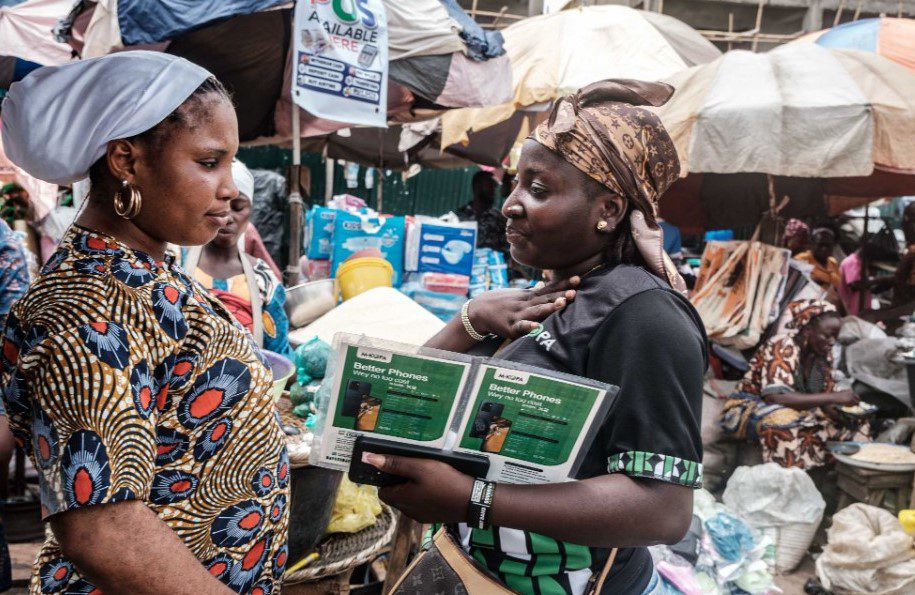 Direct sales agent marketing to a market women
As M-KOPA looks toward the horizon, an obvious question arises: will the company pivot to financing other physical assets desperately needed in the Nigerian market, such as solar power for SMEs or logistical tools? The answer, at least for now, is a resolute no.
For M-KOPA, the smartphone is not a mere communication device; it is the ultimate engine of economic mobility. When asked if the smartphone will remain the primary anchor for their digital credit roadmap, Babajide is unequivocal.
“The smartphone remains the primary anchor for digital credit,” he confirms. His reasoning distils the company’s entire strategic philosophy into a single, potent sentence: “Because everything can be built on the smartphone.”
In a volatile, unpredictable economy, the smartphone represents a portable office, a digital shopfront, and a verified financial identity. By mastering the financing of this single, pivotal asset, M-KOPA isn’t just weathering the Nigerian macroeconomic storm; they are laying the very digital infrastructure that allows the everyday earner to rise above it.
The post How M-KOPA unlocked N231bn in Nigeria’s credit economy despite endemic default culture first appeared on Technext.


You May Also Like

Seturion expands European token settlement network with Societe Generale and flatexDEGIRO

AEVIS VICTORIA Shareholders Approve All Proposals at 2025 AGM

Mike Johnson 'fed up' with Trump as he ditches White House for first time: insiders



