Hackers are now exploiting vulnerabilities in widely-used NPM coding libraries to inject malware into Ethereum smart contracts, according to cybersecurity research by blockchain compliance firm Reversing Labs(RL). In a September 3 blog post detailing the discovery, researcher Lucija Valentić revealed that threat actors bypass security scans by exploiting new open-source malware present in the Node Package Manager (NPM) package repository, which contains extensive JavaScript packages and libraries. The most destructive malware discovered was “colortoolsv2” and “mimelib2“, both published in July, which were found to abuse smart contracts to conceal malicious commands that install downloader malware on infected systems.Source: ReversingLabs How Ethereum Smart Contracts Turn Into Malware Command Centers These packages are part of broader open-source libraries affecting both NPM and GitHub, where malicious supply chain actors use advanced social engineering and deception tactics to trick developers into incorporating harmful code into their projects. According to ReversingLabs, 2025 has witnessed a diverse range of malicious campaigns targeting NPM, the leading online repository for JavaScript packages. In March, RL documented the discovery of NPM packages ethers-provider2 and ethers-providerz Since discovering the ethers campaign, researchers have detected numerous additional infostealers, downloaders, and droppers found on NPM. At the beginning of July, RL researcher Karlo Zanki discovered and reported a new NPM campaign involving a basic package that deployed blockchain in a novel way to deliver a malicious second stage. The exact package colortoolsv2 is being used to infiltrate Ethereum smart contracts. According to RL researchers, the malware is a basic NPM package containing just two files. The major file is a script named index.js, which contains a hidden malicious payload. Once installed in a project, the script would run to fetch blockchain data and execute a harmful command by loading the URL for a command and control (C2) server that would then download second-stage malware to the requesting system. Although “downloader” malware is a common method hackers use in NPM repositories to target victims, this specific malware is unusual as it uses Ethereum smart contracts to host the URLs where malicious commands are located for downloading the second-stage malware. Notably, the cybersecurity researchers acknowledge that they haven’t encountered this approach previously. Two-File Malware Hides a $2.5M Bridge Exploit Method The researchers uncovered a Solana-trading-bot infected by the malicious colortoolsv2 package called solana-trading-bot-v2, which appears to be a trustworthy GitHub project to the average observer.Source: ReversingLabs It has thousands of commits, several active contributors, and a decent number of stars and watchers, all characteristics of legitimate open-source repositories. However, all these details were fabricated, and any developer who installs it risks having user wallets that interact with the bot drained of funds. Software supply chain attacks targeting smart contracts and blockchain infrastructure are now on the rise. In July, hackers exploited a vulnerability in Arcadia Finance’s Rebalancer contract, draining approximately $2.5 million in cryptocurrency from the decentralized finance platform operating on Base blockchain. The attackers manipulated arbitrary swapData parameters to execute unauthorized swaps that emptied user vaults. A recent report by blockchain analytics firm Global Ledger revealed that hackers have now stolen $3 billion worth of crypto in 119 separate incidents during the first half of 2025, which is 150% more than all of 2024.Source: Global Ledger Slava Demchuk, CEO of analytics firm AMLBot, said access-control flaws and smart contract vulnerabilities, especially in bridges, continue to be dominant attack methods. Demchuk told Cryptonews that these hackers are exploiting the interconnected and composable nature of decentralized finance (DeFi) protocols to amplify the impact. Blockchain auditors advised that it is critical for developers to assess each library they are considering implementing before deciding to include it in their development cycleHackers are now exploiting vulnerabilities in widely-used NPM coding libraries to inject malware into Ethereum smart contracts, according to cybersecurity research by blockchain compliance firm Reversing Labs(RL). In a September 3 blog post detailing the discovery, researcher Lucija Valentić revealed that threat actors bypass security scans by exploiting new open-source malware present in the Node Package Manager (NPM) package repository, which contains extensive JavaScript packages and libraries. The most destructive malware discovered was “colortoolsv2” and “mimelib2“, both published in July, which were found to abuse smart contracts to conceal malicious commands that install downloader malware on infected systems.Source: ReversingLabs How Ethereum Smart Contracts Turn Into Malware Command Centers These packages are part of broader open-source libraries affecting both NPM and GitHub, where malicious supply chain actors use advanced social engineering and deception tactics to trick developers into incorporating harmful code into their projects. According to ReversingLabs, 2025 has witnessed a diverse range of malicious campaigns targeting NPM, the leading online repository for JavaScript packages. In March, RL documented the discovery of NPM packages ethers-provider2 and ethers-providerz Since discovering the ethers campaign, researchers have detected numerous additional infostealers, downloaders, and droppers found on NPM. At the beginning of July, RL researcher Karlo Zanki discovered and reported a new NPM campaign involving a basic package that deployed blockchain in a novel way to deliver a malicious second stage. The exact package colortoolsv2 is being used to infiltrate Ethereum smart contracts. According to RL researchers, the malware is a basic NPM package containing just two files. The major file is a script named index.js, which contains a hidden malicious payload. Once installed in a project, the script would run to fetch blockchain data and execute a harmful command by loading the URL for a command and control (C2) server that would then download second-stage malware to the requesting system. Although “downloader” malware is a common method hackers use in NPM repositories to target victims, this specific malware is unusual as it uses Ethereum smart contracts to host the URLs where malicious commands are located for downloading the second-stage malware. Notably, the cybersecurity researchers acknowledge that they haven’t encountered this approach previously. Two-File Malware Hides a $2.5M Bridge Exploit Method The researchers uncovered a Solana-trading-bot infected by the malicious colortoolsv2 package called solana-trading-bot-v2, which appears to be a trustworthy GitHub project to the average observer.Source: ReversingLabs It has thousands of commits, several active contributors, and a decent number of stars and watchers, all characteristics of legitimate open-source repositories. However, all these details were fabricated, and any developer who installs it risks having user wallets that interact with the bot drained of funds. Software supply chain attacks targeting smart contracts and blockchain infrastructure are now on the rise. In July, hackers exploited a vulnerability in Arcadia Finance’s Rebalancer contract, draining approximately $2.5 million in cryptocurrency from the decentralized finance platform operating on Base blockchain. The attackers manipulated arbitrary swapData parameters to execute unauthorized swaps that emptied user vaults. A recent report by blockchain analytics firm Global Ledger revealed that hackers have now stolen $3 billion worth of crypto in 119 separate incidents during the first half of 2025, which is 150% more than all of 2024.Source: Global Ledger Slava Demchuk, CEO of analytics firm AMLBot, said access-control flaws and smart contract vulnerabilities, especially in bridges, continue to be dominant attack methods. Demchuk told Cryptonews that these hackers are exploiting the interconnected and composable nature of decentralized finance (DeFi) protocols to amplify the impact. Blockchain auditors advised that it is critical for developers to assess each library they are considering implementing before deciding to include it in their development cycle

Hackers Exploit Ethereum to Inject Malware in Popular Coding Libraries

2025/09/04 20:39
4 min read

Hackers are now exploiting vulnerabilities in widely-used NPM coding libraries to inject malware into Ethereum smart contracts, according to cybersecurity research by blockchain compliance firm Reversing Labs(RL).

In a September 3 blog post detailing the discovery, researcher Lucija Valentić revealed that threat actors bypass security scans by exploiting new open-source malware present in the Node Package Manager (NPM) package repository, which contains extensive JavaScript packages and libraries.

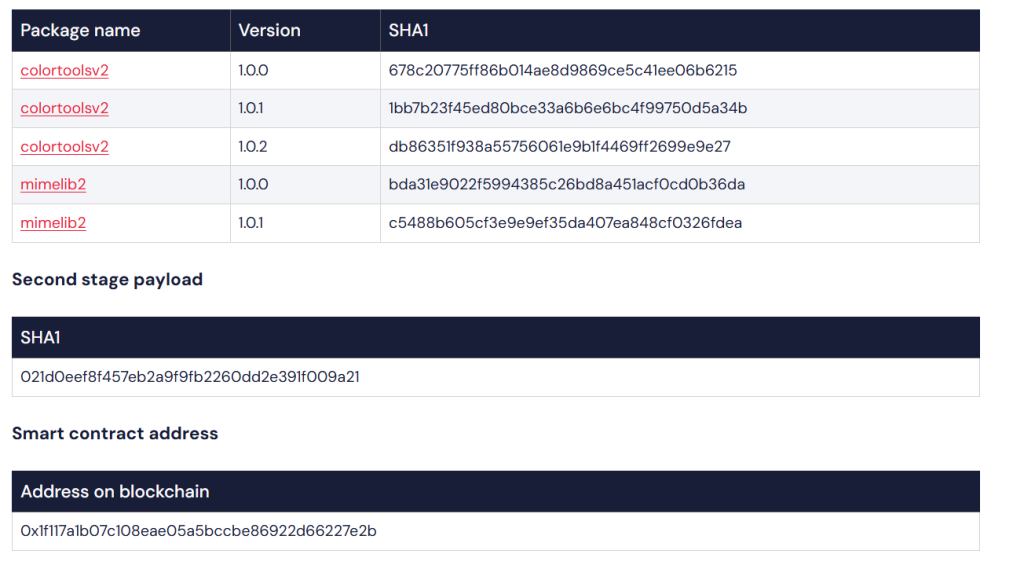
The most destructive malware discovered was “colortoolsv2” and “mimelib2“, both published in July, which were found to abuse smart contracts to conceal malicious commands that install downloader malware on infected systems.
Hackers Exploit Ethereum to Inject Malware in Popular Coding LibrariesSource: ReversingLabs

How Ethereum Smart Contracts Turn Into Malware Command Centers

These packages are part of broader open-source libraries affecting both NPM and GitHub, where malicious supply chain actors use advanced social engineering and deception tactics to trick developers into incorporating harmful code into their projects.

According to ReversingLabs, 2025 has witnessed a diverse range of malicious campaigns targeting NPM, the leading online repository for JavaScript packages.

In March, RL documented the discovery of NPM packages ethers-provider2 and ethers-providerz

Since discovering the ethers campaign, researchers have detected numerous additional infostealers, downloaders, and droppers found on NPM.

At the beginning of July, RL researcher Karlo Zanki discovered and reported a new NPM campaign involving a basic package that deployed blockchain in a novel way to deliver a malicious second stage.

The exact package colortoolsv2 is being used to infiltrate Ethereum smart contracts.

According to RL researchers, the malware is a basic NPM package containing just two files.

The major file is a script named index.js, which contains a hidden malicious payload.

Once installed in a project, the script would run to fetch blockchain data and execute a harmful command by loading the URL for a command and control (C2) server that would then download second-stage malware to the requesting system.

Although “downloader” malware is a common method hackers use in NPM repositories to target victims, this specific malware is unusual as it uses Ethereum smart contracts to host the URLs where malicious commands are located for downloading the second-stage malware.

Notably, the cybersecurity researchers acknowledge that they haven’t encountered this approach previously.

Two-File Malware Hides a $2.5M Bridge Exploit Method

The researchers uncovered a Solana-trading-bot infected by the malicious colortoolsv2 package called solana-trading-bot-v2, which appears to be a trustworthy GitHub project to the average observer.

Hackers Exploit Ethereum to Inject Malware in Popular Coding LibrariesSource: ReversingLabs

It has thousands of commits, several active contributors, and a decent number of stars and watchers, all characteristics of legitimate open-source repositories.

However, all these details were fabricated, and any developer who installs it risks having user wallets that interact with the bot drained of funds.

Software supply chain attacks targeting smart contracts and blockchain infrastructure are now on the rise.

In July, hackers exploited a vulnerability in Arcadia Finance’s Rebalancer contract, draining approximately $2.5 million in cryptocurrency from the decentralized finance platform operating on Base blockchain.

The attackers manipulated arbitrary swapData parameters to execute unauthorized swaps that emptied user vaults.

A recent report by blockchain analytics firm Global Ledger revealed that hackers have now stolen $3 billion worth of crypto in 119 separate incidents during the first half of 2025, which is 150% more than all of 2024.

Hackers Exploit Ethereum to Inject Malware in Popular Coding LibrariesSource: Global Ledger

Slava Demchuk, CEO of analytics firm AMLBot, said access-control flaws and smart contract vulnerabilities, especially in bridges, continue to be dominant attack methods.

Demchuk told Cryptonews that these hackers are exploiting the interconnected and composable nature of decentralized finance (DeFi) protocols to amplify the impact.

Blockchain auditors advised that it is critical for developers to assess each library they are considering implementing before deciding to include it in their development cycle.

Disclaimer: The articles reposted on this site are sourced from public platforms and are provided for informational purposes only. They do not necessarily reflect the views of MEXC. All rights remain with the original authors. If you believe any content infringes on third-party rights, please contact service@support.mexc.com for removal. MEXC makes no guarantees regarding the accuracy, completeness, or timeliness of the content and is not responsible for any actions taken based on the information provided. The content does not constitute financial, legal, or other professional advice, nor should it be considered a recommendation or endorsement by MEXC.

You May Also Like

Is Doge Losing Steam As Traders Choose Pepeto For The Best Crypto Investment?

Is Doge Losing Steam As Traders Choose Pepeto For The Best Crypto Investment?

The post Is Doge Losing Steam As Traders Choose Pepeto For The Best Crypto Investment? appeared on BitcoinEthereumNews.com. Crypto News 17 September 2025 | 17:39 Is dogecoin really fading? As traders hunt the best crypto to buy now and weigh 2025 picks, Dogecoin (DOGE) still owns the meme coin spotlight, yet upside looks capped, today’s Dogecoin price prediction says as much. Attention is shifting to projects that blend culture with real on-chain tools. Buyers searching “best crypto to buy now” want shipped products, audits, and transparent tokenomics. That frames the true matchup: dogecoin vs. Pepeto. Enter Pepeto (PEPETO), an Ethereum-based memecoin with working rails: PepetoSwap, a zero-fee DEX, plus Pepeto Bridge for smooth cross-chain moves. By fusing story with tools people can use now, and speaking directly to crypto presale 2025 demand, Pepeto puts utility, clarity, and distribution in front. In a market where legacy meme coin leaders risk drifting on sentiment, Pepeto’s execution gives it a real seat in the “best crypto to buy now” debate. First, a quick look at why dogecoin may be losing altitude. Dogecoin Price Prediction: Is Doge Really Fading? Remember when dogecoin made crypto feel simple? In 2013, DOGE turned a meme into money and a loose forum into a movement. A decade on, the nonstop momentum has cooled; the backdrop is different, and the market is far more selective. With DOGE circling ~$0.268, the tape reads bearish-to-neutral for the next few weeks: hold the $0.26 shelf on daily closes and expect choppy range-trading toward $0.29–$0.30 where rallies keep stalling; lose $0.26 decisively and momentum often bleeds into $0.245 with risk of a deeper probe toward $0.22–$0.21; reclaim $0.30 on a clean daily close and the downside bias is likely neutralized, opening room for a squeeze into the low-$0.30s. Source: CoinMarketcap / TradingView Beyond the dogecoin price prediction, DOGE still centers on payments and lacks native smart contracts; ZK-proof verification is proposed,…
Share
BitcoinEthereumNews2025/09/18 00:14
SEI Technical Analysis Feb 6

SEI Technical Analysis Feb 6

The post SEI Technical Analysis Feb 6 appeared on BitcoinEthereumNews.com. SEI is consolidating at the $0.08 level under general downtrend pressure; although RSI
Share
BitcoinEthereumNews2026/02/07 02:43
South Korean Crypto Exchange Accidentally Gave Away $95 Billion in Bitcoin

South Korean Crypto Exchange Accidentally Gave Away $95 Billion in Bitcoin

The post South Korean Crypto Exchange Accidentally Gave Away $95 Billion in Bitcoin appeared on BitcoinEthereumNews.com. In brief South Korean exchange Bithumb
Share
BitcoinEthereumNews2026/02/07 02:16