

Global Crypto Adoption 2025: Chainalysis Reveals Which Countries Are Winning
Chainalysis has released its sixth annual Global Crypto Adoption Index, naming India the world’s top market for grassroots crypto adoption in 2025, with the United States in second place, followed by Pakistan, Vietnam and Brazil. Published on September 2, 2025 as an excerpt from the forthcoming Geography of Cryptocurrency Report, the study blends on-chain and off-chain data to rank 151 countries by how widely and intensively ordinary people and institutions are using crypto, rather than by headline market capitalization alone.
Global Crypto Adoption Report 2025
At the heart of the ranking is a composite score built from four sub-indices: on-chain value received by centralized services; retail-sized on-chain value received by centralized services; on-chain value received by DeFi protocols; and institutional-sized on-chain value received by centralized services. Chainalysis says it ranks each country across these pillars, weights the results by factors such as population and purchasing power, and then takes a geometric mean to produce a normalized 0–1 score. The firm emphasizes scale, noting that its inputs encompass “hundreds of millions of cryptocurrency transactions and more than 13 billion web visits,” while acknowledging web-traffic-based geolocation limits.
Methodologically, 2025 marks a notable pivot. Chainalysis “removed the retail decentralized finance (DeFi) sub-index” after concluding it over-weighted a “relatively niche behavior,” and added a new institutional activity lens capturing transfers over $1 million, reflecting the post-ETF surge in professional participation. The aim, the firm writes, is a “fuller view of global crypto engagement, capturing both bottom-up (retail) and top-down (institutional) activity.”
The headline table underscores Asia’s weight. India sits first overall and first across all four underlying categories; Pakistan and Vietnam join it in the global top four, while Brazil rounds out the top five. Nigeria, Indonesia, Ukraine and the Philippines rank sixth through ninth, with the Russian Federation at ten and the United Kingdom at eleven. Notably, Ethiopia and Yemen enter the top twenty at twelfth and sixteenth, respectively, while Japan ranks nineteenth and Argentina twentieth. Chainalysis attributes the regional momentum to a surge in both centralized and decentralized usage across major APAC markets.
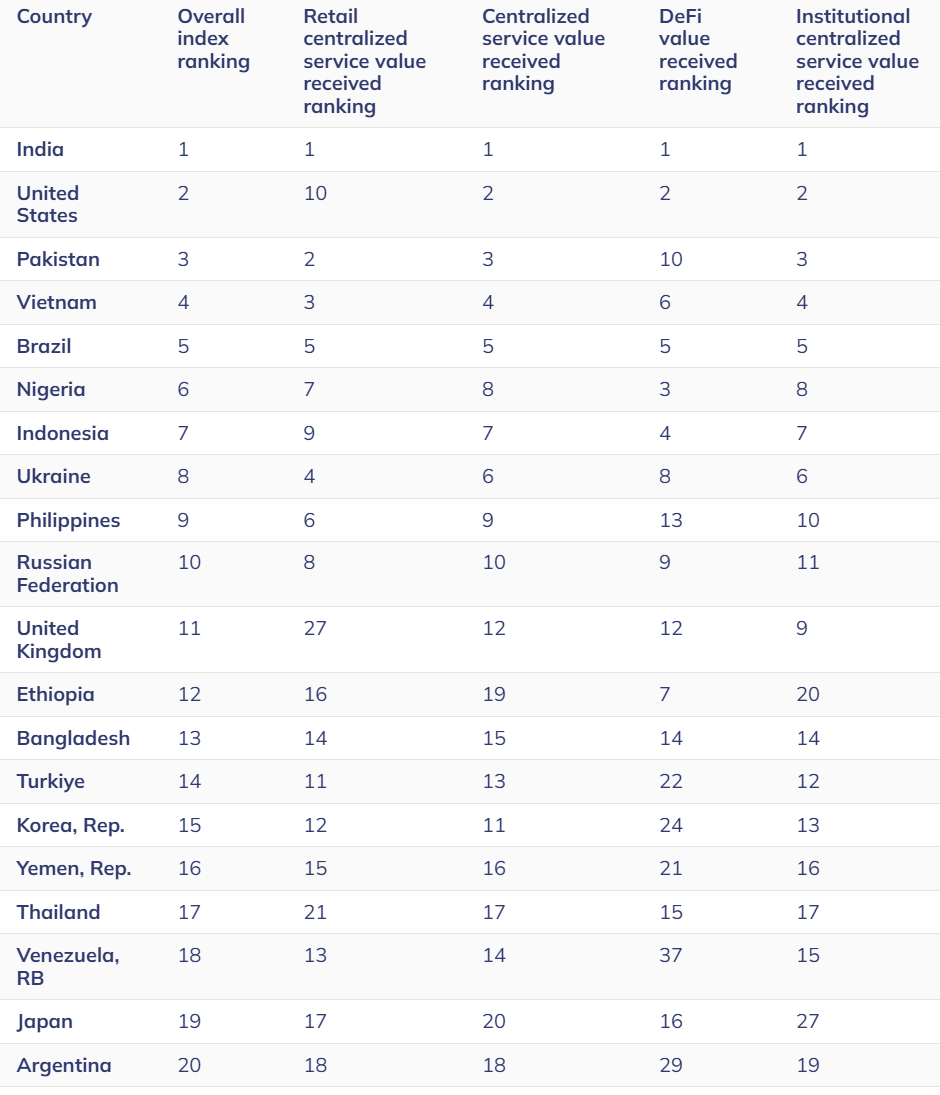
Regional flow data deepen that picture. Over the twelve months to June 2025, APAC’s on-chain value received jumped 69% year over year—from roughly $1.4 trillion to $2.36 trillion—making it the fastest-growing region. Latin America followed at 63% growth and Sub-Saharan Africa at 52%. In absolute terms, Europe and North America still dominate, receiving about $2.6 trillion and $2.2 trillion respectively over the period; North America’s activity grew 49% amid renewed institutional participation, while Europe rose 42%. MENA expanded by 33%.
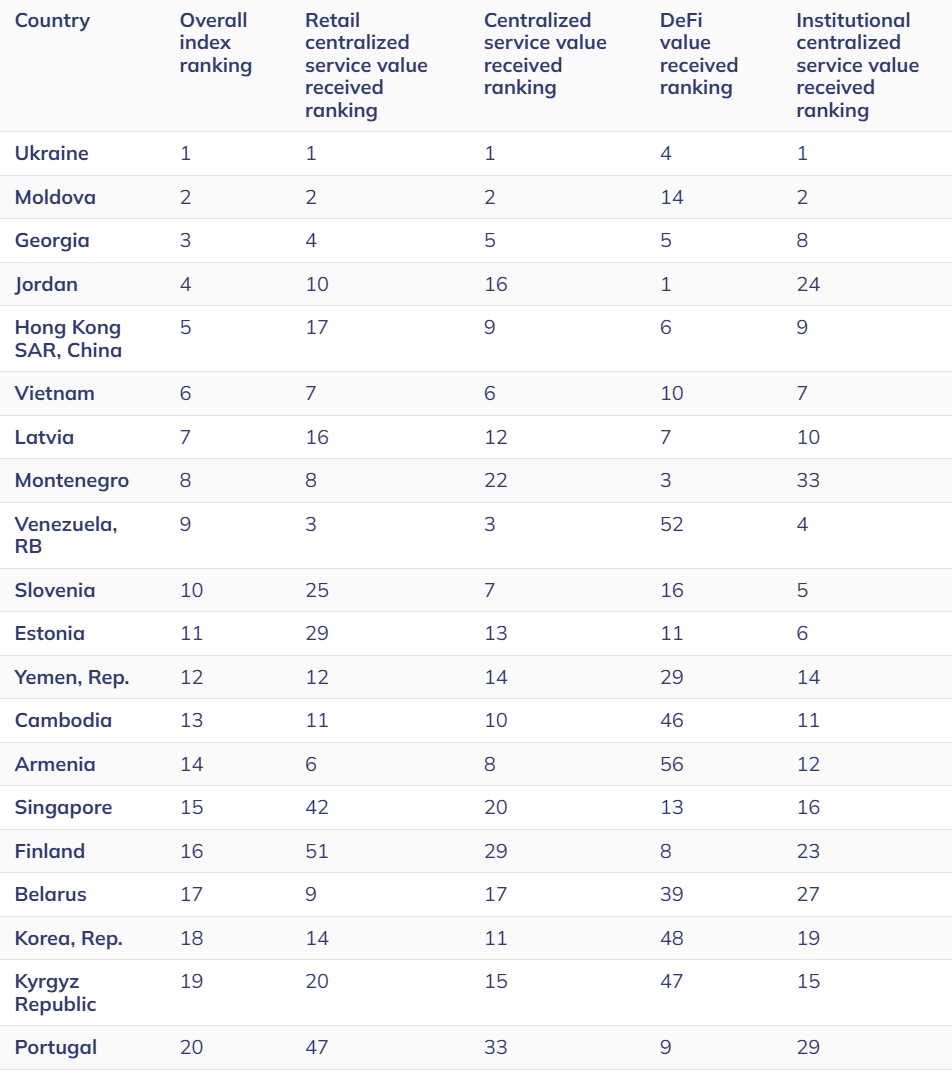
A population-adjusted cut of the index tells a different story, highlighting where crypto has penetrated most deeply relative to country size. On that basis, Eastern Europe is ascendant: Ukraine ranks first, Moldova second and Georgia third, ahead of Jordan and Hong Kong SAR. Chainalysis links the region’s leadership to economic uncertainty, distrust in banks, and high technical literacy that make crypto attractive for wealth preservation and cross-border transfers. Vietnam again appears near the top in this view, underscoring its broad-based retail engagement.
Stablecoins remain the connective tissue of global crypto commerce. Chainalysis finds that USDT and USDC continue to dwarf peers in transaction volume, with USDT processing over $1 trillion per month between June 2024 and June 2025 and USDC ranging roughly from $1.24 trillion to $3.29 trillion monthly, even as newer, more regulated or regionally tailored tokens accelerate. EURC’s monthly volume, for example, rose from about $47 million to more than $7.5 billion over the period, while PYUSD climbed from roughly $783 million to $3.95 billion.
The firm situates these flows within shifting rulesets—MiCA’s stablecoin regime in the EU and US legislative momentum exemplified by the GENIUS Act—alongside expanding merchant rails from payments giants and card-linked integrations by major crypto platforms.
Crucially, the report analyzes the fiat “on-ramp” into crypto across centralized exchanges. “Bitcoin leads by a wide margin,” Chainalysis writes, accounting for over $4.6 trillion in fiat purchase volume from July 2024 to June 2025—more than double Layer-1 tokens ex-BTC and ETH (about $3.8 trillion), with stablecoins at $1.3 trillion and altcoins around $540 billion. The United States is the largest national on-ramp at more than $4.2 trillion, followed by South Korea above $1 trillion and the European Union just under $500 billion; Bitcoin’s share of fiat inflow is especially pronounced in the UK and EU at roughly 47% and 45%.
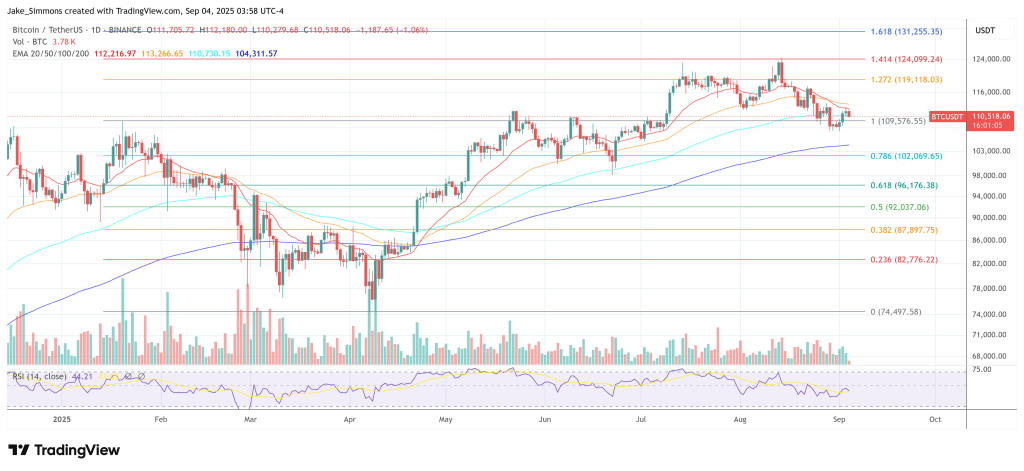
At press time, Bitcoin traded at $110,518.


You May Also Like

The Role of Reference Points in Achieving Equilibrium Efficiency in Fair and Socially Just Economies

ETH Enters High-Stakes Decision Zone

Emergency room doctor names worrying Trump behavior: 'Something just seems not right'



