TLDRs; TSMC stock rose 1.13% to $230.98 on Wednesday despite U.S. moves to end its China export waiver. The waiver’s expiration in 2025 means TSMC must seek licenses for restricted equipment shipped to its Nanjing plant. Analysts warn of administrative friction, longer lead times, and higher compliance costs for semiconductor firms in China. Despite headwinds, [...] The post TSMC (TSM) Stock: Holds Steady Despite U.S. Export Control Changes appeared first on CoinCentral.TLDRs; TSMC stock rose 1.13% to $230.98 on Wednesday despite U.S. moves to end its China export waiver. The waiver’s expiration in 2025 means TSMC must seek licenses for restricted equipment shipped to its Nanjing plant. Analysts warn of administrative friction, longer lead times, and higher compliance costs for semiconductor firms in China. Despite headwinds, [...] The post TSMC (TSM) Stock: Holds Steady Despite U.S. Export Control Changes appeared first on CoinCentral.

TSMC (TSM) Stock: Holds Steady Despite U.S. Export Control Changes

2025/09/04 01:47
3 min read

TLDRs;

  • TSMC stock rose 1.13% to $230.98 on Wednesday despite U.S. moves to end its China export waiver.
  • The waiver’s expiration in 2025 means TSMC must seek licenses for restricted equipment shipped to its Nanjing plant.
  • Analysts warn of administrative friction, longer lead times, and higher compliance costs for semiconductor firms in China.
  • Despite headwinds, TSMC stock stability shows investor confidence in its dominance in global advanced chip manufacturing.

Taiwan Semiconductor Manufacturing Company (TSM) stock showed resilience on Wednesday, closing up just over 1% despite the latest move from Washington to end its export waiver for China.

The stock climbed to $230.98, gaining 1.13% on Wednesday, and held relatively stable through the trading session even as concerns lingered about the long-term implications of U.S. export policy.

The U.S. Commerce Department announced that TSMC’s validated end user (VEU) waiver, which allowed the company to ship certain restricted semiconductor equipment to its Nanjing, China plant, will expire on December 31, 2025. After this date, the chip giant will need individual licenses for exports, a significant shift from blanket permissions that previously simplified operations.

This policy mirrors actions already taken against Samsung Electronics and SK Hynix, signaling that Washington intends to close what officials describe as “export control loopholes” in advanced technology trade.
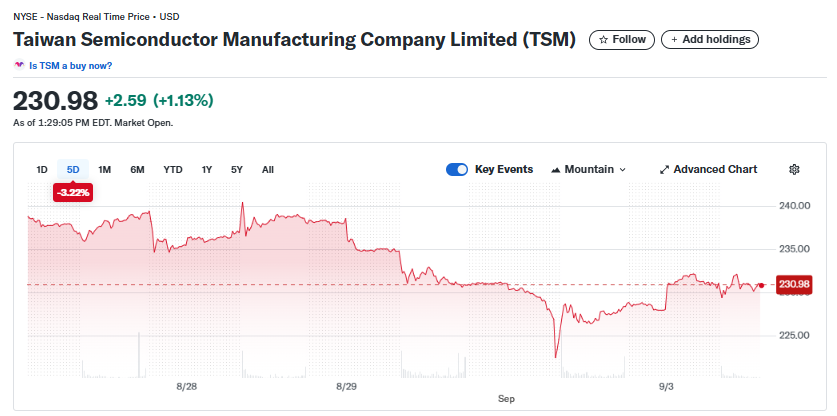
Taiwan Semiconductor Manufacturing Company Limited (TSM)

TSMC’s Stock Performance Shows Stability

Despite geopolitical tensions, TSMC’s share performance highlights investor confidence in its market position. Over the past five trading days, the stock experienced some volatility, dipping late August before rebounding in early September. The 1% surge on Wednesday suggests that investors view the company’s long-term fundamentals as intact.

Market watchers believe the limited impact stems from the relatively small share of revenue tied to its Nanjing facility, which accounts for just a fraction of TSMC’s global output.

Still, the changes could introduce administrative and operational friction, including potentially longer lead times and compliance costs that may affect competitiveness in China.

Export Rules as a Strategic Weapon

Analysts note that the shift from blanket waivers to case-by-case licensing illustrates how bureaucratic processes can serve as policy tools in the U.S.-China tech rivalry. Instead of outright bans, Washington is relying on regulatory hurdles to restrict sensitive technology transfers.

According to estimates, the new system could generate over 1,000 additional license applications annually, creating paperwork burdens for TSMC and its suppliers. While most licenses may still be approved, the uncertainty over timing could disrupt supply chain planning and add hidden costs to doing business in China.

This approach allows the U.S. to maintain leverage without escalating into more aggressive measures that could trigger diplomatic fallout. The strategy reflects Washington’s broader push to control critical supply chains where U.S.-made equipment and components give it global influence.

Broader Geopolitical Context

The export control development follows other headlines surrounding TSMC. Just last month, company CEO C.C. Wei reassured investors that the U.S. government will not seek an equity stake in the firm, despite earlier media speculation tied to CHIPS Act subsidies. That reassurance helped stabilize investor sentiment after shares had briefly fallen in Taipei on related rumors.

Together, these events underline the delicate balance TSMC faces. On one hand, it is expanding globally with new fabs in the U.S. and Japan, strengthening its role in securing advanced chip supply chains. On the other, it must navigate geopolitical headwinds in China, where even small operational exposures can become points of vulnerability.

The post TSMC (TSM) Stock: Holds Steady Despite U.S. Export Control Changes appeared first on CoinCentral.

Market Opportunity
Oasis Logo
Oasis Price(ROSE)
$0.01128
$0.01128$0.01128
-11.66%
USD
Oasis (ROSE) Live Price Chart
Disclaimer: The articles reposted on this site are sourced from public platforms and are provided for informational purposes only. They do not necessarily reflect the views of MEXC. All rights remain with the original authors. If you believe any content infringes on third-party rights, please contact crypto.news@mexc.com for removal. MEXC makes no guarantees regarding the accuracy, completeness, or timeliness of the content and is not responsible for any actions taken based on the information provided. The content does not constitute financial, legal, or other professional advice, nor should it be considered a recommendation or endorsement by MEXC.

You May Also Like

Italy passes law on AI outlining privacy and child access

Italy passes law on AI outlining privacy and child access

The post Italy passes law on AI outlining privacy and child access appeared on BitcoinEthereumNews.com. Italy has formally passed a sweeping new law to regulate artificial intelligence, becoming the first member of the European Union to roll out comprehensive legislation in step with the bloc’s landmark AI Act. The Italian Senate granted final approval after a year of debate, concluding what Prime Minister Giorgia Meloni’s government described as a decisive step in shaping how new technologies are deployed across the country. Italy sets tough penalties for offenders The legislation, ministers argue, lays out the boundaries for human-centric, transparent, and safe use of AI while balancing the need to foster innovation, cybersecurity, and economic growth. The law casts its net widely, and it stretches into healthcare, schools, the justice system, workplaces, sport, and the public sector. AI access for children under 14 has also been tightened, and it now requires parental consent. “This law brings innovation back within the perimeter of the public interest, steering AI toward growth, rights and full protection of citizens.” Alessio Butti, the undersecretary for digital transformation. Lawmakers also opted for a hard line on abuses. A new offence has been added to the criminal code covering the unlawful spread of AI-generated or manipulated content, such as deepfakes. Anyone found guilty faces between one and five years in prison if their actions cause harm. Using AI to commit fraud, identity theft, market manipulation, or money laundering will now be treated as an aggravating circumstance, raising potential sentences by a third. Judges remain the sole authority in legal rulings, though courts are empowered to demand rapid takedowns of illicit material. Government agencies to oversee its implementation Responsibility for enforcing the regime lies with the Agency for Digital Italy and the National Cybersecurity Agency, though existing financial watchdogs such as the Bank of Italy and Consob retain powers in their own spheres. The Department…
Share
BitcoinEthereumNews2025/09/18 06:05
Strategic Silence As Beijing Media Blames US, Israel For Dangerous Escalation
Strategic Silence As Beijing Media Blames US, Israel For Dangerous Escalation

The post Strategic Silence As Beijing Media Blames US, Israel For Dangerous Escalation appeared on BitcoinEthereumNews.com. China Iran Tensions: Strategic Silence
Share
BitcoinEthereumNews2026/02/28 21:31
Trump sabotages emerging peace deal with military escalation

Trump sabotages emerging peace deal with military escalation

President Donald Trump launched strikes on Iran early Saturday morning, claiming that talks over a nuclear agreement had broken down. Speaking after midnight, Trump
Share
Alternet2026/02/28 20:52