Bitcoin (BTC) acts as a barometer for global fear, but the latest geopolitical flare-up, which has many fearing for WW3, has failed to break the asset’s bullishBitcoin (BTC) acts as a barometer for global fear, but the latest geopolitical flare-up, which has many fearing for WW3, has failed to break the asset’s bullish

Bitcoin and WW3: 5 Key Indicators as BTC Eyes Global Liquidity Surge

2026/03/02 21:17
5 min read
For feedback or concerns regarding this content, please contact us at crypto.news@mexc.com

Bitcoin (BTC) acts as a barometer for global fear, but the latest geopolitical flare-up, which has many fearing for WW3, has failed to break the asset’s bullish prospects.

While headlines scream conflict, Bitcoin is holding the $60,000 line, eyeing a liquidity-driven breakout rather than a capitulation event.

Traders are now pricing in resilience, looking past the initial volatility to the underlying supply mechanics that favor the bulls.

The market climaxed with a sharp dip near $63,000 over the weekend before buyers stepped in, rejecting lower lows.

This price action suggests the market is desensitizing to headline risk, shifting focus back to the monetary drivers that typically fuel Q4 rallies. It is a clash of narratives: geopolitical uncertainty versus undeniable on-chain strength.

Key Takeaways:
  • Bitcoin Exchange Reserves have dropped to levels not seen since 2018, creating a significant supply shock as demand creates a floor.
  • Spot BTC ETF Inflows are absorbing retail panic selling, with institutional players treating dips as accumulation opportunities.
  • Global Liquidity M2 is expanding again, historically a primary driver for crypto asset repricing regardless of news cycles.

Indicator 1: Bitcoin Exchange Reserves Signal Supply Shock

The most critical on-chain metric currently is the rapid depletion of Bitcoin Exchange Reserves. According to data from CryptoQuant, reserves have fallen to approximately 2.6 million BTC, the lowest level since 2018. This is a structural supply squeeze that cannot be ignored.
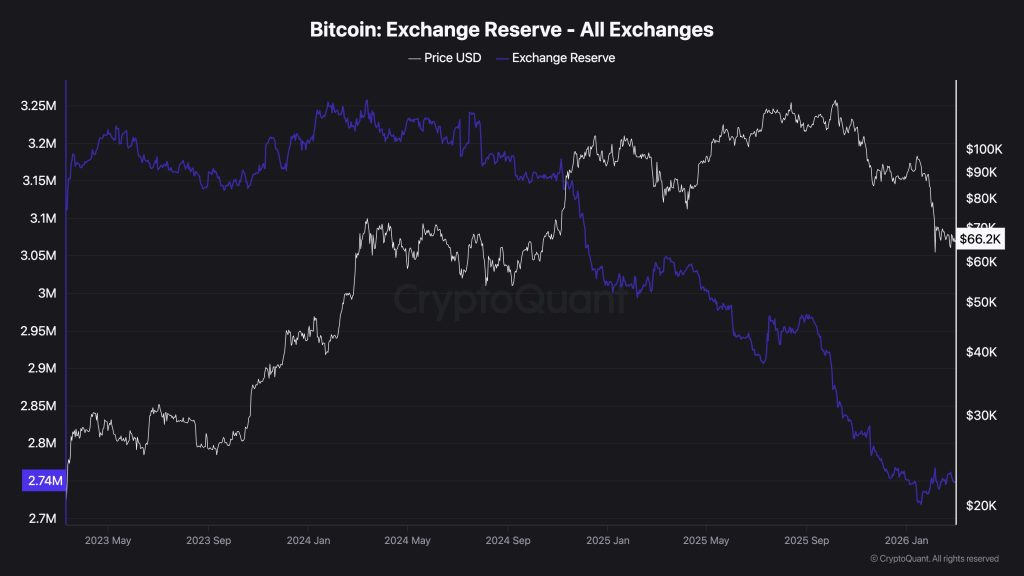
Bitcoin and WW3: 5 Key Indicators as BTC Eyes Global Liquidity SurgeSource: CryptoQuant

When coins leave exchanges, they move to cold storage or custody solutions, effectively removing them from the immediate sellable supply.

The implication is straightforward: fewer coins available for sale means it takes less buy volume to push prices higher. In previous cycles, sharp declines in exchange balances often preceded supply shock rallies.

This drain on liquidity suggests that while weak hands are selling into headline fear, long-term holders are moving assets off the ledger. We are witnessing a transfer of wealth from impatient retail traders to high-conviction entities who understand the scarcity mechanics of the halving year.

Discover: The best crypto to diversify your portfolio with

Indicator 2: Bitcoin (BTC) ETF Inflows vs. Spot Selling

Institutional demand continues to act as a massive buffer against spot market volatility. Despite the bearish sentiment on social media, Spot BTC ETF Inflows tell a different story.

Recent weeks have seen net inflows effectively neutralizing the selling pressure from short-term holders, with the last week generated net inflows of $787.3 million, according to data by SoSoValue.

So, funds like BlackRock’s IBIT continue to attract capital even as price action chops sideways. This divergence of falling price against rising inflows is a classic accumulation signal. Institutional accumulation is not slowing down; it is accelerating during dips.

Adding to this institutional bedrock, major financial players are deepening their infrastructure. Morgan Stanley has moved to hold client crypto directly, signaling that the smart money thesis remains focused on long-term adoption rather than short-term geopolitical noise.

Indicator 3: How Bitcoin is Breaking the Downtrend Despite WW3 Fears

Technically, Bitcoin is respecting critical levels. The weekend dip found support before reaching the psychological $60,000 barrier, a level many traders had eyed for aggressive longs.

Trader CrypNuevo noted on X that a trip to anywhere between $60,000 and $61,000 would be a prime long entry, but the market front-ran that level, showing eagerness to buy.

A clean break above $70,000 would invalidate the downtrending structure that has plagued the chart since March.

Bitcoin and WW3: 5 Key Indicators as BTC Eyes Global Liquidity Surge

Support at $60,000 is the line in the sand; lose that, and the conversation shifts to $55,000 or lower. If Bitcoin can hold the line, the path back to six figures by Summer remains open.

Indicator 4: Global Liquidity and Central Bank Easing

Bitcoin is, above all else, a liquidity sponge. The current expansion of Global Liquidity M2, a measure of global liquidity that takes into account cash, checking and savings deposits, money market securities, and other near-cash assets, is the macro tailwind that bearish traders are overlooking.

As central banks from the ECB to the Fed signal or enact rate cuts, the cost of capital decreases, forcing money out of risk-free assets and into growth vehicles.

Historically, Bitcoin’s parabolic runs align perfectly with cycles of M2 expansion. We are currently in the early stages of a global easing cycle. While inflation data may cause temporary pauses in the Fed’s roadmap, the broader trend is clear: money printers are warming up.

Bitcoin and WW3: 5 Key Indicators as BTC Eyes Global Liquidity SurgeSource: Fidelity Digital Assets

Given the historic lag between M2 liquidity expansion cycles and Bitcoin bull markets, the injections hitting the system now will likely reflect in asset prices in Q4 2024 and Q1 2025.

Traders betting on a crash are effectively betting against the central bank liquidity cycle, a wager that rarely pays off in the crypto markets.

Discover: The best crypto to buy now

Indicator 5: Bitcoin Sees Geopolitical Resilience Despite WW3 Fears

The market’s reaction to recent Middle East tensions reinforces the “digital gold” narrative, albeit with high beta volatility.

While the initial reaction was a sell-off, Bitcoin rebounded swiftly after the shock, erasing nearly all losses within 48 hours. This V-shaped recovery is a hallmark of a resilient bull market structure.

Analyst consensus is shifting away from “World War Three” scenarios toward a contained conflict narrative, limiting the downside risk for risk assets.

However, the connection between energy prices and crypto remains tight. As oil prices react to Iran tensions, inflation expectations could tick up, complicating the Fed’s pivot. Yet, Bitcoin has shrugged off this correlation for now, trading more on idiosyncratic crypto flows than petrodollar dynamics.

Data from CoinGlass shows that the initial dip flushed out over-leveraged longs, resetting open interest to healthier levels. The market is now lighter, cleaner, and ready for organic price discovery without the weight of excessive leverage.

Ultimately, with institutional accumulation quietly putting a floor under price and Bitcoin Exchange Reserves draining, the path of least resistance appears to be upwards despite WW3 fears. The Bitcoin market has already priced in the conflict shock. Now it waits for the liquidity surge.

Market Opportunity
Bitcoin Logo
Bitcoin Price(BTC)
$71,829.01
$71,829.01$71,829.01
-2.13%
USD
Bitcoin (BTC) Live Price Chart
Disclaimer: The articles reposted on this site are sourced from public platforms and are provided for informational purposes only. They do not necessarily reflect the views of MEXC. All rights remain with the original authors. If you believe any content infringes on third-party rights, please contact crypto.news@mexc.com for removal. MEXC makes no guarantees regarding the accuracy, completeness, or timeliness of the content and is not responsible for any actions taken based on the information provided. The content does not constitute financial, legal, or other professional advice, nor should it be considered a recommendation or endorsement by MEXC.

You May Also Like

X money beta expands with 6% yield and cashback in beta

X money beta expands with 6% yield and cashback in beta

The post X money beta expands with 6% yield and cashback in beta appeared on BitcoinEthereumNews.com. This week, Elon Musk moved another step toward his vision
Share
BitcoinEthereumNews2026/03/05 20:55
Crucial US Stock Market Update: What Wednesday’s Mixed Close Reveals

Crucial US Stock Market Update: What Wednesday’s Mixed Close Reveals

BitcoinWorld Crucial US Stock Market Update: What Wednesday’s Mixed Close Reveals The financial world often keeps us on our toes, and Wednesday was no exception. Investors watched closely as the US stock market concluded the day with a mixed performance across its major indexes. This snapshot offers a crucial glimpse into current investor sentiment and economic undercurrents, prompting many to ask: what exactly happened? Understanding the Latest US Stock Market Movements On Wednesday, the closing bell brought a varied picture for the US stock market. While some indexes celebrated gains, others registered slight declines, creating a truly mixed bag for investors. The Dow Jones Industrial Average showed resilience, climbing by a notable 0.57%. This positive movement suggests strength in some of the larger, more established companies. Conversely, the S&P 500, a broader benchmark often seen as a barometer for the overall market, experienced a modest dip of 0.1%. The technology-heavy Nasdaq Composite also saw a slight retreat, sliding by 0.33%. This particular index often reflects investor sentiment towards growth stocks and the tech sector. These divergent outcomes highlight the complex dynamics currently at play within the American economy. It’s not simply a matter of “up” or “down” for the entire US stock market; rather, it’s a nuanced landscape where different sectors and company types are responding to unique pressures and opportunities. Why Did the US Stock Market See Mixed Results? When the US stock market delivers a mixed performance, it often points to a tug-of-war between various economic factors. Several elements could have contributed to Wednesday’s varied closings. For instance, positive corporate earnings reports from certain industries might have bolstered the Dow. At the same time, concerns over inflation, interest rate policies by the Federal Reserve, or even global economic uncertainties could have pressured growth stocks, affecting the S&P 500 and Nasdaq. Key considerations often include: Economic Data: Recent reports on employment, manufacturing, or consumer spending can sway market sentiment. Corporate Announcements: Strong or weak earnings forecasts from influential companies can significantly impact their respective sectors. Interest Rate Expectations: The prospect of higher or lower interest rates directly influences borrowing costs for businesses and consumer spending, affecting future profitability. Geopolitical Events: Global tensions or trade policies can introduce uncertainty, causing investors to become more cautious. Understanding these underlying drivers is crucial for anyone trying to make sense of daily market fluctuations in the US stock market. Navigating Volatility in the US Stock Market A mixed close, while not a dramatic downturn, serves as a reminder that market volatility is a constant companion for investors. For those involved in the US stock market, particularly individuals managing their portfolios, these days underscore the importance of a well-thought-out strategy. It’s important not to react impulsively to daily movements. Instead, consider these actionable insights: Diversification: Spreading investments across different sectors and asset classes can help mitigate risk when one area underperforms. Long-Term Perspective: Focusing on long-term financial goals rather than short-term gains can help weather daily market swings. Stay Informed: Keeping abreast of economic news and company fundamentals provides context for market behavior. Consult Experts: Financial advisors can offer personalized guidance based on individual risk tolerance and objectives. Even small movements in major indexes can signal shifts that require attention, guiding future investment decisions within the dynamic US stock market. What’s Next for the US Stock Market? Looking ahead, investors will be keenly watching for further economic indicators and corporate announcements to gauge the direction of the US stock market. Upcoming inflation data, statements from the Federal Reserve, and quarterly earnings reports will likely provide more clarity. The interplay of these factors will continue to shape investor confidence and, consequently, the performance of the Dow, S&P 500, and Nasdaq. Remaining informed and adaptive will be key to understanding the market’s trajectory. Conclusion: Wednesday’s mixed close in the US stock market highlights the intricate balance of forces influencing financial markets. While the Dow showed strength, the S&P 500 and Nasdaq experienced slight declines, reflecting a nuanced economic landscape. This reminds us that understanding the ‘why’ behind these movements is as important as the movements themselves. As always, a thoughtful, informed approach remains the best strategy for navigating the complexities of the market. Frequently Asked Questions (FAQs) Q1: What does a “mixed close” mean for the US stock market? A1: A mixed close indicates that while some major stock indexes advanced, others declined. It suggests that different sectors or types of companies within the US stock market are experiencing varying influences, rather than a uniform market movement. Q2: Which major indexes were affected on Wednesday? A2: On Wednesday, the Dow Jones Industrial Average gained 0.57%, while the S&P 500 edged down 0.1%, and the Nasdaq Composite slid 0.33%, illustrating the mixed performance across the US stock market. Q3: What factors contribute to a mixed stock market performance? A3: Mixed performances in the US stock market can be influenced by various factors, including specific corporate earnings, economic data releases, shifts in interest rate expectations, and broader geopolitical events that affect different market segments uniquely. Q4: How should investors react to mixed market signals? A4: Investors are generally advised to maintain a long-term perspective, diversify their portfolios, stay informed about economic news, and avoid impulsive decisions. Consulting a financial advisor can also provide personalized guidance for navigating the US stock market. Q5: What indicators should investors watch for future US stock market trends? A5: Key indicators to watch include upcoming inflation reports, statements from the Federal Reserve regarding monetary policy, and quarterly corporate earnings reports. These will offer insights into the future direction of the US stock market. Did you find this analysis of the US stock market helpful? Share this article with your network on social media to help others understand the nuances of current financial trends! To learn more about the latest stock market trends, explore our article on key developments shaping the US stock market‘s future performance. This post Crucial US Stock Market Update: What Wednesday’s Mixed Close Reveals first appeared on BitcoinWorld.
Share
Coinstats2025/09/18 05:30
Surge Reload or Downside Drift Ahead?

Surge Reload or Downside Drift Ahead?

The post Surge Reload or Downside Drift Ahead? appeared on BitcoinEthereumNews.com. Pump.fun is hovering at the $0.0020 mark. PUMP’s trading volume has soared by
Share
BitcoinEthereumNews2026/03/05 21:25