

Tensor robocar to use Arm platform and massive sensor suite for Level 4 autonomy by 2026
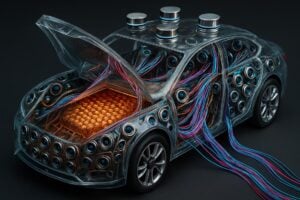
Backed by a new AI-focused automotive alliance, the upcoming tensor robocar is positioned as a next-generation personal vehicle with advanced autonomous capabilities.
Tensor and Arm sign multi-year deal for AI-first robocar
American AI company Tensor has signed a multi-year agreement with Arm to co-develop the compute architecture for what both companies describe as the first personal robocar powered by agentic AI. The project targets commercial deployment in the US, Europe, and the Middle East by 2026.
Under the deal, Tensor will deploy the Arm compute platform across each vehicle to manage AI workloads end to end. Moreover, the company plans to integrate more than 400 Arm-based cores per robocar to support intensive perception, planning, and control tasks.
The partners state that the vehicle will support Level 4 autonomous driving features, enabling high automation within defined operational domains. However, full rollout will depend on regulatory approvals and infrastructure readiness in each target region.
Integrated autonomy stack and dense sensor suite
Both companies emphasize that the robocar will use an integrated autonomy stack tightly coupled with an extensive sensor suite. This design aims to give the vehicle robust situational awareness in complex urban and highway environments.
The sensor package includes 37 cameras, five lidars, 11 radars, 22 microphones, ten ultrasonic sensors, and three inertial measurement units (IMUs). Moreover, it incorporates GNSS capability for precise positioning, 16 collision detectors, eight water-level detectors, four tyre pressure monitors, a smoke detector, and triple-channel 5G connectivity for data and cloud links.
According to the companies, this configuration is designed to support Level 4 autonomy by providing redundant sensing and communication paths. That said, performance in real-world traffic will ultimately define how quickly large-scale deployment can proceed.
Arm-based compute architecture at the core
Tensor is building its vehicle architecture around AI from inception instead of retrofitting existing automotive platforms. This AI-centric approach is meant to optimize compute density, energy efficiency, and safety for a fully digital chassis.
The Arm compute platform distributes safety-capable intelligence throughout the vehicle, from onboard supercomputing units down to individual sensors. Moreover, the vehicles will incorporate 433 Arm-based cores using multiple Arm architectures tuned to specific tasks.
The compute stack includes Neoverse AE cores for AI processing and high-performance workloads, Cortex-X for cabin control and system management, Cortex-A for drive-by-wire and general computation, Cortex-R for safety-critical real-time systems, and Cortex-M for power-efficient subsystem control.
These elements will operate alongside NVIDIA technology to support Tensor‘s proprietary autonomy stack. However, the companies have not yet disclosed detailed benchmarks or per-vehicle compute throughput figures.
Industry reactions and supplier ecosystem
Drew Henry, EVP of the Arm Physical AI Business Unit, said the collaboration showcases how Arm’s hardware and software ecosystem can enable new physical AI applications at scale. His comments highlight both toolchain maturity and safety certification as key differentiators.
Henry noted that the tensor robocar exemplifies how a clear vision, combined with engineering rigor, can bring advanced autonomy to market. Moreover, he positioned the project as a proof point for Arm’s role in future mobility infrastructure.
To support production and operations, Tensor and Arm have also formed collaborations with a wide range of automotive hardware and cloud computing suppliers. Named partners include Autoliv, ZF, Continental, NVIDIA, AMD, Qualcomm, Samsung, and Oracle, covering components from safety systems to compute and data services.
Roadmap to 2026 global launch
Tensor plans a global personal robocar launch in 2026, positioning the fleet as a cornerstone of its strategy for next-generation mobility. However, timing and scale will depend on industrialization, regulatory clearances, and market adoption across its target regions.
Tensor COO Dr Jewel Li said the tensor robocar will move from advanced technology to real-world roads safely and reliably, thanks to Arm’s decades-long expertise in AI-capable compute and the broader ecosystem of strategic partners. Moreover, the company frames this program as a template for future connected and autonomous vehicle platforms.
In summary, the Tensor Arm partnership combines dense sensing, high-performance compute, and an AI-first design philosophy to deliver a highly automated personal vehicle. If the roadmap holds, the project could become a prominent reference case for agentic AI in consumer-grade mobility from 2026 onward.


You May Also Like

UNI Price Prediction: $3.80 Target Within 10 Days as Whales Stack Against Retail Euphoria

MATIC Price Prediction: Dead Cat Bounce Exhaustion Signals 65% Crash to $0.13 by June




