We show that one can simultaneously achieve strong secrecy and strong privacy, i.e., the conditional mutual information terms in (2) and (3), respectively, are negligible, by using a large private key K. The lossy secure and and private source coding region RD is characterized below; see Section V for its proof. We next take the liberty to use the lossy rate region in Corollary 1, characterized for discrete memoryless channels, for the model in (29)-(31)We show that one can simultaneously achieve strong secrecy and strong privacy, i.e., the conditional mutual information terms in (2) and (3), respectively, are negligible, by using a large private key K. The lossy secure and and private source coding region RD is characterized below; see Section V for its proof. We next take the liberty to use the lossy rate region in Corollary 1, characterized for discrete memoryless channels, for the model in (29)-(31)

Can Coding Be Both Lossless and Private?

Abstract and I. Introduction

II. System Model

III. Secure and Private Source Coding Regions

IV. Gaussian Sources and Channels

V. Proof for Theorem 1

Acknowledgment and References

III. SECURE AND PRIVATE SOURCE CODING REGIONS

A. Lossy Source Coding

\ The lossy secure and and private source coding region RD is characterized below; see Section V for its proof.

\
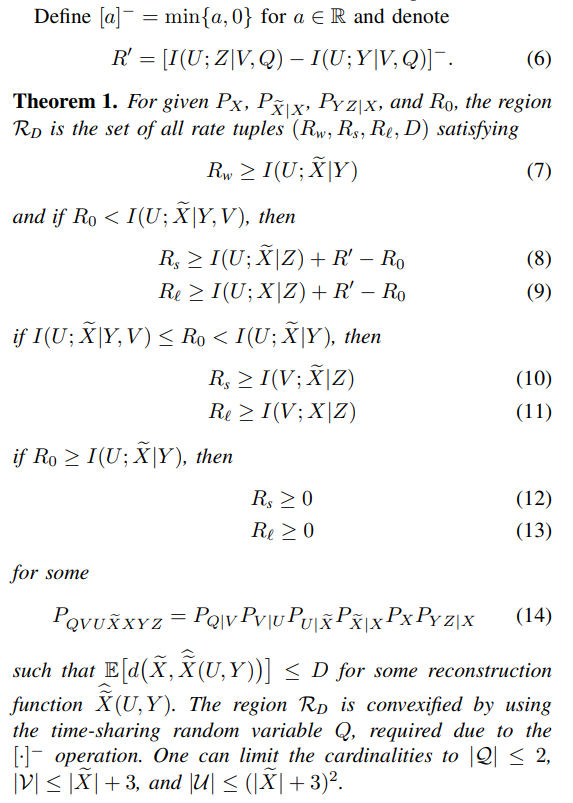
\ We remark that (12) and (13) show that one can simultaneously achieve strong secrecy and strong privacy, i.e., the conditional mutual information terms in (2) and (3), respectively, are negligible, by using a large private key K, which is a result missing in some recent works on secure source coding with private key.

\ B. Lossless Source Coding

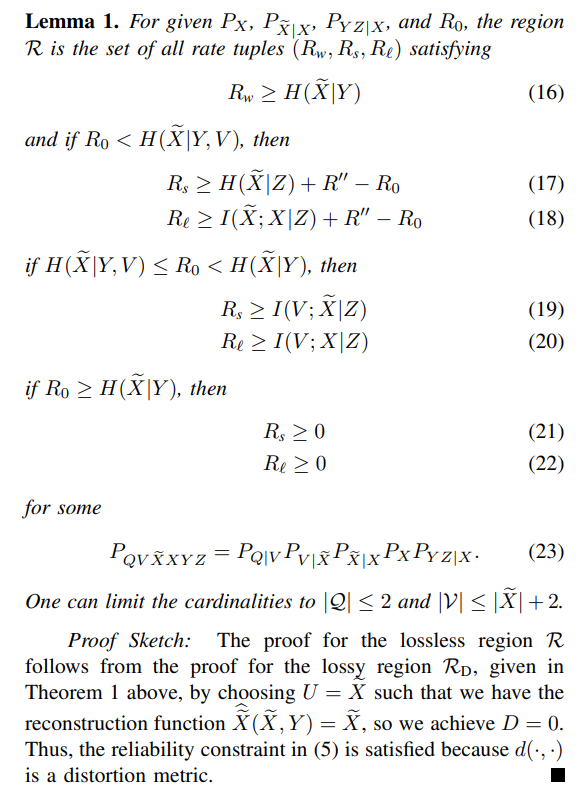
\ The lossless secure and and private source coding region R is characterized next; see below for a proof sketch.

\ Denote

\

\
\

IV. GAUSSIAN SOURCES AND CHANNELS
\
\ Suppose the following scalar discrete-time Gaussian source and channel model for the lossy source coding problem depicted in Fig.

\
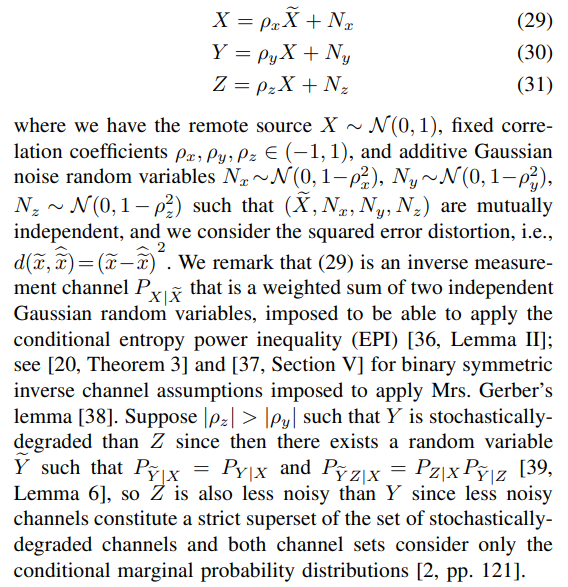
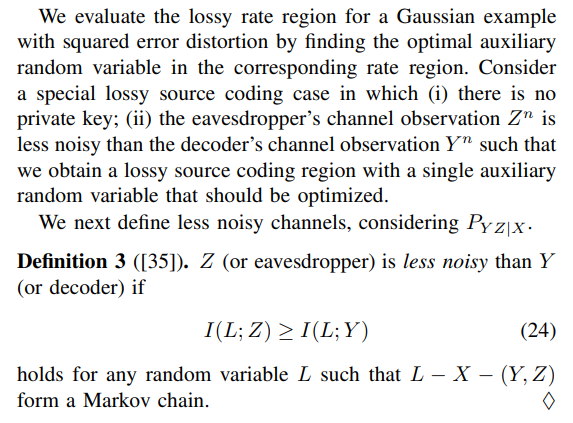
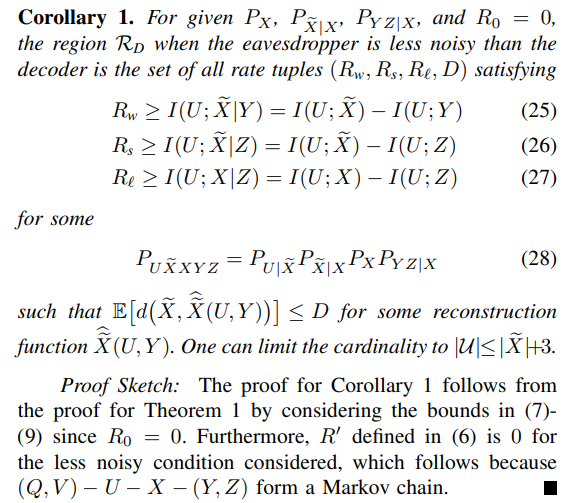
\ We next take the liberty to use the lossy rate region in Corollary 1, characterized for discrete memoryless channels, for the model in (29)-(31). This is common in the literature since there is a discretization procedure to extend the achievability proof to well-behaved continuous-alphabet random variables and the converse proof applies to arbitrary random variables; see [2, Remark 3.8]. For Gaussian sources and channels, we use differential entropy and eliminate the cardinality bound on the auxiliary random variable. The lossy source coding region for the model in (29)-(31) without a private key is given below.

\
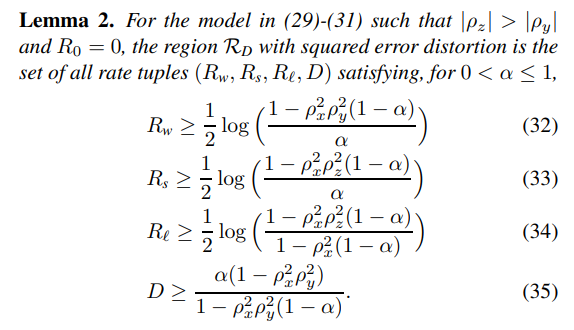
\
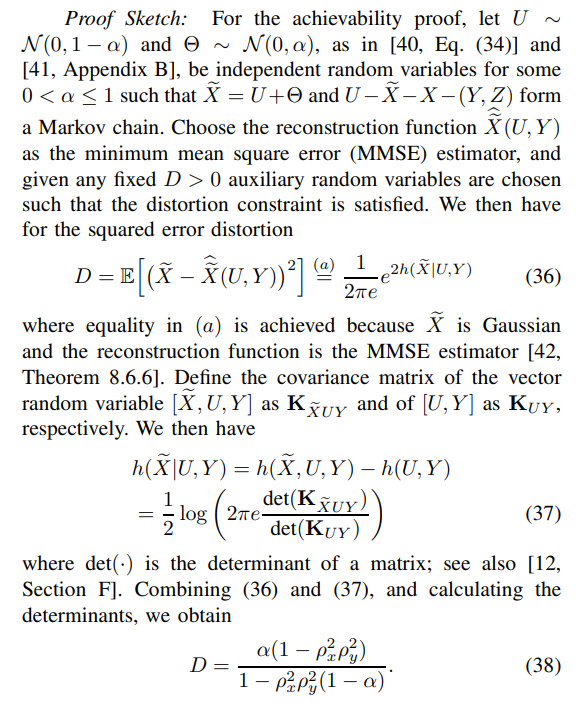
\ One can also show that

\
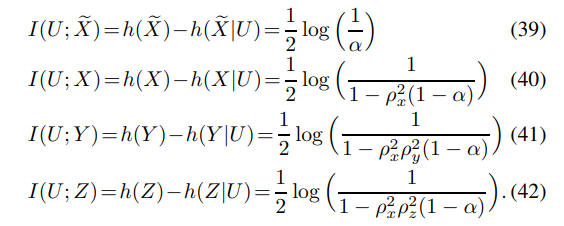
\ Thus, by calculating (25)-(27), the achievability proof follows.

\ For the converse proof, one can first show that

\
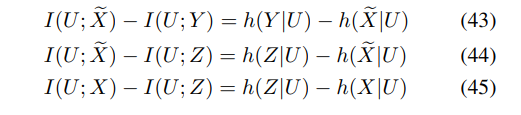
\
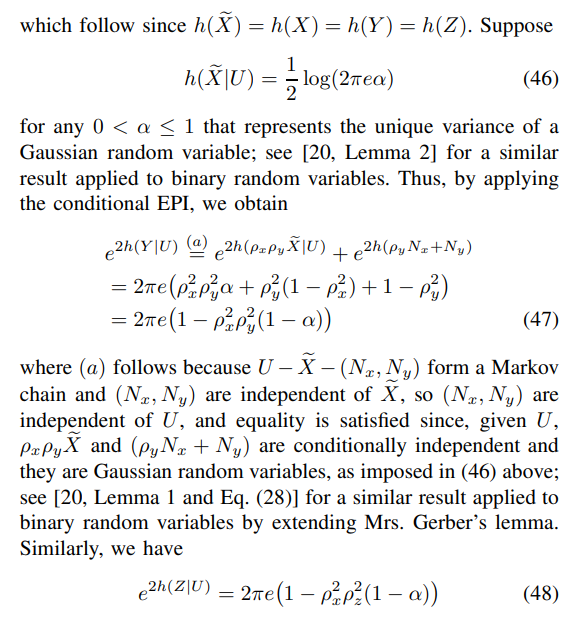
\
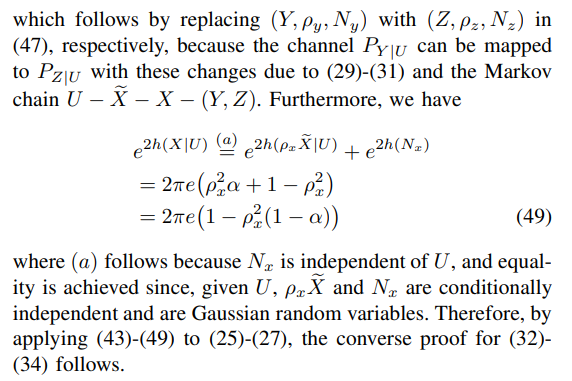
\ Next, consider

\
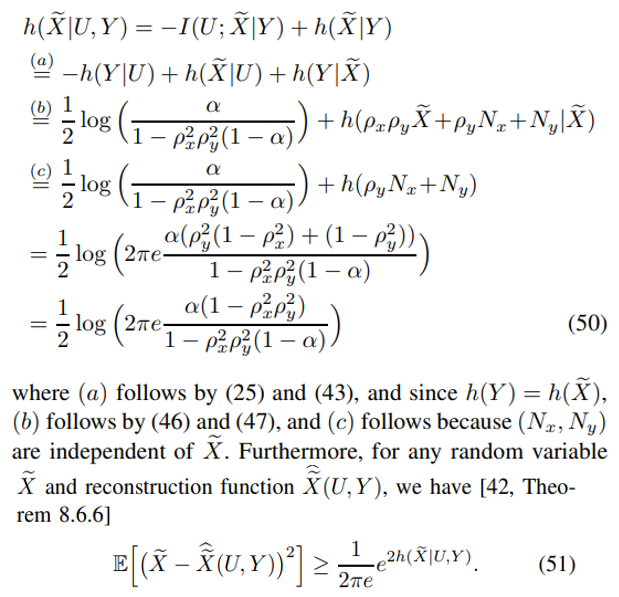
\ Combining the distortion constraint given in Corollary 1 with (50) and (51), the converse proof for (35) follows.

\ \

:::info Authors:

(1) Onur Gunlu, Chair of Communications Engineering and Security, University of Siegen and Information Coding Division, Department of Electrical Engineering, Linkoping University (onur.guenlue@uni-siegen.de);

(2) Rafael F. Schaefer, Chair of Communications Engineering and Security, University of Siegen (rafael.schaefer@uni-siegen.de);

(3) Holger Boche, Chair of Theoretical Information Technology, Technical University of Munich, CASA: Cyber Security in the Age of Large-Scale Adversaries Exzellenzcluster, Ruhr-Universitat Bochum, and BMBF Research Hub 6G-Life, Technical University of Munich (boche@tum.de);

(4) H. Vincent Poor, Department of Electrical and Computer Engineering, Princeton University (poor@princeton.edu).

:::


:::info This paper is available on arxiv under CC BY 4.0 DEED license.

:::

\

Market Opportunity
Sidekick Logo
Sidekick Price(K)
$0,00621
$0,00621$0,00621
-4,69%
USD
Sidekick (K) Live Price Chart
Disclaimer: The articles reposted on this site are sourced from public platforms and are provided for informational purposes only. They do not necessarily reflect the views of MEXC. All rights remain with the original authors. If you believe any content infringes on third-party rights, please contact service@support.mexc.com for removal. MEXC makes no guarantees regarding the accuracy, completeness, or timeliness of the content and is not responsible for any actions taken based on the information provided. The content does not constitute financial, legal, or other professional advice, nor should it be considered a recommendation or endorsement by MEXC.

You May Also Like

Gold hits yet another new all-time high of $4,740 as Bitcoin crashes to $91,000

Gold hits yet another new all-time high of $4,740 as Bitcoin crashes to $91,000

The post Gold hits yet another new all-time high of $4,740 as Bitcoin crashes to $91,000 appeared on BitcoinEthereumNews.com. Gold futures pushed to a new all time
Share
BitcoinEthereumNews2026/01/20 14:04
CLARITY Act Gains Support as Bitcoin Policy Momentum Builds

CLARITY Act Gains Support as Bitcoin Policy Momentum Builds

The post CLARITY Act Gains Support as Bitcoin Policy Momentum Builds appeared on BitcoinEthereumNews.com. The crypto regulation in the United States has gained momentum ahead of midterm elections in 2026. Satoshi Action Fund CEO has promised a massive Bitcoin announcement that may change crypto adoption optics. The Clarity Act has already received minimum required support from the Democratic Senators. Crypto regulation in the U.S. is picking up speed heading into the 2026 midterms. The Satoshi Action Fund, led by Dennis Porter, has ramped up lobbying efforts in Washington D.C., pushing lawmakers to prioritize the CLARITY Act. Porter also teased that a “massive” Bitcoin announcement is coming next week; one he claims could change the trajectory of Bitcoin adoption in the U.S.  Industry voices are urging traders to watch closely. Benjamin Aaron Semchee, chairman of Averliz, told followers that Porter’s call deserves attention, underscoring how policy shifts could hit markets fast. What Crypto Regulations Are Expected from Washington D.C? Building on the GENIUS Act The U.S. lawmakers came together from both major parties to pass the GENIUS Act, which focuses on stablecoins as a form of payment.  With the country’s labor data having revealed weakness, lawmakers are now more keen than ever to tap into the emerging technologies to create new and higher paying jobs. Bipartisan Push for the CLARITY Act Momentum is now behind the CLARITY Act, which aims to overhaul crypto market structure rules. On Friday, 12 Democratic Senators, led by Senator Ruben Gallego, reaffirmed their intent to work across the aisle. “We hope our Republican colleagues will agree to a bipartisan authorship process, as is the norm for legislation of this scale. Given our shared interest in moving forward quickly on this issue, we hope they will agree to reasonable requests to allow for true collaboration,” the Dem Senators noted. Related: Ray Dalio Warns of US ‘Economic Heart Attack’ From Debt, Sees…
Share
BitcoinEthereumNews2025/09/20 21:02
Goddess of Wealth Jailed for $7.2 Billion Crypto Scam Targeting Thousands

Goddess of Wealth Jailed for $7.2 Billion Crypto Scam Targeting Thousands

Zhimin Qian jailed in UK for $7.2B crypto scam targeting 128,000 victims; 61,000 Bitcoin seized in record-breaking operation. Zhimin Qian, also known as Yadi Zhang
Share
LiveBitcoinNews2026/01/20 14:00