Institutional capital has transformed the cryptocurrency market dynamics, changing who participates and how digital assets are traded. The arrival of spot exchangeInstitutional capital has transformed the cryptocurrency market dynamics, changing who participates and how digital assets are traded. The arrival of spot exchange

Are Institutions Killing Bitcoin And Ethereum? Here’s How They’ve Fared Since Companies Got Involved

2026/02/28 06:00
3 min read

Institutional capital has transformed the cryptocurrency market dynamics, changing who participates and how digital assets are traded. The arrival of spot exchange-traded funds, corporate treasury allocations, and access through major brokerage platforms has pulled Bitcoin and Ethereum deeper into traditional finance.

Vanguard, for instance, reversed its long-held anti-crypto stance just a few months ago, allowing trading in funds that hold Bitcoin, Ethereum, XRP, and Solana. However, talking about bad timing, these cryptocurrencies have struggled in the months following that policy change.

Challenging Months For Institutional Investors

The entrance of major asset managers such as BlackRock and Fidelity Investments was a structural turning point for Bitcoin. The January 2024 launch of Spot Bitcoin ETFs in the United States opened the door for pension funds, registered investment advisors, and other conservative capital pools to gain exposure without directly holding Bitcoin. These ETFs have accumulated billions of dollars in inflows, with custodians now holding a meaningful share of Bitcoin’s circulating supply.

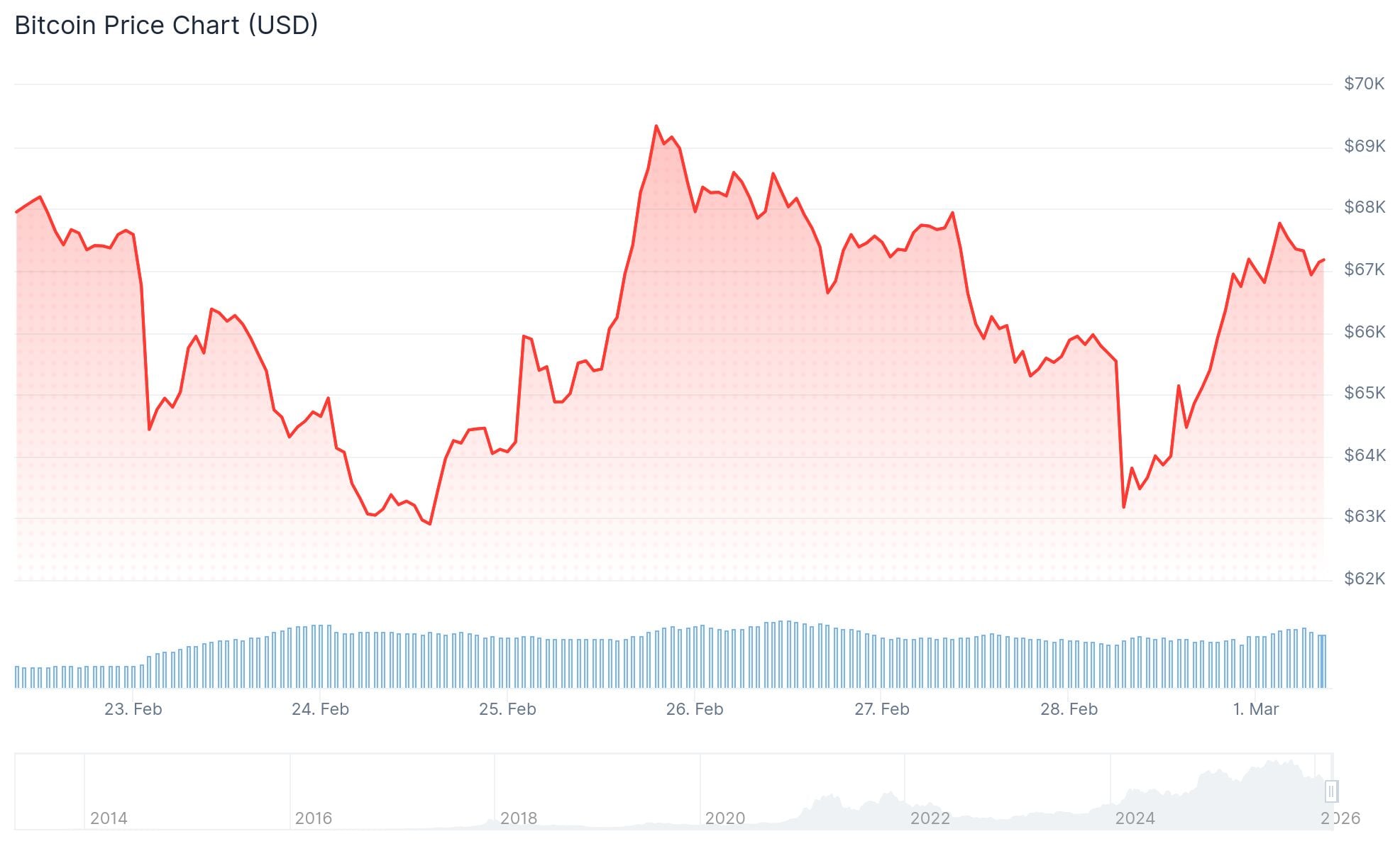
However, the past few months have been really challenging for investors. Notably, the last month of inflows into Spot Bitcoin ETFs was in October 2025, when it was pushing to new all-time highs above $126,000. Since then, it has been months of net outflows, and this has weighed down on Bitcoin’s price action. Same goes for Spot Ethereum ETFs, which recorded consecutive months of outflows since November 2025.

Vanguard clients are likely among those feeling the impact most directly. In December 2025, US-based investment management company Vanguard reversed its anti-crypto stance and started allowing trading of ETFs and mutual funds that hold Bitcoin, Ethereum, XRP, and Solana. 

The availability of these crypto products on a major mainstream brokerage like Vanguard was a milestone for crypto investing. Vanguard manages over $12 trillion in assets and serves tens of millions of investors. Unsurprisingly, the price action of Bitcoin and other top cryptocurrencies initially reacted positively to the Vanguard news.

However, the timing coincided with a downturn across the entire crypto market, which has been having a red 2026 so far. Since Vanguard’s rollout, Bitcoin’s price has fallen by about 30%, while Ethereum, Solana, and XRP have fallen by about 40% in the same period.

Is Institutional Involvement A Threat Or A Sign Of Maturity?

It is clear that institutional entry has not erased the volatile nature of crypto markets. Bitcoin and Ethereum are still subject to swings in investor risk appetite, although this is now at a larger scale. Therefore, the question of whether institutions are killing Bitcoin and Ethereum is based on perspective. 

The presence of regulated ETFs means that downturns are now absorbed by a wider set of market participants. Companies like BitMine and Strategy are still in the business of huge purchases. New investor bases like this can help sustain prices over time. 

However, one thing is clear: cryptocurrencies like Bitcoin, Ethereum, XRP, and Solana are no longer fringe assets operating outside the traditional investment system; they now sit within it. This integration will even become more clear once the CLARITY Act is passed in the US.

Bitcoin
Market Opportunity
XRP Logo
XRP Price(XRP)
$1.388
$1.388$1.388
+4.84%
USD
XRP (XRP) Live Price Chart
Disclaimer: The articles reposted on this site are sourced from public platforms and are provided for informational purposes only. They do not necessarily reflect the views of MEXC. All rights remain with the original authors. If you believe any content infringes on third-party rights, please contact crypto.news@mexc.com for removal. MEXC makes no guarantees regarding the accuracy, completeness, or timeliness of the content and is not responsible for any actions taken based on the information provided. The content does not constitute financial, legal, or other professional advice, nor should it be considered a recommendation or endorsement by MEXC.
Tags:

You May Also Like

The Channel Factories We’ve Been Waiting For
The Channel Factories We’ve Been Waiting For

The post The Channel Factories We’ve Been Waiting For appeared on BitcoinEthereumNews.com. Visions of future technology are often prescient about the broad strokes while flubbing the details. The tablets in “2001: A Space Odyssey” do indeed look like iPads, but you never see the astronauts paying for subscriptions or wasting hours on Candy Crush.  Channel factories are one vision that arose early in the history of the Lightning Network to address some challenges that Lightning has faced from the beginning. Despite having grown to become Bitcoin’s most successful layer-2 scaling solution, with instant and low-fee payments, Lightning’s scale is limited by its reliance on payment channels. Although Lightning shifts most transactions off-chain, each payment channel still requires an on-chain transaction to open and (usually) another to close. As adoption grows, pressure on the blockchain grows with it. The need for a more scalable approach to managing channels is clear. Channel factories were supposed to meet this need, but where are they? In 2025, subnetworks are emerging that revive the impetus of channel factories with some new details that vastly increase their potential. They are natively interoperable with Lightning and achieve greater scale by allowing a group of participants to open a shared multisig UTXO and create multiple bilateral channels, which reduces the number of on-chain transactions and improves capital efficiency. Achieving greater scale by reducing complexity, Ark and Spark perform the same function as traditional channel factories with new designs and additional capabilities based on shared UTXOs.  Channel Factories 101 Channel factories have been around since the inception of Lightning. A factory is a multiparty contract where multiple users (not just two, as in a Dryja-Poon channel) cooperatively lock funds in a single multisig UTXO. They can open, close and update channels off-chain without updating the blockchain for each operation. Only when participants leave or the factory dissolves is an on-chain transaction…
Share
BitcoinEthereumNews2025/09/18 00:09
Top 5 Cryptocurrencies for Long-Term Investment in 2026: Expert Analysis

Top 5 Cryptocurrencies for Long-Term Investment in 2026: Expert Analysis

Discover the top 5 cryptocurrencies for long-term investment in 2026. Bitcoin, Ethereum, Solana, Chainlink, and Avalanche lead with institutional backing. The post
Share
Blockonomi2026/03/01 19:48
Tindig Pilipinas backs clergy’s complaint to fast-track Sara Duterte impeachment

Tindig Pilipinas backs clergy’s complaint to fast-track Sara Duterte impeachment

'Consolidating our support behind the third complaint will strengthen our position and help move the case forward to the Senate impeachment court,' Tindig Pilipinas
Share
Rappler2026/03/01 19:47