Bitcoin core developer Matt Corallo used a fresh Blockstream announcement this week to push back on a familiar line in the quantum debate: that nobody serious isBitcoin core developer Matt Corallo used a fresh Blockstream announcement this week to push back on a familiar line in the quantum debate: that nobody serious is

New Bitcoin Post-Quantum Work Undercuts ‘No One Is Building’ Claims

2026/02/28 03:00
4 min read

Bitcoin core developer Matt Corallo used a fresh Blockstream announcement this week to push back on a familiar line in the quantum debate: that nobody serious is working on post-quantum cryptography for Bitcoin. The immediate trigger was Blockstream’s preview of OP_SHRINCSVERIFY, but the broader point was that the work did not appear out of nowhere; it sits on top of research that has already been published and debated in public.

Bitcoin’s Post-Quantum Critics Are Wrong

Corallo’s post was blunt: “And the Bitcoin fudsters keep trying to claim no one is working on PQC in Bitcoin…” Blockstream, in turn, framed Jonas Nick’s upcoming talk at OPNEXT 2026 (on April 16, 2026) around a specific technical artifact rather than a vague promise, saying, “He’ll be presenting on OP_SHRINCSVERIFY.” It described the proposal as “a new opcode enabling SHRINCS,” a construction aimed at 324-byte stateful post-quantum signatures with static backups.

The event lineup itself also reinforces Corallo’s point. Quantum is not a one-off mention tied only to Jonas Nick’s OP_SHRINCSVERIFY session. The main stage schedule also includes Alex Pruden of Project 11 speaking on “Quantum Bitcoin,” and later a “Quantum/Investor fireside” featuring Robert Mitchnick of BlackRock and David Duong of Coinbase.

In other words, post-quantum risk and the response to it are showing up repeatedly across both the technical and institutional sides of the program.
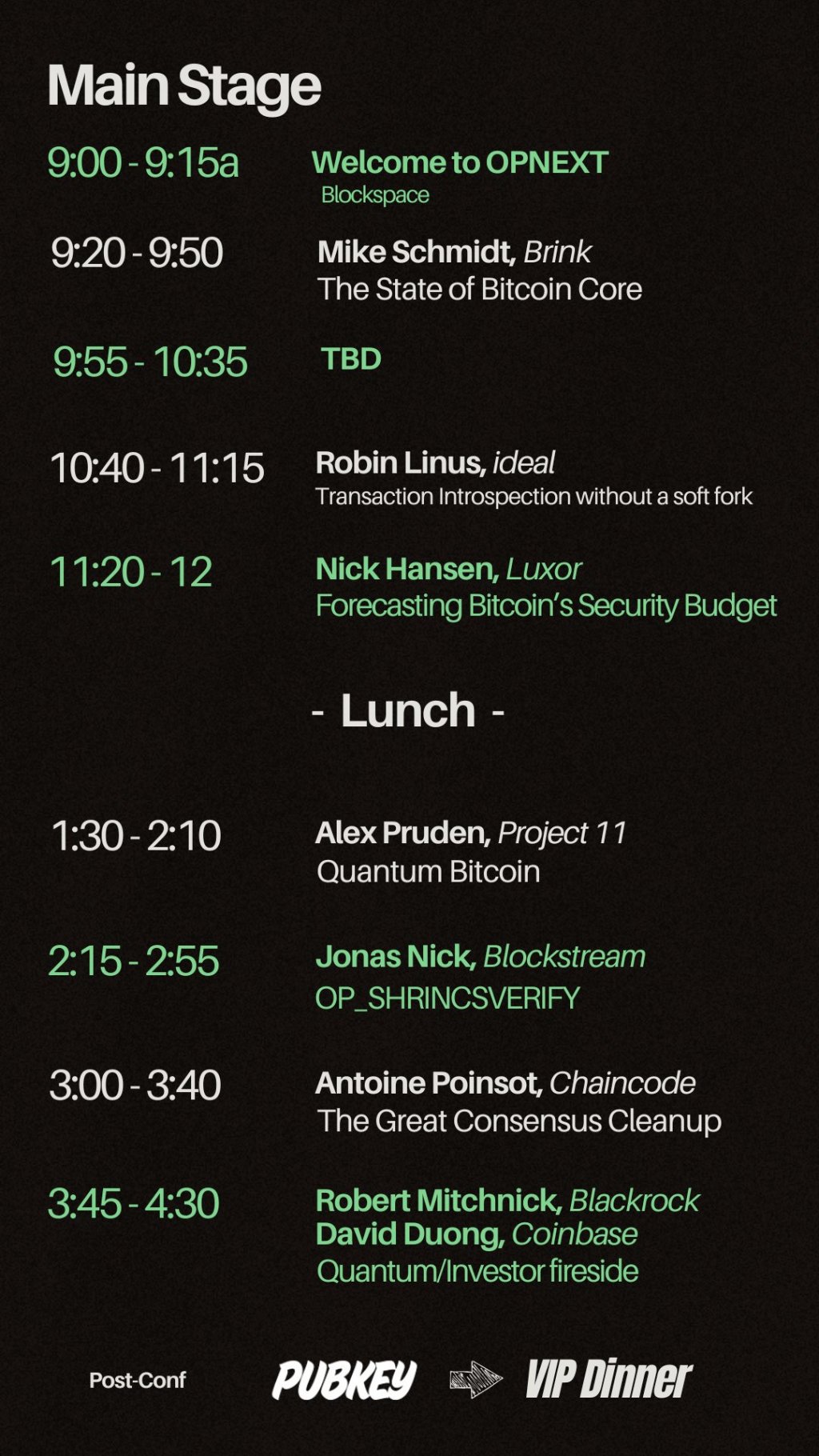
OPNEXT 2026

The subtext was hard to miss: whatever one thinks about Bitcoin’s quantum timetable, the claim that the problem is being ignored is increasingly difficult to sustain.

What SHRINCS Actually Is

Nick laid out SHRINCS in a December post on Delving Bitcoin as a hybrid hash-based signature design that combines a stateless scheme such as SPHINCS+ with a stateful scheme based on unbalanced XMSS. The design goal is to get the efficiency benefits of stateful signing when wallet state is intact, while keeping a stateless fallback available if that state is lost or a backup has to be restored.

In Nick’s words, the scheme is “extremely efficient when only a few signatures are required” and “can be backed up with a static seed.” Bitcoin Optech later summarized the same trade-off more plainly: cheaper normal-path signing, heavier fallback signing when state integrity is in doubt.

That efficiency claim is where the proposal gets interesting for BTC. Nick wrote that the normal-path SHRINCS signature size is min(292 + q·16, s_l) + 16, where q is the number of signatures already produced through the stateful path. For q = 1, that yields the now-circulating 324-byte figure, which he said is more than 11x smaller than the smallest NIST-standardized alternative, ML-DSA, in that setting.

The earlier paper by Nick and Mikhail Kudinov made the broader case for hash-based signatures in Bitcoin, arguing that they are attractive post-quantum candidates because their security reduces to hash assumptions, while keeping public keys small and verification cost per byte within a workable range.

None of that means Bitcoin suddenly has a settled post-quantum roadmap. Nick’s Delving post explicitly invited feedback, and the December mailing-list discussion raised unresolved questions about hardware performance, signature limits, wallet design, and whether Bitcoin should standardize stateful schemes alongside stateless ones. Bitcoin Optech also covered SHRINCS as part of ongoing consensus-change discussion, not as an adopted upgrade.

That is why Corallo’s jab matters. The more precise framing is not that BTC has solved post-quantum cryptography, but that the engineering work is already underway in public view, with concrete proposals, concrete trade-offs, and increasingly concrete opcodes attached to them.

For a debate that often swings between complacency and panic, OP_SHRINCSVERIFY is evidence of something more grounded: Bitcoin’s post-quantum discussion is no longer theoretical hand-waving, even if it is still very much a research problem.

At press time, BTC traded at $66,630.
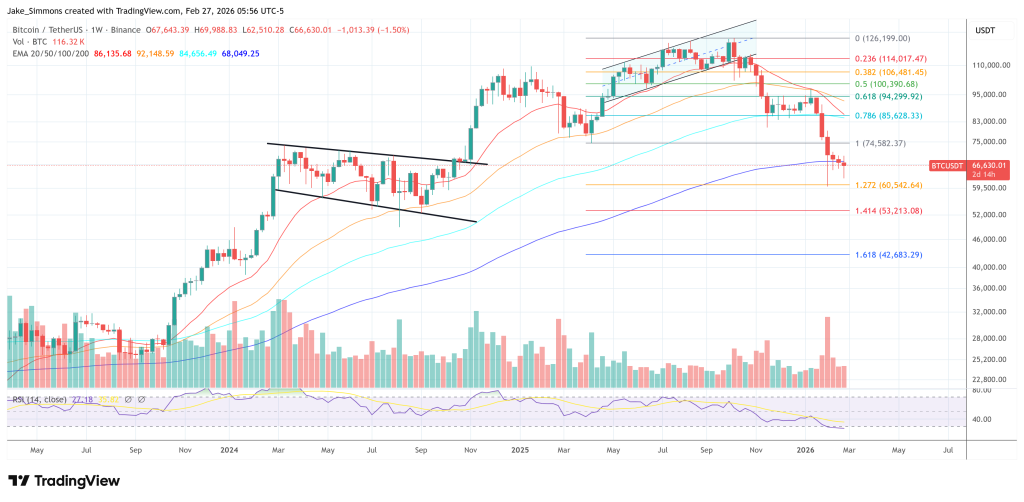
Bitcoin price chart
Market Opportunity
QUANTUM Logo
QUANTUM Price(QUANTUM)
$0.002819
$0.002819$0.002819
-0.94%
USD
QUANTUM (QUANTUM) Live Price Chart
Disclaimer: The articles reposted on this site are sourced from public platforms and are provided for informational purposes only. They do not necessarily reflect the views of MEXC. All rights remain with the original authors. If you believe any content infringes on third-party rights, please contact crypto.news@mexc.com for removal. MEXC makes no guarantees regarding the accuracy, completeness, or timeliness of the content and is not responsible for any actions taken based on the information provided. The content does not constitute financial, legal, or other professional advice, nor should it be considered a recommendation or endorsement by MEXC.
Tags:

You May Also Like

Regulatory Clarity Could Drive 40% of Americans to Adopt DeFi Protocols, Survey Shows
Regulatory Clarity Could Drive 40% of Americans to Adopt DeFi Protocols, Survey Shows

Over 40% of Americans express willingness to use decentralized finance (DeFi) protocols once regulatory clarity on crypto privacy emerges, according to a recent survey from crypto advocacy organization the DeFi Education Fund (DEF). The survey, released on September 18, revealed that many Americans feel frustrated with traditional financial institutions and seek greater control over their financial assets and data. Respondents believe DeFi innovations can deliver this change by providing affordability, equity, and consumer protection. The survey was conducted with Ipsos on KnowledgePanel and included supplementary in-depth interviews in the Bronx and Queens between August 18 and 21, polling 1,321 US adults. Survey Results Show Americans Ready to Adopt DeFi Protocols The findings demonstrate that many Americans are curious about DeFi despite its early stage. 42% of Americans indicated they would likely try DeFi if proposed legislation becomes law (9% extremely/very likely and 33% somewhat likely). 84% said they would use it to “make purchases online,” while 78% would use it to “pay bills.” According to the survey, 77% would use DeFi protocols to “save money,” and 12% of Americans are “extremely” and “very” interested in learning about DeFi. Moreover, nearly 4 in 10 Americans believe that DeFi can address high transaction and service fees found in traditional finance (39%). Consistent with other probability-based sample surveys, the Ipsos x DEF research shows that almost 1 in 5 Americans (18%) have owned or used crypto at some point in their lifetime. Nearly a quarter of Americans (22%) said they’re interested in learning more about nontraditional forms of finance, such as blockchain, crypto, or decentralized finance.Source: DEF The research shows that more than half (56%) of Americans want to reclaim control of their finances. Americans are interested in having control over their money at all times, and many seek ways to send or receive money without intermediaries. One Bronx, NY resident shared his experience of needing to transfer money between accounts, but the bank required him to certify the transfer and visit in person because he couldn’t move the amount he needed remotely. He expressed frustration about the situation because “it was my money… I didn’t understand why I was given a hard time.“ More than half of surveyed Americans agree there should be a way to digitally send money to people without third-party involvement, and this number rises notably for foreign-born Americans (66%). The researchers concluded that Americans are interested in DeFi and believe DeFi can reduce friction points in today’s financial system. Regulatory Developments on DeFi Adoption in the U.S Last month, DeFi Education Fund called on the US Senate Banking Committee to rethink how it plans to regulate the decentralized finance industry after reviewing its recently published discussion draft on a key crypto market-structure bill. The response, signed on behalf of DeFi Education Fund (DEF) members including a16z Crypto, Uniswap Labs, and Paradigm, argued the Responsible Financial Innovation Act of 2025 (RFA) bill should be crafted in a more tech-neutral manner. The group also emphasized that crypto developers should be protected from “inappropriate regulation meant for intermediaries,” and that self-custody rights for all Americans are “essential.” The banking committee is now working on the discussion draft to help ensure it builds on the Digital Asset Market Clarity Act of 2025. The goal is to promote innovation in the $162 billion DeFi industry without compromising consumer protections or financial stability. On September 5, US Federal Reserve Governor Christopher Waller said there was “nothing to be afraid of” about crypto payments operating outside the traditional banking system. This statement has raised hopes among many that DeFi would soon become the new financial infrastructure for Americans and the world
Share
CryptoNews2025/09/18 21:29
MYX Finance price surges again as funding rate points to a crash

MYX Finance price surges again as funding rate points to a crash

MYX Finance price went parabolic again as the recent short-squeeze resumed. However, the formation of a double-top pattern and the funding rate point to an eventual crash in the coming days. MYX Finance (MYX) came in the spotlight earlier this…
Share
Crypto.news2025/09/18 02:57
US Pentagon chief orders Anthropic retaliation designation and lays out the ban

US Pentagon chief orders Anthropic retaliation designation and lays out the ban

Anthropic is now tagged as a Supply-Chain Risk to National Security by the Department of War, according to U.S. Defense Secretary Pete Hegseth, who posted a long
Share
Cryptopolitan2026/02/28 13:20
