Tether's dominance is falling, as competitors and regulatory pressure threaten its position.Tether's dominance is falling, as competitors and regulatory pressure threaten its position.

Tether’s grip on stablecoins slips below 60% for first time since 2023

USDT dominance is eroding as Circle and other stablecoin competitors fight for a share of the pie.

Summary
  • USDT dominance fell below 60% for the first time since 2023
  • Circle’s USDC is its primary competitor, nearing 30% dominance
  • The passage of the US GENIUS Act is making the market more competitive

Competition among stablecoin issuers is growing. On Friday, August 29, USDT dominance fell to 59.45%, according to data from DeFiLlama. This was the first time the key figure fell to these levels since March 2023, indicating that Tether may be losing its grip on the market.
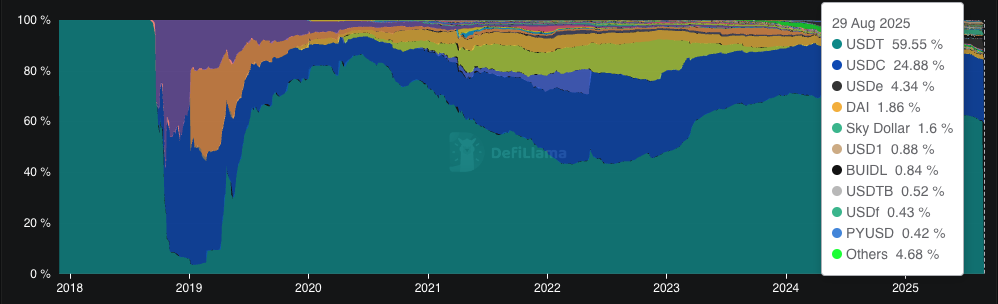
Stablecoins by dominance since 2018

Notably, in the first half of 2024, USDT dominance hovered around 70%. At the same time, Tether’s main competitor, Circle’s USDC, controlled just 18% of the market, a figure which is now close to 30%. On the other hand, DAI’s dominance fell in that period, from around 3.5% to its current level of 1.86%.

One standout performer this year is Ethena’s USDe. Launched in December 2024, already reached 4.34% in dominance and a market cap of $12.275 billion. On the other hand, Trump World Liberty Financial’s USD1 controls 0.88% of the market.

Tether faces regulatory issues in Europe, the U.S.

Tether is not just facing increased competition. With more countries issuing stricter rules on stablecoins, its USDT is at a disadvantage. So far, Tether has declined to comply with Europe’s MiCA stablecoin framework, leading to its delisting on major exchanges.
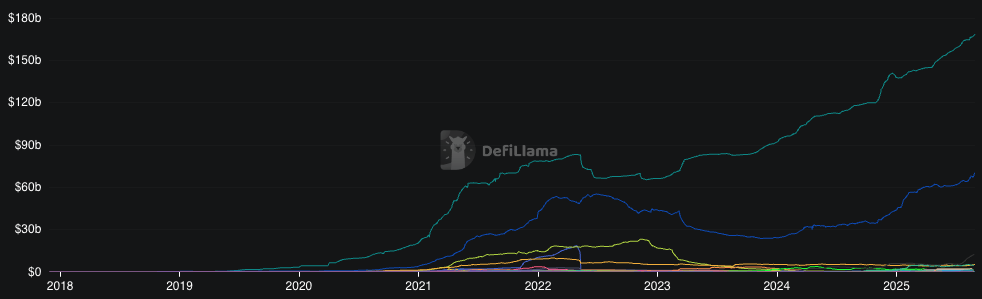
Top stablecoins by market cap

Tether may soon face the same issue in the United States, which recently passed the GENIUS Act, which requires more transparency from stablecoin issuers. Still, despite a shift in market positioning, major players, including Tether, are on the rise. Both USDT and USDC are at record levels, at $168.43 billion and $70.378 billion, respectively.

Disclosure: This article does not represent investment advice. The content and materials featured on this page are for educational purposes only.


Disclaimer: The articles reposted on this site are sourced from public platforms and are provided for informational purposes only. They do not necessarily reflect the views of MEXC. All rights remain with the original authors. If you believe any content infringes on third-party rights, please contact service@support.mexc.com for removal. MEXC makes no guarantees regarding the accuracy, completeness, or timeliness of the content and is not responsible for any actions taken based on the information provided. The content does not constitute financial, legal, or other professional advice, nor should it be considered a recommendation or endorsement by MEXC.

You May Also Like

X to cut off InfoFi crypto projects from accessing its API

X to cut off InfoFi crypto projects from accessing its API

X, the most widely used app for crypto projects, is changing its API access policy. InfoFi projects, which proliferated non-organic bot content, will be cut off
Share
Cryptopolitan2026/01/16 02:50
X Just Killed Kaito and InfoFi Crypto, Several Tokens Crash

X Just Killed Kaito and InfoFi Crypto, Several Tokens Crash

The post X Just Killed Kaito and InfoFi Crypto, Several Tokens Crash appeared on BitcoinEthereumNews.com. X has revoked API access for apps that reward users for
Share
BitcoinEthereumNews2026/01/16 03:42
China Blocks Nvidia’s RTX Pro 6000D as Local Chips Rise

China Blocks Nvidia’s RTX Pro 6000D as Local Chips Rise

The post China Blocks Nvidia’s RTX Pro 6000D as Local Chips Rise appeared on BitcoinEthereumNews.com. China Blocks Nvidia’s RTX Pro 6000D as Local Chips Rise China’s internet regulator has ordered the country’s biggest technology firms, including Alibaba and ByteDance, to stop purchasing Nvidia’s RTX Pro 6000D GPUs. According to the Financial Times, the move shuts down the last major channel for mass supplies of American chips to the Chinese market. Why Beijing Halted Nvidia Purchases Chinese companies had planned to buy tens of thousands of RTX Pro 6000D accelerators and had already begun testing them in servers. But regulators intervened, halting the purchases and signaling stricter controls than earlier measures placed on Nvidia’s H20 chip. Image: Nvidia An audit compared Huawei and Cambricon processors, along with chips developed by Alibaba and Baidu, against Nvidia’s export-approved products. Regulators concluded that Chinese chips had reached performance levels comparable to the restricted U.S. models. This assessment pushed authorities to advise firms to rely more heavily on domestic processors, further tightening Nvidia’s already limited position in China. China’s Drive Toward Tech Independence The decision highlights Beijing’s focus on import substitution — developing self-sufficient chip production to reduce reliance on U.S. supplies. “The signal is now clear: all attention is focused on building a domestic ecosystem,” said a representative of a leading Chinese tech company. Nvidia had unveiled the RTX Pro 6000D in July 2025 during CEO Jensen Huang’s visit to Beijing, in an attempt to keep a foothold in China after Washington restricted exports of its most advanced chips. But momentum is shifting. Industry sources told the Financial Times that Chinese manufacturers plan to triple AI chip production next year to meet growing demand. They believe “domestic supply will now be sufficient without Nvidia.” What It Means for the Future With Huawei, Cambricon, Alibaba, and Baidu stepping up, China is positioning itself for long-term technological independence. Nvidia, meanwhile, faces…
Share
BitcoinEthereumNews2025/09/18 01:37



