The most ambitious consensus overhaul foe Solana to date—SIMD-0326, nicknamed “Alpenglow”—has officially moved into the community voting window, a three-epoch process that began at the start of Epoch 840 and will conclude at the end of Epoch 842. The proposal rewrites Solana’s core consensus, replacing Proof-of-History plus TowerBFT with a modern architecture centered on a […]The most ambitious consensus overhaul foe Solana to date—SIMD-0326, nicknamed “Alpenglow”—has officially moved into the community voting window, a three-epoch process that began at the start of Epoch 840 and will conclude at the end of Epoch 842. The proposal rewrites Solana’s core consensus, replacing Proof-of-History plus TowerBFT with a modern architecture centered on a […]

Solana Successfully Starts Community Voting Phase On Alpenglow

The most ambitious consensus overhaul foe Solana to date—SIMD-0326, nicknamed “Alpenglow”—has officially moved into the community voting window, a three-epoch process that began at the start of Epoch 840 and will conclude at the end of Epoch 842.

The proposal rewrites Solana’s core consensus, replacing Proof-of-History plus TowerBFT with a modern architecture centered on a direct-vote finality engine (“Votor”). The authors say Alpenglow significantly reduces latency (from 12.8 seconds under TowerBFT to as low as 100–150 milliseconds) while eliminating heavy vote-gossip traffic through off-chain messaging and signature aggregation.

Solana Validators Begin Deciding Future Of Alpenglow

Governance mechanics for SIMD-0326 are unusually explicit. Vote tokens are claimable by validators according to captured stake weights, using a Merkle distributor tool; tokens may be sent to “Yes,” “No,” or “Abstain” accounts. Passage requires a supermajority: the sum of Yes votes is equal to or greater than 2/3 of the total sum of Yes + No votes,” with a quorum of 33% in which abstentions count toward quorum but not toward the Yes/No denominator.

On day one of the window (Epoch 840), early snapshots show modest—but distinctly positive—participation. Multiple market data posts report turnout near 11.5%, with roughly 11.3% of stake signaling “Yes” and negligible “No.” Because the overwhelming share of stake has not yet cast ballots, this should be treated as an initial reading rather than a trend. A public tally dashboard is being maintained by Staking Facilities.
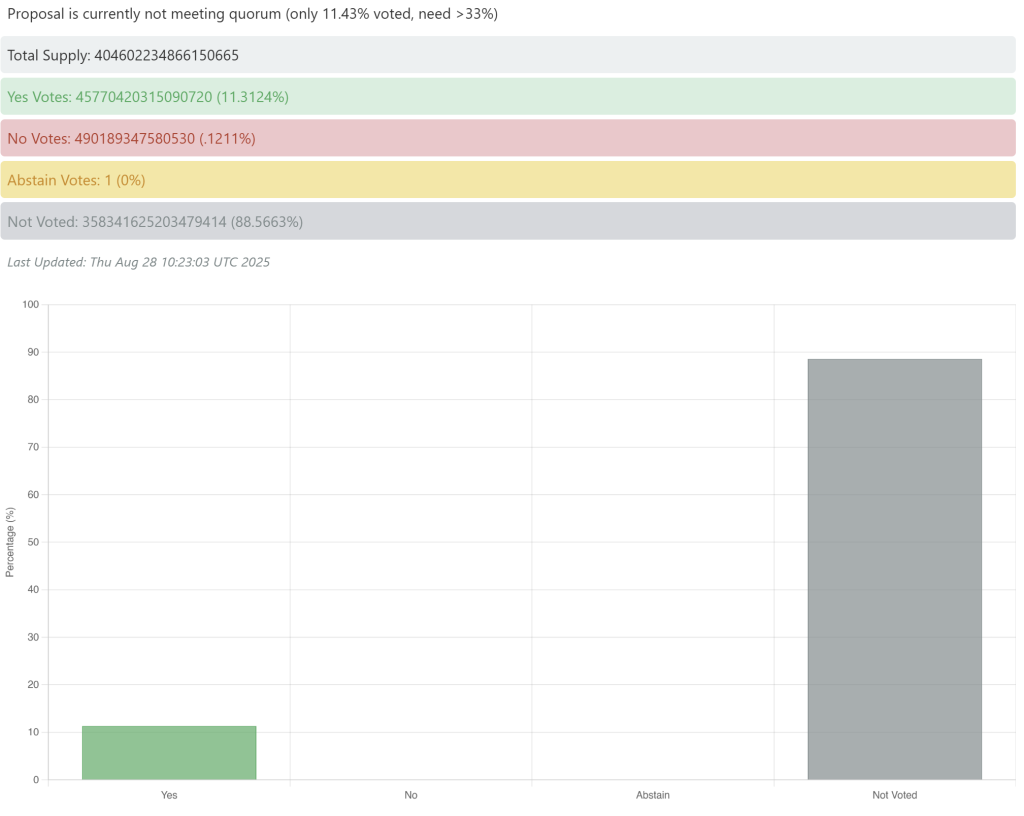
SIMD-0326 vote status

Alpenglow’s design changes go beyond speed. The protocol introduces certificate-based notarization and finalization, aggregates validator votes off-chain to reduce overhead, and rebalances incentives around voting. Notably, the proposal replaces per-slot on-chain vote fees with a fixed “Validator Admission Ticket” (VAT) currently set at 1.6 SOL per epoch and burned—an economic continuity measure intended to keep cost structures comparable to today’s while votes move off-chain.

“Before each epoch, each validator must pay a fixed fee—initially set to 1.6 SOL per epoch,” the authors write, adding that the figure mirrors roughly 80% of current on-chain voting costs. Forum participants have already begun debating whether a flat VAT raises entry barriers for smaller operators, underscoring that the governance discussion is as much about economics as it is about protocol mechanics.

Timing matters for operators and tokenholders following the vote. Solana epochs are approximately two days in length, so a three-epoch voting window implies about six days from start to finish. The network entered Epoch 840 on August 27, 2025, which places the expected end of the voting window around September 2, 2025, when Epoch 842 concludes.

If the supermajority threshold is reached, Alpenglow would clear governance, with subsequent activation depending on client readiness and the standard Solana release process. For now, the focus is on turnout. With ~90% of stake yet to be tallied in the opening snapshot, every validator ballot over the coming epochs will carry outsized weight in determining whether Solana pursues ~150-millisecond finality as its next consensus horizon.

At press time, SOL traded at $215.

Solana price
Market Opportunity
Core DAO Logo
Core DAO Price(CORE)
$0.1271
$0.1271$0.1271
-0.46%
USD
Core DAO (CORE) Live Price Chart
Disclaimer: The articles reposted on this site are sourced from public platforms and are provided for informational purposes only. They do not necessarily reflect the views of MEXC. All rights remain with the original authors. If you believe any content infringes on third-party rights, please contact service@support.mexc.com for removal. MEXC makes no guarantees regarding the accuracy, completeness, or timeliness of the content and is not responsible for any actions taken based on the information provided. The content does not constitute financial, legal, or other professional advice, nor should it be considered a recommendation or endorsement by MEXC.

You May Also Like

Pump.fun CEO to Call Low-Cap Gem to Test New ‘Callouts’ Feature — Is a 100x Incoming?

Pump.fun CEO to Call Low-Cap Gem to Test New ‘Callouts’ Feature — Is a 100x Incoming?

Pump.fun has rolled out a new social feature that is already stirring debate across Solana’s meme coin scene, after founder Alon Cohen said he would personally
Share
CryptoNews2026/01/16 06:26
This U.S. politician’s suspicious stock trade just returned over 200% in weeks

This U.S. politician’s suspicious stock trade just returned over 200% in weeks

The post This U.S. politician’s suspicious stock trade just returned over 200% in weeks appeared on BitcoinEthereumNews.com. United States Representative Cloe Fields has seen his stake in Opendoor Technologies (NASDAQ: OPEN) stock return over 200% in just a matter of weeks. According to congressional trade filings, the lawmaker purchased a stake in the online real estate company on July 21, 2025, investing between $1,001 and $15,000. At the time, the stock was trading around $2 and had been largely stagnant for months. Receive Signals on US Congress Members’ Stock Trades Stocks Stay up-to-date on the trading activity of US Congress members. The signal triggers based on updates from the House disclosure reports, notifying you of their latest stock transactions. Enable signal The trade has since paid off, with Opendoor surging to $10, a gain of nearly 220% in under two months. By comparison, the broader S&P 500 index rose less than 5% during the same period. OPEN one-week stock price chart. Source: Finbold Assuming he invested a minimum of $1,001, the purchase would now be worth about $3,200, while a $15,000 stake would have grown to nearly $48,000, generating profits of roughly $2,200 and $33,000, respectively. OPEN’s stock rally Notably, Opendoor’s rally has been fueled by major corporate shifts and market speculation. For instance, in August, the company named former Shopify COO Kaz Nejatian as CEO, while co-founders Keith Rabois and Eric Wu rejoined the board, moves seen as a return to the company’s early innovative spirit.  Outgoing CEO Carrie Wheeler’s resignation and sale of millions in stock reinforced the sense of a new chapter. Beyond leadership changes, Opendoor’s surge has taken on meme-stock characteristics. In this case, retail investors piled in as shares climbed, while short sellers scrambled to cover, pushing prices higher.  However, the stock is still not without challenges, where its iBuying model is untested at scale, margins are thin, and debt tied to…
Share
BitcoinEthereumNews2025/09/18 04:02
Iran’s Crypto Use Reaches $7.8 Billion Amid Protests

Iran’s Crypto Use Reaches $7.8 Billion Amid Protests

Iran's crypto usage hit $7.8 billion in 2025, fueled by protests and economic instability, says Chainalysis.
Share
bitcoininfonews2026/01/16 05:51






