Author: BUBBLE, Rhythm In August 2025, two prominent figures in the Ethereum ecosystem were almost simultaneously drawn into the memecoin narrative. On one side was Tom Lee, CEO of BitMine Immersion Technologies, which holds the world's largest corporate Ethereum treasury. On the other side was Joseph Lubin, CEO of ConsenSys and Ethereum co-founder, who also serves as chairman of SharpLink Gaming. The publicly listed companies behind them were the two largest holders of Ethereum, holding over $10 billion worth of ETH. The statements from these two industry leaders not only demonstrate institutional recognition of Ethereum's long-term value but also garner new attention for the related memecoin. On social media, some investors noticed that Tom Lee and Lubin's social media accounts had followed the memecoin project, Book of Ethereum (BOOE). Driven by market sentiment, BOOE has become a hot topic. This article will discuss the concept, history, and related projects of this established project, while also delving into the whale behind the token, fbb4. The Concept and History of BOOE: Religious Narratives and Community Economy BOOE was launched on the Ethereum mainnet on April 24, 2024, and the project has positioned it as the "Bible" of the Ethereum ecosystem. The official website uses religious symbolism to construct a virtual universe, listing "Ten Commandments" such as prohibitions on buying Bitcoin and shorting BOOE, emphasizing loyalty and community awareness. Furthermore, the "Sacred Economics" section of the website states that BOOE has a total supply of 100 million, the contract has been audited and control has been permanently relinquished, all liquidity is locked for 1,337 years, and there are no transaction taxes or fees. This economic model makes it more difficult for holders to withdraw their investment, reinforcing the symbolism of long-term faith. Complementing this religious narrative is the development of a community culture. A Medium post written by the BOOE team describes coin holders calling themselves "believers," claiming the Ethereum Book is a refuge for those deceived and encouraging investors to gather and wait for "opportunities" during a bear market. While the post carries obvious propaganda overtones, it reflects the project's strategy of using religious language to rally the community and downplay speculative overtones. During BOOE's development, the project launched two collaborative tokens: HOPE and PROPHET. HOPE's official website states that its total supply is 1 billion, its contract has been abandoned and audited, and its team members use the pseudonyms Shiba Prophet, Lord NPC, and Saint Vitalik. The project's mission is to "bring hope" and encourage collaboration among different memecoin communities, such as Pepe and Doge. PROPHET, also with a supply of 1 billion, promises permanent liquidity lock-in and no transaction tax. The BOOE website refers to the three tokens as the "Trinity of Faith," attempting to expand the boundaries of the community through this trinity structure. In addition to building a story universe, the BOOE community has also experimented with NFTs. On OpenSea, there's a collection called Booelievers, which features artwork and derivatives related to BOOE themes. While limited in scale, this type of asset provides the project with additional cultural symbols and revenue streams. Overall, BOOE leverages religious narratives and decentralized finance concepts to build a unique community economic model. Amidst the widespread Solana meme, the sustainability and diffusion of this narrative are crucial to the project's vitality. A key figure behind this is fbb4, known among E-guards as "Diamond Hand." fbb4, the driving force behind BOOE Since the launch of BOOE, the movements of anonymous whale fbb4 have attracted much attention. As one of the most well-known "trendsetters" of the Ethereum meme, his earlier successes in tokens such as Pepecoin and GME have greatly increased his fame. fbb4's trading style differs significantly from that of the current P-jung. Media personality Brian Fanzo wrote an analysis emphasizing that fbb4's wallet is valued between $28 million and $40 million, and that he generated approximately $9 million in profits in just one month. Overall, fbb4's trading model is straightforward and can be summarized as "buy, provide liquidity, hold, and maintain market momentum while shifting the narrative." He typically begins by transferring ETH from a centralized exchange or performing multiple cross-chain transactions before purchasing the target coin in batches to minimize slippage. He then provides liquidity to stabilize prices, and ultimately rotates investments based on the popularity of the narrative. The most noticeable thing is that he almost never sells the tokens he purchased. Of course, this does not rule out the possibility that he also has other "small wallets" for selling. However, this open and transparent long-term holding strategy still attracts many retail investors to imitate his behavior. Often, after his public wallet "fbb4" makes a purchase, there will be a "rising green column". fbb4 has been buying since BOOE launched This trading style has drawn comparisons to Michael Saylor and Roaring Kitty, the leader of the GameStop retail investor-Wall Street short-sale war. Community member Roar4Kitty even compared the two's movements, expressing his suspicion that fbb4 is Roaring Kitty. fbb4 and Roaring Kitty's major event action line, source: Roar4Kitty Of course, this isn't entirely unfounded; fbb4 is indeed incredibly loyal to GameStop. According to the New York Post, in August of this year, to support GameStop culture, he spent $250,000 at auction on a stapler and the GameStop CEO's underwear. A few days later, he tweeted about another $100,000 GameStop purchase. In the same post, he announced a partnership with the charity CMN Hospitals, donating another $100,000 to raise funds for 170 children's hospitals in the US and Canada. fbb4 purchased GME "stapler" and CEO underwear, source: NewYork Post Fanzo's article also documents fbb4's investments in multiple memecoins, including Pepecoin, the Ethereum-based GameStop token $GME, BasedAI, KEK, BOOE, and KPOP. These projects share distinct narratives, active communities, and ample liquidity. fbb4, known as a "narrative curator," drives narrative momentum by personally authoring posts and engaging with the community. fbb4's success has its limitations. His strategy relies heavily on personal credibility and community sentiment. If the narrative loses steam or he changes his strategy, investors could be left stranded. Furthermore, his role as a market promoter in multiple projects has fueled discussions of price manipulation. From a regulatory perspective, large holders engaging in concentrated buying and selling without oversight could potentially reach the boundaries of market manipulation. For BOOE, fbb4's involvement undoubtedly brought in funding and attention, but whether this translates into sustained growth remains to be seen. For investors, understanding fbb4's strategies and institutional trends is crucial, but even more crucial is discerning the true value and risks behind these narratives. As Lubin noted, while Ethereum's long-term value cannot be ignored, memecoin's bubble cycles and regulatory risks also warrant vigilance. Between faith and bubbles, rational judgment is the key to navigating market noise.Author: BUBBLE, Rhythm In August 2025, two prominent figures in the Ethereum ecosystem were almost simultaneously drawn into the memecoin narrative. On one side was Tom Lee, CEO of BitMine Immersion Technologies, which holds the world's largest corporate Ethereum treasury. On the other side was Joseph Lubin, CEO of ConsenSys and Ethereum co-founder, who also serves as chairman of SharpLink Gaming. The publicly listed companies behind them were the two largest holders of Ethereum, holding over $10 billion worth of ETH. The statements from these two industry leaders not only demonstrate institutional recognition of Ethereum's long-term value but also garner new attention for the related memecoin. On social media, some investors noticed that Tom Lee and Lubin's social media accounts had followed the memecoin project, Book of Ethereum (BOOE). Driven by market sentiment, BOOE has become a hot topic. This article will discuss the concept, history, and related projects of this established project, while also delving into the whale behind the token, fbb4. The Concept and History of BOOE: Religious Narratives and Community Economy BOOE was launched on the Ethereum mainnet on April 24, 2024, and the project has positioned it as the "Bible" of the Ethereum ecosystem. The official website uses religious symbolism to construct a virtual universe, listing "Ten Commandments" such as prohibitions on buying Bitcoin and shorting BOOE, emphasizing loyalty and community awareness. Furthermore, the "Sacred Economics" section of the website states that BOOE has a total supply of 100 million, the contract has been audited and control has been permanently relinquished, all liquidity is locked for 1,337 years, and there are no transaction taxes or fees. This economic model makes it more difficult for holders to withdraw their investment, reinforcing the symbolism of long-term faith. Complementing this religious narrative is the development of a community culture. A Medium post written by the BOOE team describes coin holders calling themselves "believers," claiming the Ethereum Book is a refuge for those deceived and encouraging investors to gather and wait for "opportunities" during a bear market. While the post carries obvious propaganda overtones, it reflects the project's strategy of using religious language to rally the community and downplay speculative overtones. During BOOE's development, the project launched two collaborative tokens: HOPE and PROPHET. HOPE's official website states that its total supply is 1 billion, its contract has been abandoned and audited, and its team members use the pseudonyms Shiba Prophet, Lord NPC, and Saint Vitalik. The project's mission is to "bring hope" and encourage collaboration among different memecoin communities, such as Pepe and Doge. PROPHET, also with a supply of 1 billion, promises permanent liquidity lock-in and no transaction tax. The BOOE website refers to the three tokens as the "Trinity of Faith," attempting to expand the boundaries of the community through this trinity structure. In addition to building a story universe, the BOOE community has also experimented with NFTs. On OpenSea, there's a collection called Booelievers, which features artwork and derivatives related to BOOE themes. While limited in scale, this type of asset provides the project with additional cultural symbols and revenue streams. Overall, BOOE leverages religious narratives and decentralized finance concepts to build a unique community economic model. Amidst the widespread Solana meme, the sustainability and diffusion of this narrative are crucial to the project's vitality. A key figure behind this is fbb4, known among E-guards as "Diamond Hand." fbb4, the driving force behind BOOE Since the launch of BOOE, the movements of anonymous whale fbb4 have attracted much attention. As one of the most well-known "trendsetters" of the Ethereum meme, his earlier successes in tokens such as Pepecoin and GME have greatly increased his fame. fbb4's trading style differs significantly from that of the current P-jung. Media personality Brian Fanzo wrote an analysis emphasizing that fbb4's wallet is valued between $28 million and $40 million, and that he generated approximately $9 million in profits in just one month. Overall, fbb4's trading model is straightforward and can be summarized as "buy, provide liquidity, hold, and maintain market momentum while shifting the narrative." He typically begins by transferring ETH from a centralized exchange or performing multiple cross-chain transactions before purchasing the target coin in batches to minimize slippage. He then provides liquidity to stabilize prices, and ultimately rotates investments based on the popularity of the narrative. The most noticeable thing is that he almost never sells the tokens he purchased. Of course, this does not rule out the possibility that he also has other "small wallets" for selling. However, this open and transparent long-term holding strategy still attracts many retail investors to imitate his behavior. Often, after his public wallet "fbb4" makes a purchase, there will be a "rising green column". fbb4 has been buying since BOOE launched This trading style has drawn comparisons to Michael Saylor and Roaring Kitty, the leader of the GameStop retail investor-Wall Street short-sale war. Community member Roar4Kitty even compared the two's movements, expressing his suspicion that fbb4 is Roaring Kitty. fbb4 and Roaring Kitty's major event action line, source: Roar4Kitty Of course, this isn't entirely unfounded; fbb4 is indeed incredibly loyal to GameStop. According to the New York Post, in August of this year, to support GameStop culture, he spent $250,000 at auction on a stapler and the GameStop CEO's underwear. A few days later, he tweeted about another $100,000 GameStop purchase. In the same post, he announced a partnership with the charity CMN Hospitals, donating another $100,000 to raise funds for 170 children's hospitals in the US and Canada. fbb4 purchased GME "stapler" and CEO underwear, source: NewYork Post Fanzo's article also documents fbb4's investments in multiple memecoins, including Pepecoin, the Ethereum-based GameStop token $GME, BasedAI, KEK, BOOE, and KPOP. These projects share distinct narratives, active communities, and ample liquidity. fbb4, known as a "narrative curator," drives narrative momentum by personally authoring posts and engaging with the community. fbb4's success has its limitations. His strategy relies heavily on personal credibility and community sentiment. If the narrative loses steam or he changes his strategy, investors could be left stranded. Furthermore, his role as a market promoter in multiple projects has fueled discussions of price manipulation. From a regulatory perspective, large holders engaging in concentrated buying and selling without oversight could potentially reach the boundaries of market manipulation. For BOOE, fbb4's involvement undoubtedly brought in funding and attention, but whether this translates into sustained growth remains to be seen. For investors, understanding fbb4's strategies and institutional trends is crucial, but even more crucial is discerning the true value and risks behind these narratives. As Lubin noted, while Ethereum's long-term value cannot be ignored, memecoin's bubble cycles and regulatory risks also warrant vigilance. Between faith and bubbles, rational judgment is the key to navigating market noise.

BOOE: Why did the old meme on Ethereum attract Tom Lee’s attention?

2025/08/27 09:00

Author: BUBBLE, Rhythm

In August 2025, two prominent figures in the Ethereum ecosystem were almost simultaneously drawn into the memecoin narrative. On one side was Tom Lee, CEO of BitMine Immersion Technologies, which holds the world's largest corporate Ethereum treasury. On the other side was Joseph Lubin, CEO of ConsenSys and Ethereum co-founder, who also serves as chairman of SharpLink Gaming. The publicly listed companies behind them were the two largest holders of Ethereum, holding over $10 billion worth of ETH.

The statements from these two industry leaders not only demonstrate institutional recognition of Ethereum's long-term value but also garner new attention for the related memecoin. On social media, some investors noticed that Tom Lee and Lubin's social media accounts had followed the memecoin project, Book of Ethereum (BOOE).
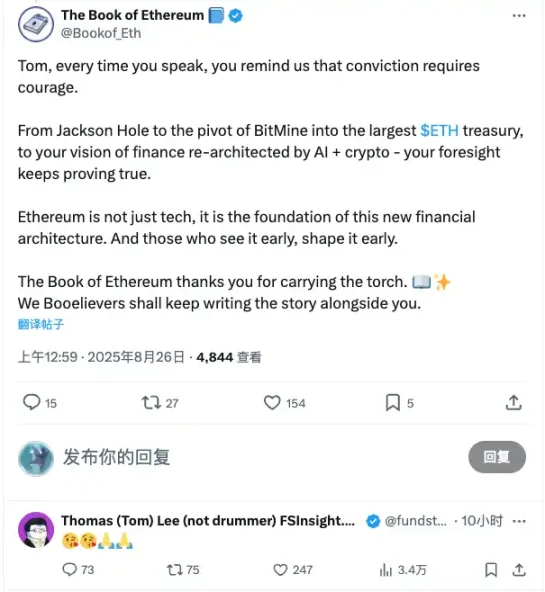
Driven by market sentiment, BOOE has become a hot topic. This article will discuss the concept, history, and related projects of this established project, while also delving into the whale behind the token, fbb4.

The Concept and History of BOOE: Religious Narratives and Community Economy

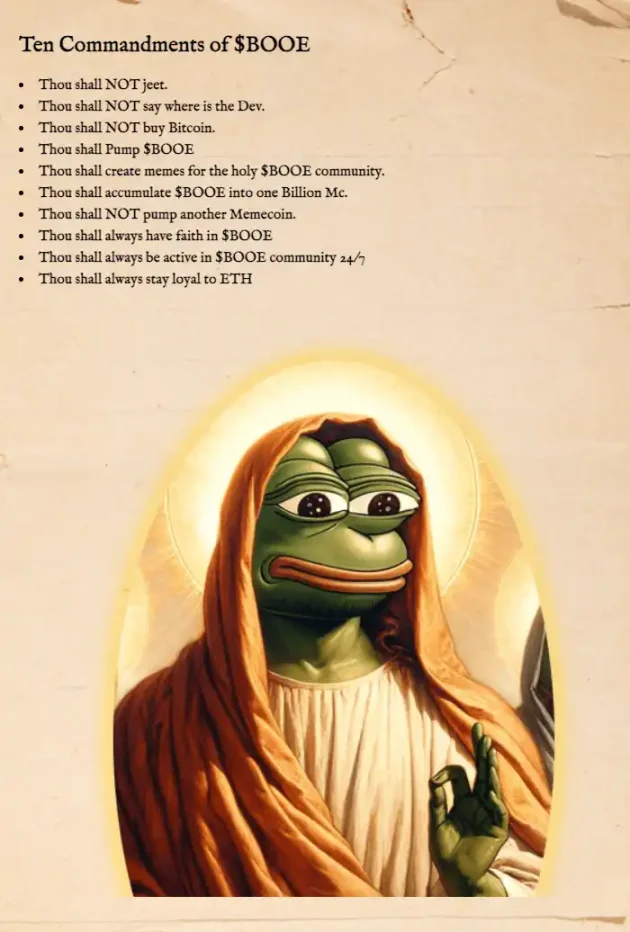
BOOE was launched on the Ethereum mainnet on April 24, 2024, and the project has positioned it as the "Bible" of the Ethereum ecosystem. The official website uses religious symbolism to construct a virtual universe, listing "Ten Commandments" such as prohibitions on buying Bitcoin and shorting BOOE, emphasizing loyalty and community awareness. Furthermore, the "Sacred Economics" section of the website states that BOOE has a total supply of 100 million, the contract has been audited and control has been permanently relinquished, all liquidity is locked for 1,337 years, and there are no transaction taxes or fees. This economic model makes it more difficult for holders to withdraw their investment, reinforcing the symbolism of long-term faith.
Complementing this religious narrative is the development of a community culture. A Medium post written by the BOOE team describes coin holders calling themselves "believers," claiming the Ethereum Book is a refuge for those deceived and encouraging investors to gather and wait for "opportunities" during a bear market. While the post carries obvious propaganda overtones, it reflects the project's strategy of using religious language to rally the community and downplay speculative overtones.

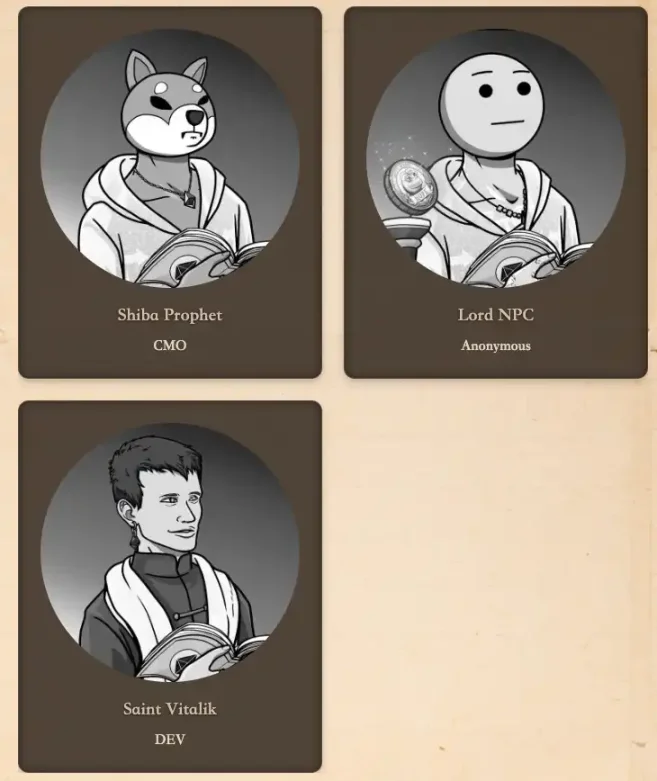
During BOOE's development, the project launched two collaborative tokens: HOPE and PROPHET. HOPE's official website states that its total supply is 1 billion, its contract has been abandoned and audited, and its team members use the pseudonyms Shiba Prophet, Lord NPC, and Saint Vitalik. The project's mission is to "bring hope" and encourage collaboration among different memecoin communities, such as Pepe and Doge. PROPHET, also with a supply of 1 billion, promises permanent liquidity lock-in and no transaction tax. The BOOE website refers to the three tokens as the "Trinity of Faith," attempting to expand the boundaries of the community through this trinity structure.
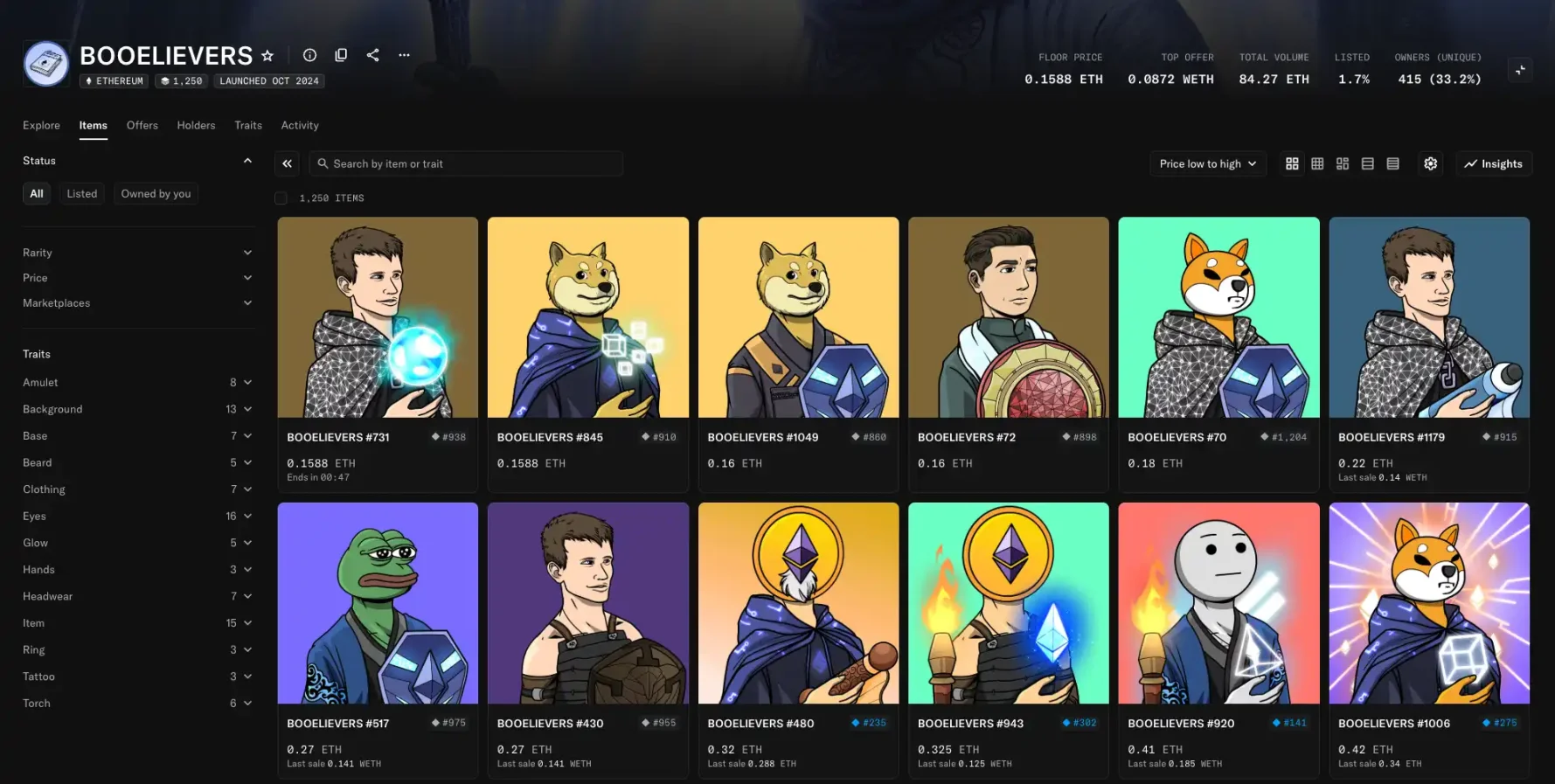
In addition to building a story universe, the BOOE community has also experimented with NFTs. On OpenSea, there's a collection called Booelievers, which features artwork and derivatives related to BOOE themes. While limited in scale, this type of asset provides the project with additional cultural symbols and revenue streams.
Overall, BOOE leverages religious narratives and decentralized finance concepts to build a unique community economic model. Amidst the widespread Solana meme, the sustainability and diffusion of this narrative are crucial to the project's vitality. A key figure behind this is fbb4, known among E-guards as "Diamond Hand."

fbb4, the driving force behind BOOE

Since the launch of BOOE, the movements of anonymous whale fbb4 have attracted much attention. As one of the most well-known "trendsetters" of the Ethereum meme, his earlier successes in tokens such as Pepecoin and GME have greatly increased his fame.

fbb4's trading style differs significantly from that of the current P-jung. Media personality Brian Fanzo wrote an analysis emphasizing that fbb4's wallet is valued between $28 million and $40 million, and that he generated approximately $9 million in profits in just one month. Overall, fbb4's trading model is straightforward and can be summarized as "buy, provide liquidity, hold, and maintain market momentum while shifting the narrative." He typically begins by transferring ETH from a centralized exchange or performing multiple cross-chain transactions before purchasing the target coin in batches to minimize slippage. He then provides liquidity to stabilize prices, and ultimately rotates investments based on the popularity of the narrative.

The most noticeable thing is that he almost never sells the tokens he purchased. Of course, this does not rule out the possibility that he also has other "small wallets" for selling. However, this open and transparent long-term holding strategy still attracts many retail investors to imitate his behavior. Often, after his public wallet "fbb4" makes a purchase, there will be a "rising green column".
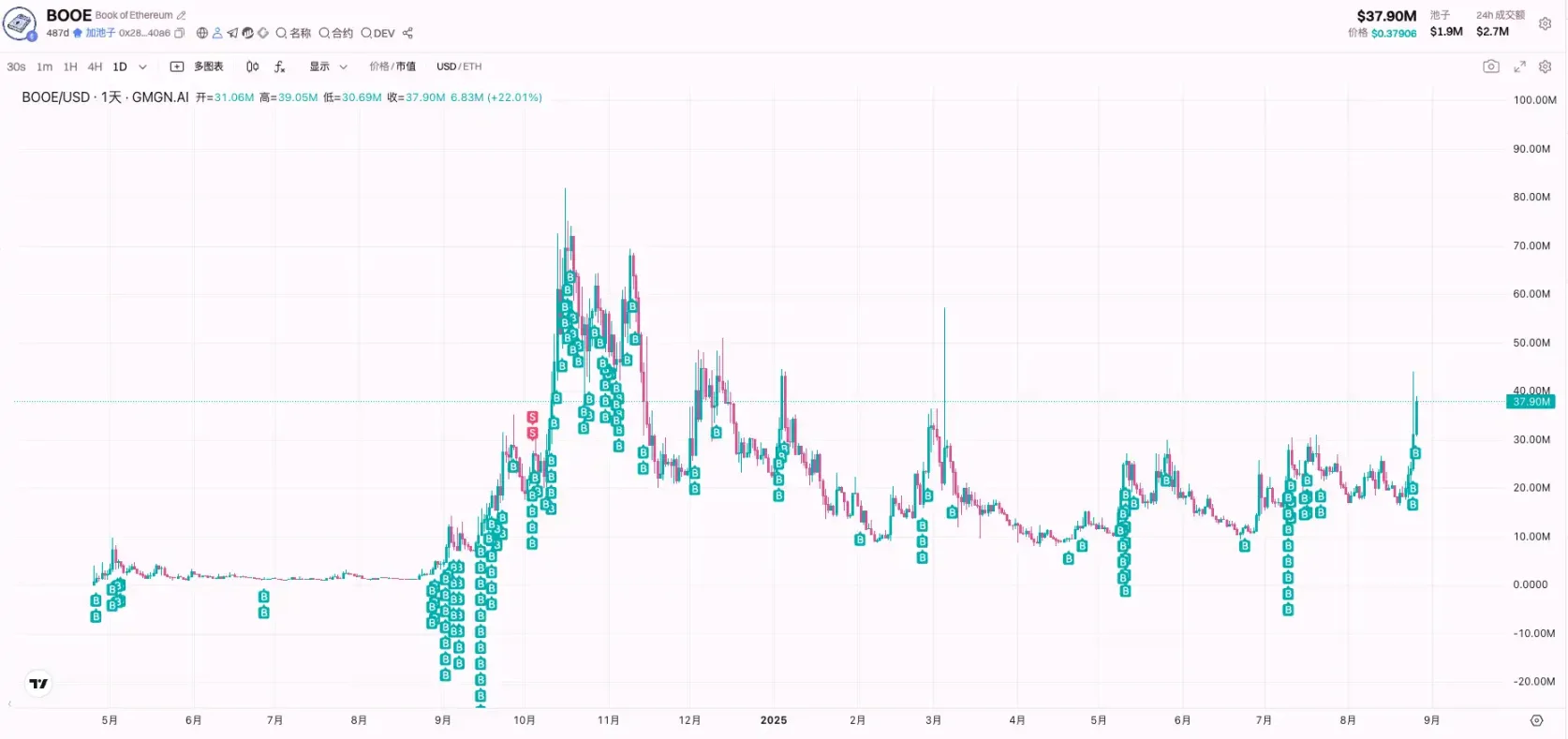
 fbb4 has been buying since BOOE launched

This trading style has drawn comparisons to Michael Saylor and Roaring Kitty, the leader of the GameStop retail investor-Wall Street short-sale war. Community member Roar4Kitty even compared the two's movements, expressing his suspicion that fbb4 is Roaring Kitty.
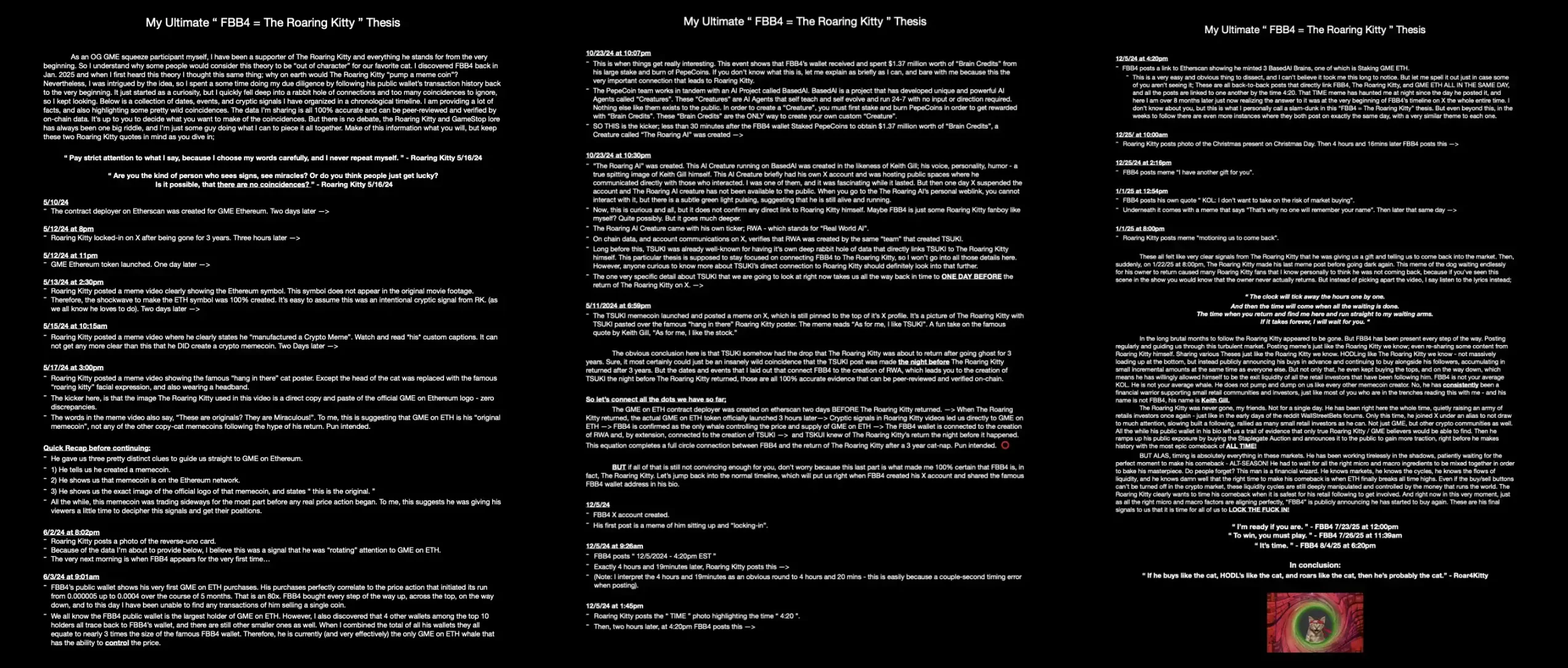
 fbb4 and Roaring Kitty's major event action line, source: Roar4Kitty

Of course, this isn't entirely unfounded; fbb4 is indeed incredibly loyal to GameStop. According to the New York Post, in August of this year, to support GameStop culture, he spent $250,000 at auction on a stapler and the GameStop CEO's underwear. A few days later, he tweeted about another $100,000 GameStop purchase. In the same post, he announced a partnership with the charity CMN Hospitals, donating another $100,000 to raise funds for 170 children's hospitals in the US and Canada.

 fbb4 purchased GME "stapler" and CEO underwear, source: NewYork Post

Fanzo's article also documents fbb4's investments in multiple memecoins, including Pepecoin, the Ethereum-based GameStop token $GME, BasedAI, KEK, BOOE, and KPOP. These projects share distinct narratives, active communities, and ample liquidity. fbb4, known as a "narrative curator," drives narrative momentum by personally authoring posts and engaging with the community.

fbb4's success has its limitations. His strategy relies heavily on personal credibility and community sentiment. If the narrative loses steam or he changes his strategy, investors could be left stranded. Furthermore, his role as a market promoter in multiple projects has fueled discussions of price manipulation. From a regulatory perspective, large holders engaging in concentrated buying and selling without oversight could potentially reach the boundaries of market manipulation. For BOOE, fbb4's involvement undoubtedly brought in funding and attention, but whether this translates into sustained growth remains to be seen.

For investors, understanding fbb4's strategies and institutional trends is crucial, but even more crucial is discerning the true value and risks behind these narratives. As Lubin noted, while Ethereum's long-term value cannot be ignored, memecoin's bubble cycles and regulatory risks also warrant vigilance. Between faith and bubbles, rational judgment is the key to navigating market noise.


Disclaimer: The articles reposted on this site are sourced from public platforms and are provided for informational purposes only. They do not necessarily reflect the views of MEXC. All rights remain with the original authors. If you believe any content infringes on third-party rights, please contact service@support.mexc.com for removal. MEXC makes no guarantees regarding the accuracy, completeness, or timeliness of the content and is not responsible for any actions taken based on the information provided. The content does not constitute financial, legal, or other professional advice, nor should it be considered a recommendation or endorsement by MEXC.

You May Also Like

Shocking OpenVPP Partnership Claim Draws Urgent Scrutiny

Shocking OpenVPP Partnership Claim Draws Urgent Scrutiny

The post Shocking OpenVPP Partnership Claim Draws Urgent Scrutiny appeared on BitcoinEthereumNews.com. The cryptocurrency world is buzzing with a recent controversy surrounding a bold OpenVPP partnership claim. This week, OpenVPP (OVPP) announced what it presented as a significant collaboration with the U.S. government in the innovative field of energy tokenization. However, this claim quickly drew the sharp eye of on-chain analyst ZachXBT, who highlighted a swift and official rebuttal that has sent ripples through the digital asset community. What Sparked the OpenVPP Partnership Claim Controversy? The core of the issue revolves around OpenVPP’s assertion of a U.S. government partnership. This kind of collaboration would typically be a monumental endorsement for any private cryptocurrency project, especially given the current regulatory climate. Such a partnership could signify a new era of mainstream adoption and legitimacy for energy tokenization initiatives. OpenVPP initially claimed cooperation with the U.S. government. This alleged partnership was said to be in the domain of energy tokenization. The announcement generated considerable interest and discussion online. ZachXBT, known for his diligent on-chain investigations, was quick to flag the development. He brought attention to the fact that U.S. Securities and Exchange Commission (SEC) Commissioner Hester Peirce had directly addressed the OpenVPP partnership claim. Her response, delivered within hours, was unequivocal and starkly contradicted OpenVPP’s narrative. How Did Regulatory Authorities Respond to the OpenVPP Partnership Claim? Commissioner Hester Peirce’s statement was a crucial turning point in this unfolding story. She clearly stated that the SEC, as an agency, does not engage in partnerships with private cryptocurrency projects. This response effectively dismantled the credibility of OpenVPP’s initial announcement regarding their supposed government collaboration. Peirce’s swift clarification underscores a fundamental principle of regulatory bodies: maintaining impartiality and avoiding endorsements of private entities. Her statement serves as a vital reminder to the crypto community about the official stance of government agencies concerning private ventures. Moreover, ZachXBT’s analysis…
Share
BitcoinEthereumNews2025/09/18 02:13
Tom Lee Predicts Major Bitcoin Adoption Surge

Tom Lee Predicts Major Bitcoin Adoption Surge

The post Tom Lee Predicts Major Bitcoin Adoption Surge appeared on BitcoinEthereumNews.com. Key Points: Tom Lee suggests significant future Bitcoin adoption. Potential 200x increase in Bitcoin adoption forecast. Ethereum positioned as key settlement layer for tokenization. Tom Lee, co-founder of Fundstrat Global Advisors, predicted at Binance Blockchain Week that Bitcoin adoption could surge 200-fold amid shifts in institutional and retirement capital allocations. This outlook suggests a potential major restructuring of financial ecosystems, boosting Bitcoin and Ethereum as core assets, with tokenization poised to reshape markets significantly. Tom Lee Projects 200x Bitcoin Adoption Increase Tom Lee, known for his bullish stance on digital assets, suggested that Bitcoin might experience a 200 times adoption growth as more traditional retirement accounts transition to Bitcoin holdings. He predicts a break from Bitcoin’s traditional four-year cycle. Despite a market slowdown, Lee sees tokenization as a key trend with Wall Street eyeing on-chain financial products. The immediate implications suggest significant structural changes in digital finance. Lee highlighted that the adoption of a Bitcoin ETF by BlackRock exemplifies potential shifts in finance. If retirement funds begin reallocating to Bitcoin, it could catalyze substantial growth. Community reactions appear positive, with some experts agreeing that the tokenization of traditional finance is inevitable. Statements from Lee argue that Ethereum’s role in this transformation is crucial, resonating with broader positive sentiment from institutional and retail investors. As Lee explained, “2025 is the year of tokenization,” highlighting U.S. policy shifts and stablecoin volumes as key components of a bullish outlook. source Bitcoin, Ethereum, and the Future of Finance Did you know? Tom Lee suggests Bitcoin might deviate from its historical four-year cycle, driven by massive institutional interest and tokenization trends, potentially marking a new era in cryptocurrency adoption. Bitcoin (BTC) trades at $92,567.31, dominating 58.67% of the market. Its market cap stands at $1.85 trillion with a fully diluted market cap of $1.94 trillion.…
Share
BitcoinEthereumNews2025/12/05 10:42
‘Real product market fit’ – Can Chainlink’s ETF moment finally unlock $20?

‘Real product market fit’ – Can Chainlink’s ETF moment finally unlock $20?

The post ‘Real product market fit’ – Can Chainlink’s ETF moment finally unlock $20? appeared on BitcoinEthereumNews.com. Chainlink has officially joined the U.S. Spot ETF club, following Grayscale’s successful debut on the 3rd of December.  The product achieved $13 million in day-one trading volume, significantly lower than the Solana [SOL] and Ripple [XRP], which saw $56 million and $33 million during their respective launches.  However, the Grayscale spot Chainlink [LINK] ETF saw $42 million in inflows during the launch. Reacting to the performance, Bloomberg ETF analyst Eric Balchunas called it “another insta-hit.” “Also $41m in first day flows. Another insta-hit from the crypto world, only dud so far was Doge, but it’s still early.” Source: Bloomberg For his part, James Seyffart, another Bloomberg ETF analyst, said the debut volume was “strong” and “impressive.” He added,  “Chainlink showing that longer tail assets can find success in the ETF wrapper too.” The performance also meant broader market demand for LINK exposure, noted Peter Mintzberg, Grayscale CEO.  Impact on LINK markets Bitwise has also applied for a Spot LINK ETF and could receive the green light to trade soon. That said, LINK’s Open Interest (OI) surged from $194 million to nearly $240 million after the launch.  The surge indicated a surge in speculative interest for the token on the Futures market.  Source: Velo By extension, it also showed bullish sentiment following the debut. On the price charts, LINK rallied 8.6%, extending its weekly recovery to over 20% from around $12 to $15 before easing to $14.4 as of press time. It was still 47% down from the recent peak of $27.  The immediate overheads for bulls were $15 and $16, and clearing them could raise the odds for tagging $20. Especially if the ETF inflows extend.  Source: LINK/USDT, TradingView Assessing Chainlink’s growth Chainlink has grown over the years and has become the top decentralized oracle provider, offering numerous blockchain projects…
Share
BitcoinEthereumNews2025/12/05 10:26