The post XRP Price Could Explode if the CLARITY Act Passes in April appeared first on Coinpedia Fintech News XRP is once again at the center of regulatory uncertaintyThe post XRP Price Could Explode if the CLARITY Act Passes in April appeared first on Coinpedia Fintech News XRP is once again at the center of regulatory uncertainty

XRP Price Could Explode if the CLARITY Act Passes in April

2026/02/17 15:57
4 min read
XRP Price

The post XRP Price Could Explode if the CLARITY Act Passes in April appeared first on Coinpedia Fintech News

XRP is once again at the center of regulatory uncertainty and market pressure. Ripple CEO Brad Garlinghouse recently said there is an 80% chance the CLARITY Act could pass by the end of April, a move that may finally bring long-awaited crypto regulation clarity to the U.S. market.

The bill, currently stuck in the Senate Banking Committee, is designed to clearly define how digital assets are regulated and reduce confusion between agencies like the SEC and CFTC.

Garlinghouse has emphasized that even imperfect crypto legislation is better than ongoing uncertainty. Many institutional investors remain cautious without clear federal guidelines, limiting large-scale capital inflows into assets like XRP.

XRP Price Bottom Outlook Amid Crypto Regulation Update

Timing now plays a crucial role. If lawmakers resolve the deadlock before the spring recess and momentum builds toward passage by late April, the market could react early. XRP has historically shown sharp price movements following major legal or regulatory news. Confirmation of legislative progress could trigger a relief rally.

However, if negotiations stall again, uncertainty could continue to weigh on XRP price action. The coming weeks may determine whether the market forms a strong bottom based on optimism or slides further due to fear.

XRP Price  Analysis: Key Support Levels and Downside Risk
XRP Price

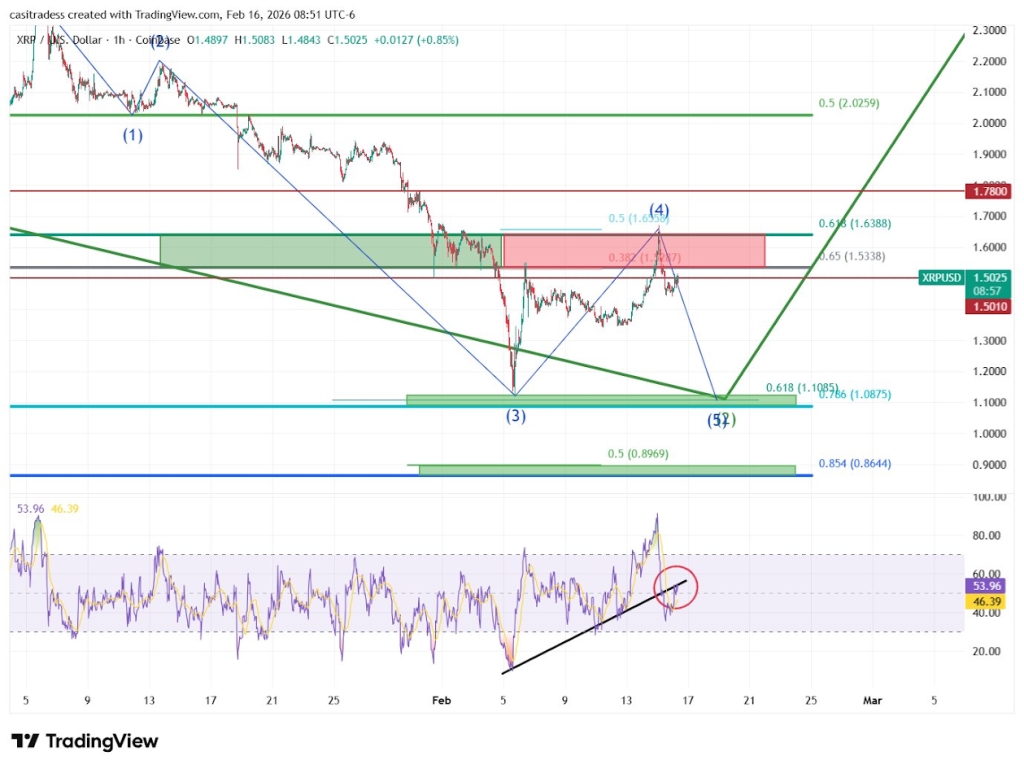
From a price chart perspective, caution remains. Analyst CasiTrades points out that XRP faced rejection near $1.65, a key Fibonacci resistance level, signaling weakening buying momentum. After falling below $1.53, the asset may need another pullback before a sustained rally can begin.

She identifies $1.11 as a possible double-bottom support zone. If selling pressure increases, XRP could even retest the $0.90 area. For a confirmed reversal, the next low would need to show clear signs of bullish divergence and improving momentum, indicating that sellers are losing control.
XRP Weekly Chart

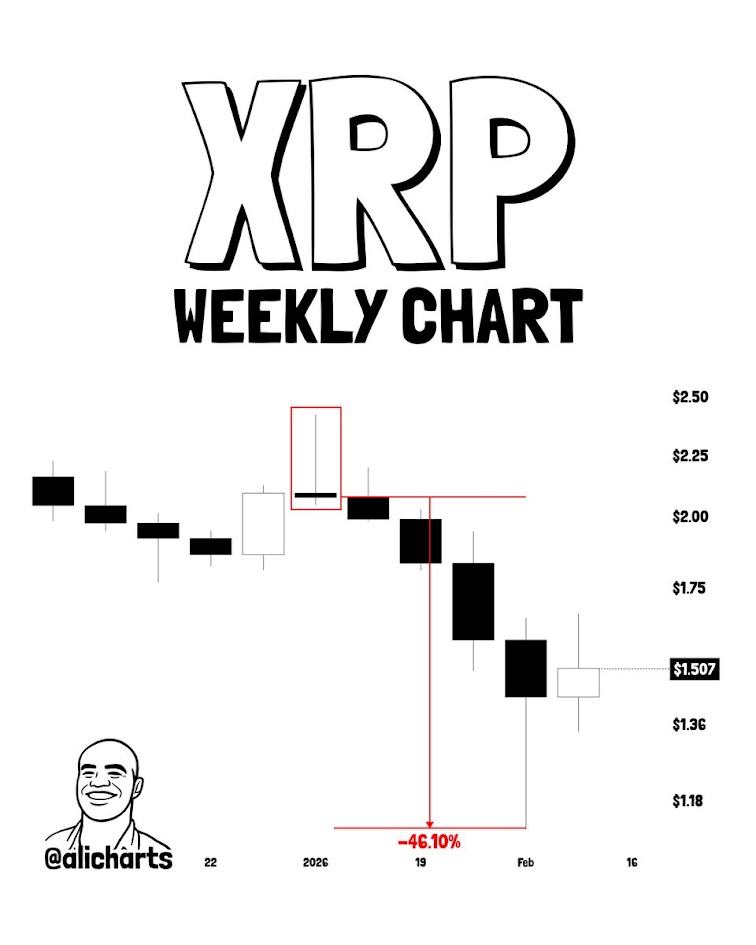
Adding to short-term concerns, analyst Ali Martinez noted a weekly gravestone doji pattern on XRP’s chart. In the past, this pattern was followed by a 46% decline, suggesting downside risks remain if market sentiment weakens further.

  • Also Read :
  •   XRP Rich List Update: 2,200 XRP Now Enough to Enter Top 10% of Wallets
  •   ,

Can XRP Price Recover if the CLARITY Act Passes?

A strong move back above $1.65 and sustained price stability there would signal that buyers are regaining control. If the CLARITY Act advances in April, XRP could shift from legal uncertainty toward stronger institutional confidence.

In that case, the initial move may begin with a relief rally driven by improved sentiment. Over time, clearer digital asset regulation and broader crypto adoption could support steady upside momentum into 2026.

For now, XRP stands at a critical point, balancing hopes of regulatory clarity with ongoing technical weakness. April could prove decisive in shaping the next major trend for XRP price.

Never Miss a Beat in the Crypto World!

Stay ahead with breaking news, expert analysis, and real-time updates on the latest trends in Bitcoin, altcoins, DeFi, NFTs, and more.

bell icon Subscribe to News

FAQs

What is the CLARITY Act and why does it matter for XRP price?

The CLARITY Act aims to define U.S. crypto rules and clarify SEC vs CFTC roles. Clear laws could boost XRP confidence and attract institutional money.

Could XRP price rally if the CLARITY Act passes?

Yes. Clear regulation may reduce uncertainty and trigger a relief rally, especially if XRP reclaims key resistance near $1.65 with strong volume.

Is XRP still facing legal uncertainty in the U.S.?

Yes. While courts ruled XRP isn’t a security in some cases, broader federal clarity is pending, keeping institutions cautious.

What signals would confirm an XRP trend reversal?

A sustained break above $1.65, bullish divergence on momentum indicators, and stronger buying volume would signal sellers are losing control.


Market Opportunity
The AI Prophecy Logo
The AI Prophecy Price(ACT)
$0.01516
$0.01516$0.01516
-1.23%
USD
The AI Prophecy (ACT) Live Price Chart
Disclaimer: The articles reposted on this site are sourced from public platforms and are provided for informational purposes only. They do not necessarily reflect the views of MEXC. All rights remain with the original authors. If you believe any content infringes on third-party rights, please contact service@support.mexc.com for removal. MEXC makes no guarantees regarding the accuracy, completeness, or timeliness of the content and is not responsible for any actions taken based on the information provided. The content does not constitute financial, legal, or other professional advice, nor should it be considered a recommendation or endorsement by MEXC.

You May Also Like

SEC Clears the Way for Spot Crypto ETFs with New Generic Rules

SEC Clears the Way for Spot Crypto ETFs with New Generic Rules

The post SEC Clears the Way for Spot Crypto ETFs with New Generic Rules appeared first on Coinpedia Fintech News The U.S. SEC has approved new listing standards that simplify the process for launching spot crypto ETFs under the ’33 Act. Cryptocurrencies with listed futures on Coinbase, currently about 12 to 15 coins, will now qualify automatically, removing the need for separate case-by-case approvals. This change streamlines regulatory procedures, cutting delays and hurdles, while opening …
Share
CoinPedia2025/09/18 14:35
Raydium’s 200% volume spike tests RAY’s breakout strength – Here’s why

Raydium’s 200% volume spike tests RAY’s breakout strength – Here’s why

The post Raydium’s 200% volume spike tests RAY’s breakout strength – Here’s why appeared on BitcoinEthereumNews.com. RAY surged over 11% in 24 hours to $0.69 as
Share
BitcoinEthereumNews2026/02/17 18:10
Bitcoin devs cheer block reconstruction stats, ignore security budget concerns

Bitcoin devs cheer block reconstruction stats, ignore security budget concerns

The post Bitcoin devs cheer block reconstruction stats, ignore security budget concerns appeared on BitcoinEthereumNews.com. This morning, Bitcoin Core developers celebrated improved block reconstruction statistics for node operators while conveniently ignoring the reason for these statistics — the downward trend in fees for Bitcoin’s security budget. Reacting with heart emojis and thumbs up to a green chart showing over 80% “successful compact block reconstructions without any requested transactions,” they conveniently omitted red trend lines of the fees that Bitcoin users pay for mining security which powered those green statistics. Block reconstructions occur when a node requests additional information about transactions within a compact block. Although compact blocks allow nodes to quickly relay valid bundles of transactions across the internet, the more frequently that nodes can reconstruct without extra, cumbersome transaction requests from their peers is a positive trend. Because so many nodes switched over in August to relay transactions bidding 0.1 sat/vB across their mempools, nodes now have to request less transaction data to reconstruct blocks containing sub-1 sat/vB transactions. After nodes switched over in August to accept and relay pending transactions bidding less than 1 sat/vB, disparate mempools became harmonized as most nodes had a better view of which transactions would likely join upcoming blocks. As a result, block reconstruction times improved, as nodes needed less information about these sub-1 sat/vB transactions. In July, several miners admitted that user demand for Bitcoin blockspace had persisted at such a low that they were willing to accept transaction fees of just 0.1 satoshi per virtual byte — 90% lower than their prior 1 sat/vB minimum. With so many blocks partially empty, they succumbed to the temptation to accept at least something — even 1 billionth of one bitcoin (BTC) — rather than $0 to fill up some of the excess blockspace. Read more: Bitcoin’s transaction fees have fallen to a multi-year low Green stats for block reconstruction after transaction fees crash After…
Share
BitcoinEthereumNews2025/09/18 04:07



