The post Dollar bearish positioning hits highest since 2012. appeared on BitcoinEthereumNews.com. Investors are most bearish on the dollar in over a decade, perThe post Dollar bearish positioning hits highest since 2012. appeared on BitcoinEthereumNews.com. Investors are most bearish on the dollar in over a decade, per

Dollar bearish positioning hits highest since 2012.

Investors are most bearish on the dollar in over a decade, per Bank of America’s (BofA) latest survey and that extreme bet could breed bitcoin BTC$68,079.67 volatility, just not the way crypto bulls have become used to.

BofA’s February survey shows investor positioning in the U.S. dollar has fallen to its most negative (bearish) level since at least early 2012, with net exposure at a record underweight. This is driven by concerns over further deterioration in the U.S. labor market, which could prompt the Federal Reserve to cut interest rates.

Since its inception, bitcoin has mostly moved in the opposite direction of the U.S. Dollar Index, rising when the greenback slides and falling when it strengthens. That tracks for two big reasons: As a dollar-denominated asset, a softer buck makes BTC cheaper to buy and vice versa. Plus, a strong dollar tightens financial conditions globally, hammering risk assets like bitcoin and the reverse holds when it weakens.

So, if history is a guide, the record bearish dollar positioning, a sign of investors aligned for a weaker dollar, could be termed a classic bullish tailwind for bitcoin.

But wait, there’s a twist. Since early 2025, and especially lately, bitcoin has developed a weird positive link to the dollar. DXY plunged over 9% last year and another 1% this year. Yet BTC dropped 6% in 2025 and is down 21% year-to-date. Their 90-day correlation hit 0.60 on Monday, the highest since April 2025, according to data source TradingView.

If that link sticks, a deeper slide in the dollar index may not bode well for bitcoin. But the flip side is a dollar bounce, fueled by a short squeeze, could drag BTC higher with it.

When investors pile into extreme bearish positions, any unexpected price bounce forces them to buy back en masse to limit losses, creating a short squeeze. This frantic covering propels the asset price higher, amplifying volatility skyward.

“Record short positioning raises the risk of volatility in major USD pairs; downside may extend on weak US data, but crowded trade dynamics increase potential for sharp short-covering rallies,” InvestingLive’s Chief Asia-Pacific Currency Analyst Eamonn Sheridan said in a market update.

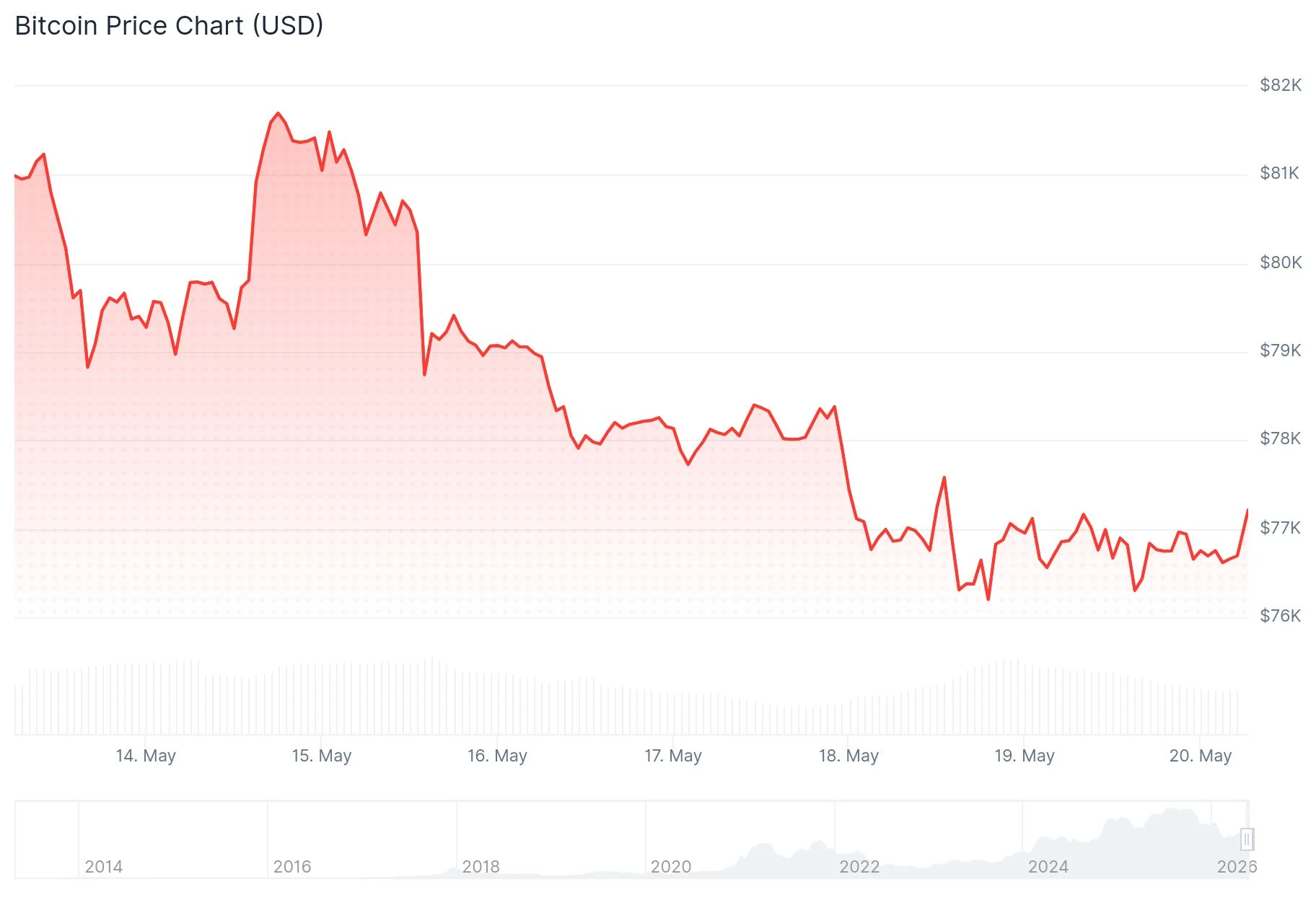
At press time, the dollar index was up 0.25% on the day at 97.13 and bitcoin changed hands at $68,150, down 1%, according to CoinDesk data.

Source: https://www.coindesk.com/markets/2026/02/17/bofa-survey-shows-record-bearish-dollar-bets-here-s-what-it-means-for-bitcoin


Market Opportunity
Bitcoin Logo
Bitcoin Price(BTC)
$67,785.6
$67,785.6$67,785.6
+0.37%
USD
Bitcoin (BTC) Live Price Chart
Disclaimer: The articles reposted on this site are sourced from public platforms and are provided for informational purposes only. They do not necessarily reflect the views of MEXC. All rights remain with the original authors. If you believe any content infringes on third-party rights, please contact service@support.mexc.com for removal. MEXC makes no guarantees regarding the accuracy, completeness, or timeliness of the content and is not responsible for any actions taken based on the information provided. The content does not constitute financial, legal, or other professional advice, nor should it be considered a recommendation or endorsement by MEXC.

You May Also Like

SEC Clears the Way for Spot Crypto ETFs with New Generic Rules

SEC Clears the Way for Spot Crypto ETFs with New Generic Rules

The post SEC Clears the Way for Spot Crypto ETFs with New Generic Rules appeared first on Coinpedia Fintech News The U.S. SEC has approved new listing standards that simplify the process for launching spot crypto ETFs under the ’33 Act. Cryptocurrencies with listed futures on Coinbase, currently about 12 to 15 coins, will now qualify automatically, removing the need for separate case-by-case approvals. This change streamlines regulatory procedures, cutting delays and hurdles, while opening …
Share
CoinPedia2025/09/18 14:35
Raydium’s 200% volume spike tests RAY’s breakout strength – Here’s why

Raydium’s 200% volume spike tests RAY’s breakout strength – Here’s why

The post Raydium’s 200% volume spike tests RAY’s breakout strength – Here’s why appeared on BitcoinEthereumNews.com. RAY surged over 11% in 24 hours to $0.69 as
Share
BitcoinEthereumNews2026/02/17 18:10
Bitcoin devs cheer block reconstruction stats, ignore security budget concerns

Bitcoin devs cheer block reconstruction stats, ignore security budget concerns

The post Bitcoin devs cheer block reconstruction stats, ignore security budget concerns appeared on BitcoinEthereumNews.com. This morning, Bitcoin Core developers celebrated improved block reconstruction statistics for node operators while conveniently ignoring the reason for these statistics — the downward trend in fees for Bitcoin’s security budget. Reacting with heart emojis and thumbs up to a green chart showing over 80% “successful compact block reconstructions without any requested transactions,” they conveniently omitted red trend lines of the fees that Bitcoin users pay for mining security which powered those green statistics. Block reconstructions occur when a node requests additional information about transactions within a compact block. Although compact blocks allow nodes to quickly relay valid bundles of transactions across the internet, the more frequently that nodes can reconstruct without extra, cumbersome transaction requests from their peers is a positive trend. Because so many nodes switched over in August to relay transactions bidding 0.1 sat/vB across their mempools, nodes now have to request less transaction data to reconstruct blocks containing sub-1 sat/vB transactions. After nodes switched over in August to accept and relay pending transactions bidding less than 1 sat/vB, disparate mempools became harmonized as most nodes had a better view of which transactions would likely join upcoming blocks. As a result, block reconstruction times improved, as nodes needed less information about these sub-1 sat/vB transactions. In July, several miners admitted that user demand for Bitcoin blockspace had persisted at such a low that they were willing to accept transaction fees of just 0.1 satoshi per virtual byte — 90% lower than their prior 1 sat/vB minimum. With so many blocks partially empty, they succumbed to the temptation to accept at least something — even 1 billionth of one bitcoin (BTC) — rather than $0 to fill up some of the excess blockspace. Read more: Bitcoin’s transaction fees have fallen to a multi-year low Green stats for block reconstruction after transaction fees crash After…
Share
BitcoinEthereumNews2025/09/18 04:07