

Optimizing Backpropagation with PC Flows
Table of Links
Abstract and 1. Introduction
-
Preliminaries and Related Work
-
Key Bottlenecks in PC Parallelization
-
Harnessing Block-Based PC Parallelization
4.1. Fully Connected Sum Layers
4.2. Generalizing To Practical Sum Layers
4.3. Efficient Implementations by Compiling PC Layers
4.4. Analysis: IO and Computation Overhead
-
Optimizing Backpropagation with PC Flows
-
Experiments
6.1. Faster Models with PyJuice
6.2. Better PCs At Scale
6.3. Benchmarking Existing PCs
-
Conclusion, Acknowledgements, Impact Statement, and References
A. Algorithm Details
B. Additional Technical Details
C. Experimental Details
D. Additional Experiments
\
6. Experiments
We evaluate the impact of using PyJuice to train PC models. In Section 6.1, we compare PyJuice against existing implementations regarding time and memory efficiency. To demonstrate its generality and flexibility, we evaluate PyJuice on four commonly used dense PC structures as well as highly unstructured and sparse PCs. Next, we demonstrate that PyJuice can be readily used to scale up PCs for various downstream applications in Section 6.2. Finally, in Section 6.3, we benchmark existing PCs on high-resolution image datasets, hoping to incentivize future research to develop better PC structures as well as learning algorithms.
5. Optimizing Backpropagation with PC Flows
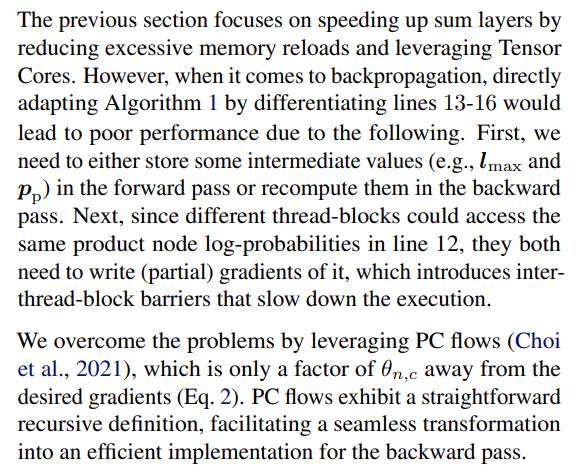
\ 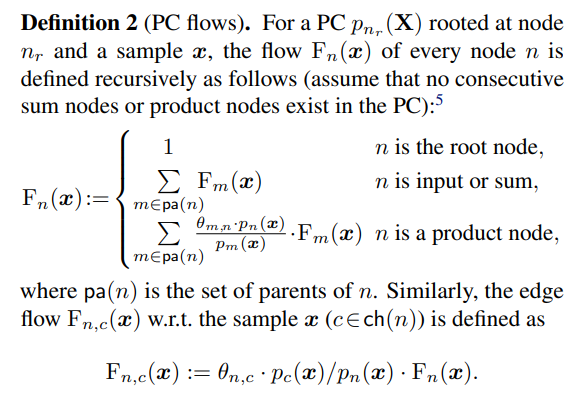
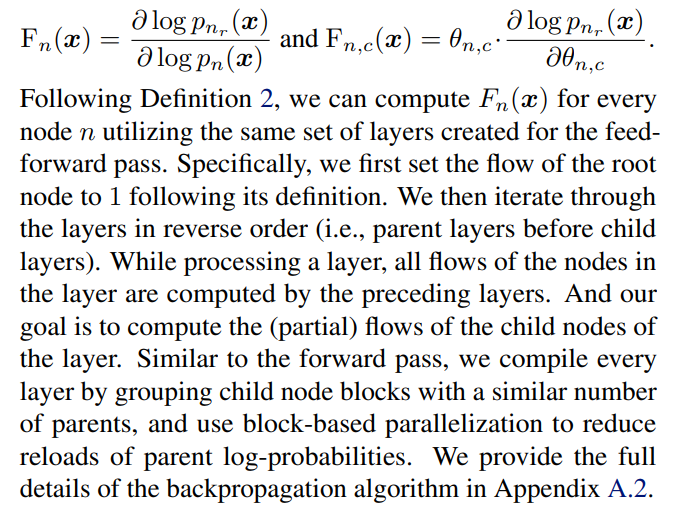
\ While similar results have been established in a slightly different context (Peharz et al., 2020a), we prove the following equations in Appendix B.2 for completeness:
\ 
\ Another important design choice that leads to a significant reduction in memory footprint is to recompute the product nodes’ probabilities in the backward pass instead of storing them all in the GPU memory during the forward pass. Specifically, we maintain a scratch space on GPU HBM that 5 If such nodes exist, we can always collapse them into a single sum or product node. can hold the results of the largest product layer. All product layers write their outputs to this same scratch space, and the required product node probabilities are re-computed when requested by a sum layer during backpropagation. Since product layers are extremely fast to evaluate compared to the sum layers (e.g., see the runtime breakdown in Fig. 2), this leads to significant memory savings at the cost of slightly increased computation time.
\
:::info Authors:
(1) Anji Liu, Department of Computer Science, University of California, Los Angeles, USA (liuanji@cs.ucla.edu);
(2) Kareem Ahmed, Department of Computer Science, University of California, Los Angeles, USA;
(3) Guy Van den Broeck, Department of Computer Science, University of California, Los Angeles, USA;
:::
:::info This paper is available on arxiv under CC BY 4.0 DEED license.
:::
[5] If such nodes exist, we can always collapse them into a single sum or product node.
You May Also Like

Spanish Banking Powerhouse Santander Opens Doors To Crypto For The Public

Will Bitcoin Make a New All-Time High Soon? Here’s What Users Think
