This article explores how block-based parallelization improves the efficiency of probabilistic circuits by reducing both IO and computation overhead. Starting with fully connected sum layers, it explains how assigning indices, grouping node blocks, and padding with pseudo-nodes enable optimized kernel launches. Using dynamic programming for partitioning ensures minimal overhead while maximizing speed. Results show that larger block sizes cut IO operations dramatically, achieving up to 50x faster performance without significant cost from padded edges.This article explores how block-based parallelization improves the efficiency of probabilistic circuits by reducing both IO and computation overhead. Starting with fully connected sum layers, it explains how assigning indices, grouping node blocks, and padding with pseudo-nodes enable optimized kernel launches. Using dynamic programming for partitioning ensures minimal overhead while maximizing speed. Results show that larger block sizes cut IO operations dramatically, achieving up to 50x faster performance without significant cost from padded edges.

How Block-Based Parallelization Cuts IO and Computation Overhead

2025/08/25 07:11
4 min read

Abstract and 1. Introduction

  1. Preliminaries and Related Work

  2. Key Bottlenecks in PC Parallelization

  3. Harnessing Block-Based PC Parallelization

    4.1. Fully Connected Sum Layers

    4.2. Generalizing To Practical Sum Layers

    4.3. Efficient Implementations by Compiling PC Layers

    4.4. Analysis: IO and Computation Overhead

  4. Optimizing Backpropagation with PC Flows

  5. Experiments

    6.1. Faster Models with PyJuice

    6.2. Better PCs At Scale

    6.3. Benchmarking Existing PCs

  6. Conclusion, Acknowledgements, Impact Statement, and References

A. Algorithm Details

B. Additional Technical Details

C. Experimental Details

D. Additional Experiments

\

4. Harnessing Block-Based PC Parallelization

This section takes gradual steps toward demonstrating how we can reduce both the IO and computation overhead using block-based parallelization. Specifically, we first utilize a fully connected sum layer to sketch the high-level idea (Sec. 4.1). Consequently, we move on to the general case, providing further details of the algorithm (Secs. 4.2, 4.3).

4.1. Fully Connected Sum Layers

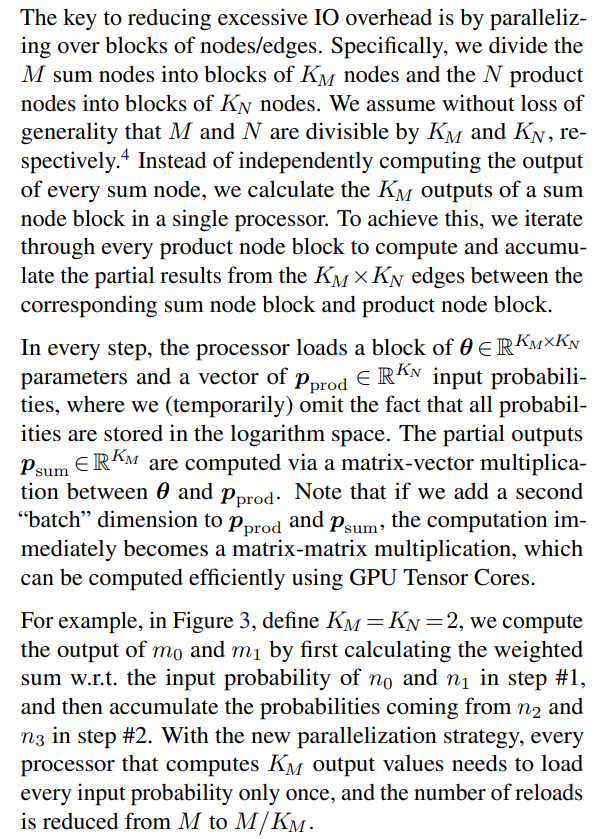
Consider a fully connected sum layer comprised of M sum nodes, each connected to the same set of N product nodes as inputs. Under the parallelization strategy mentioned in

\ Figure 3. Illustration of block-based parallelization. A processor computes the output of 2 sum nodes, by iterating through blocks of 2 input product nodes and accumulating partial results.
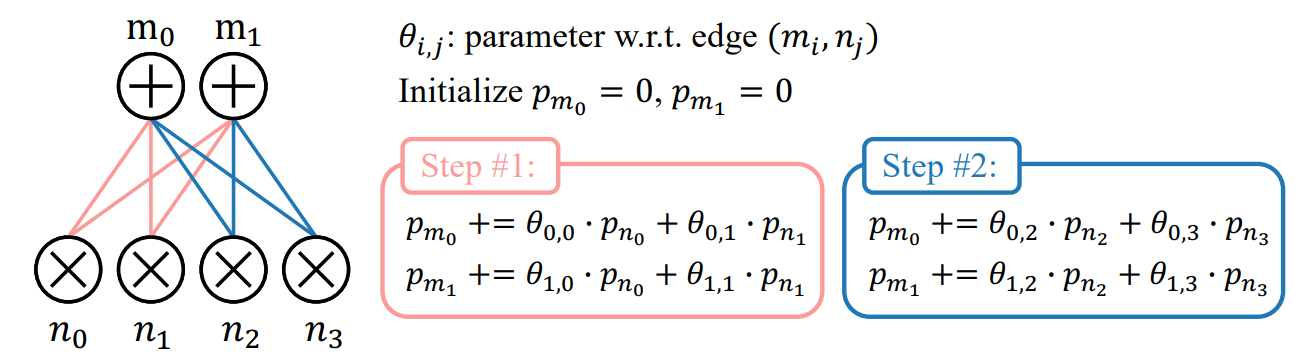
\ Section 3, with a single sample, we have M processors each computing the output of a sum node. Since the layer is fully connected, every processor loads all N input log-probabilities, which results in M reloads of every input.

\
4.2. Generalizing To Practical Sum Layers

\
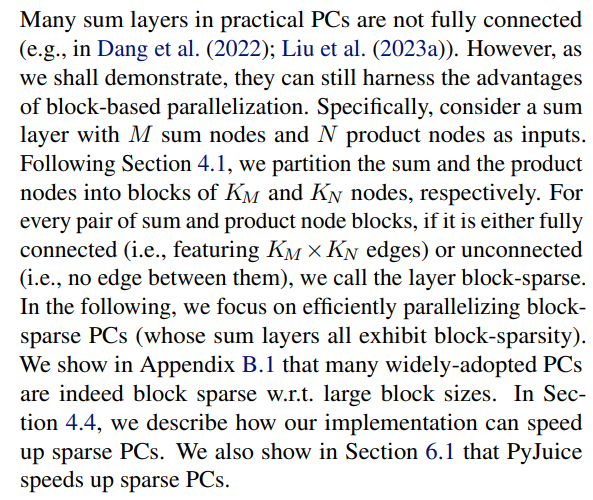
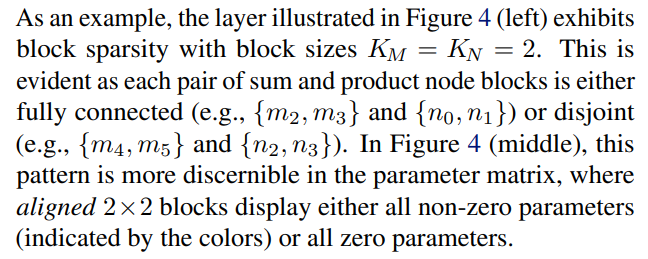
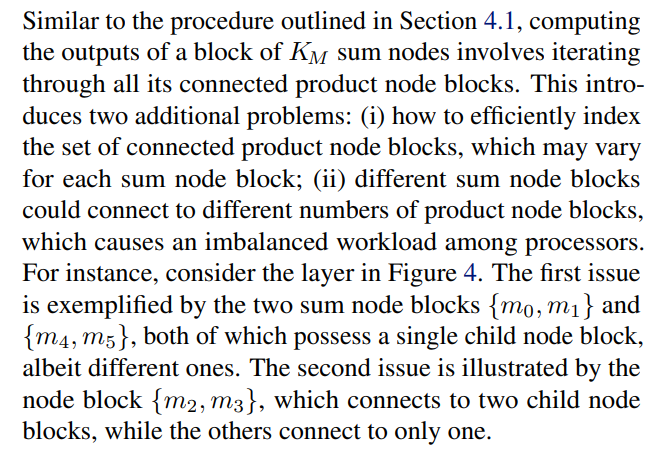
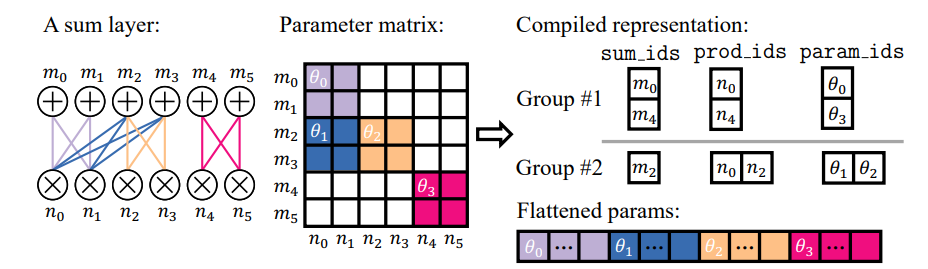
\ \ \ Figure 4. A sum layer (left) with a block-sparse parameter matrix (middle) is compiled into two kernels (right) each with a balanced workload. During execution, each kernel uses the compiled sum/prod/param indices to compute the outputs of m0, . . . , m5.
\ \ \

\ \ \

4.3. Efficient Implementations by Compiling PC Layers

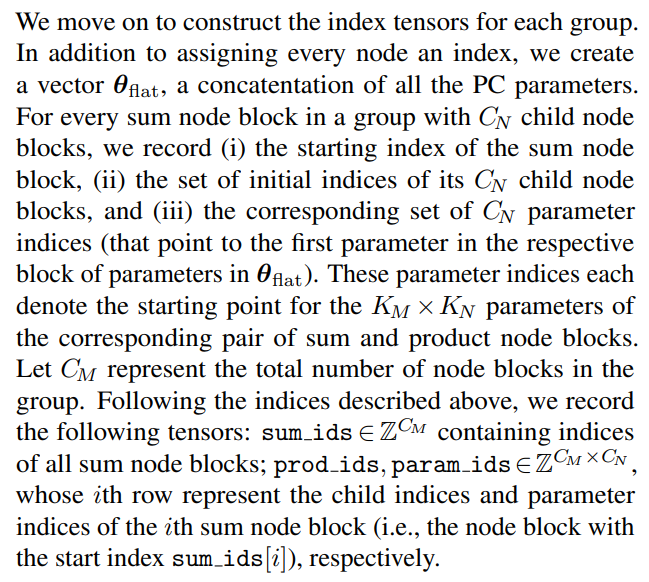
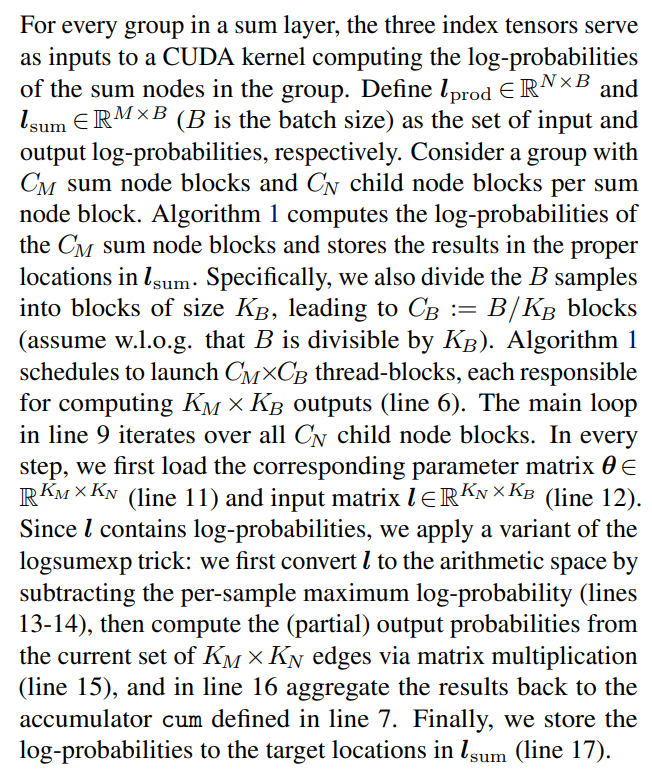
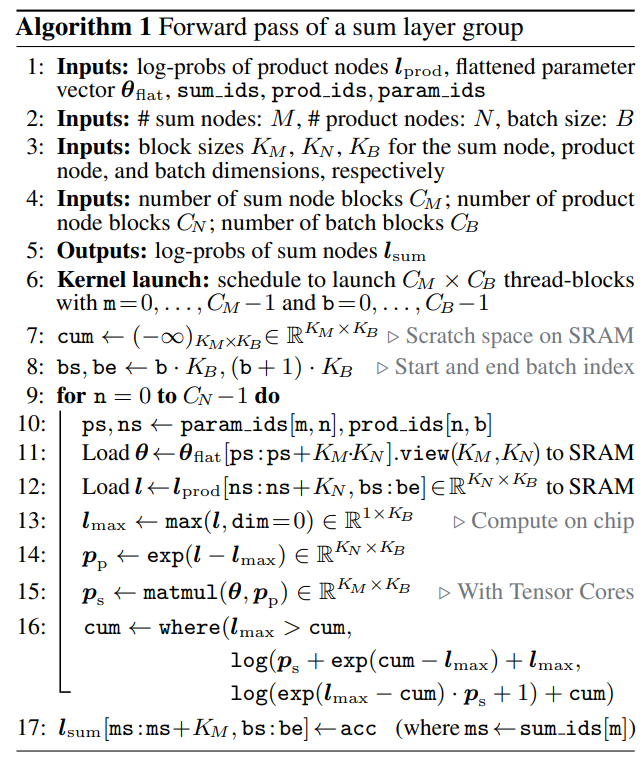
We address both problems through a compilation process, where we assign every node an index, and precompute index tensors that enable efficient block-based parallelization. The first step is to partition the sum node blocks into groups, such that every node block within a group has a similar number of connected child node blocks. We then pad the children with pseudo-product node blocks with probability 0 such that all sum node blocks in a group have the same number of children. The partition is generated by a dynamic programming algorithm that aims to divide the layer into the smallest possible number of groups while ensuring that the fraction of added pseudo-node blocks does not exceed a predefined threshold. Due to space constraints, we elaborate the node block partitioning algorithm in Appendix A.1. We also discuss its optimality and time/memory efficiency.

\ \
\ \ \
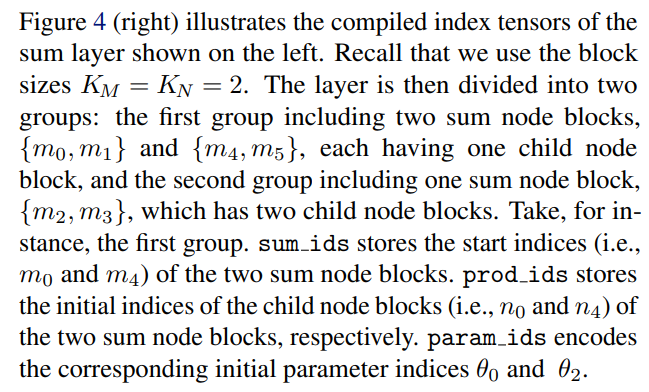
\ \ Partitioning a layer into groups with the same number of children allows us to use different kernel launching hyperparameters according to the specific setup of every node group (e.g., number of nodes) to achieve better performance.

\ \
\ \ \
\

4.4. Analysis: IO and Computation Overhead

\
\ \ \ igure 5. Runtime and IO overhead of a sum layer from the PD structure (with 29K nodes and 30M edges). The results demonstrate significant performance gains from our block-based parallelization, even with small block sizes.
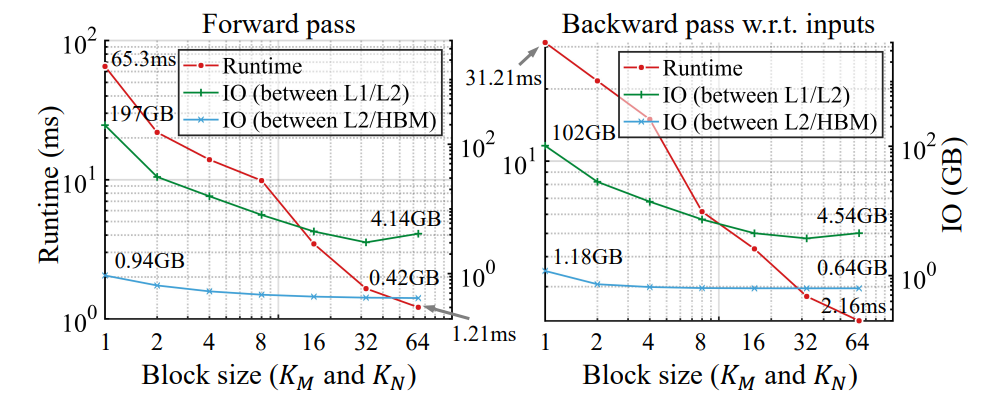
\ \ Results are shown in Figure 5. As the block size increases, both the forward and the backward pass become significantly faster. Notably, this is accompanied by a significant drop in IO overhead. Specifically, with a large block size, the kernel consumes 2x fewer reads/writes between the L2 cache and the HBM, and 25-50x fewer IO between the L1 and L2 cache. This corroborates the hypothesis stated in Section 3 that the extensive value reloads significantly slow down the computation.

\ \
\ \ the speedup obtained by having a larger block size outpaces the overhead caused by padded edges with zero parameters, which leads to speed-ups.

\ \

:::info Authors:

(1) Anji Liu, Department of Computer Science, University of California, Los Angeles, USA (liuanji@cs.ucla.edu);

(2) Kareem Ahmed, Department of Computer Science, University of California, Los Angeles, USA;

(3) Guy Van den Broeck, Department of Computer Science, University of California, Los Angeles, USA;

:::


:::info This paper is available on arxiv under CC BY 4.0 DEED license.

:::
Market Opportunity
KernelDAO Logo
KernelDAO Price(KERNEL)
$0.05806
$0.05806$0.05806
+10.67%
USD
KernelDAO (KERNEL) Live Price Chart
Disclaimer: The articles reposted on this site are sourced from public platforms and are provided for informational purposes only. They do not necessarily reflect the views of MEXC. All rights remain with the original authors. If you believe any content infringes on third-party rights, please contact service@support.mexc.com for removal. MEXC makes no guarantees regarding the accuracy, completeness, or timeliness of the content and is not responsible for any actions taken based on the information provided. The content does not constitute financial, legal, or other professional advice, nor should it be considered a recommendation or endorsement by MEXC.

You May Also Like

Coinbase CEO: We will build a financial super application to replace traditional banks

Coinbase CEO: We will build a financial super application to replace traditional banks

PANews reported on September 20th that Coinbase CEO Brian Armstrong confirmed in an interview with Fox Business that the company's vision is to build Coinbase into a full-service crypto "super app" that replaces traditional banks. The company plans to offer a full suite of financial services, from payments to credit cards and rewards, all powered by crypto. He stated: "Yes, we do want to be a super app that offers a variety of financial services, and I believe cryptocurrencies have the power to do that."
Share
PANews2025/09/20 19:04
Polygon Tops RWA Rankings With $1.1B in Tokenized Assets

Polygon Tops RWA Rankings With $1.1B in Tokenized Assets

The post Polygon Tops RWA Rankings With $1.1B in Tokenized Assets appeared on BitcoinEthereumNews.com. Key Notes A new report from Dune and RWA.xyz highlights Polygon’s role in the growing RWA sector. Polygon PoS currently holds $1.13 billion in RWA Total Value Locked (TVL) across 269 assets. The network holds a 62% market share of tokenized global bonds, driven by European money market funds. The Polygon POL $0.25 24h volatility: 1.4% Market cap: $2.64 B Vol. 24h: $106.17 M network is securing a significant position in the rapidly growing tokenization space, now holding over $1.13 billion in total value locked (TVL) from Real World Assets (RWAs). This development comes as the network continues to evolve, recently deploying its major “Rio” upgrade on the Amoy testnet to enhance future scaling capabilities. This information comes from a new joint report on the state of the RWA market published on Sept. 17 by blockchain analytics firm Dune and data platform RWA.xyz. The focus on RWAs is intensifying across the industry, coinciding with events like the ongoing Real-World Asset Summit in New York. Sandeep Nailwal, CEO of the Polygon Foundation, highlighted the findings via a post on X, noting that the TVL is spread across 269 assets and 2,900 holders on the Polygon PoS chain. The Dune and https://t.co/W6WSFlHoQF report on RWA is out and it shows that RWA is happening on Polygon. Here are a few highlights: – Leading in Global Bonds: Polygon holds 62% share of tokenized global bonds (driven by Spiko’s euro MMF and Cashlink euro issues) – Spiko U.S.… — Sandeep | CEO, Polygon Foundation (※,※) (@sandeepnailwal) September 17, 2025 Key Trends From the 2025 RWA Report The joint publication, titled “RWA REPORT 2025,” offers a comprehensive look into the tokenized asset landscape, which it states has grown 224% since the start of 2024. The report identifies several key trends driving this expansion. According to…
Share
BitcoinEthereumNews2025/09/18 00:40
Explosive 25% Penalty On Nations Trading With Tehran

Explosive 25% Penalty On Nations Trading With Tehran

The post Explosive 25% Penalty On Nations Trading With Tehran appeared on BitcoinEthereumNews.com. Trump Iran Tariffs: Explosive 25% Penalty On Nations Trading
Share
BitcoinEthereumNews2026/02/07 08:10