Dogecoin price dropped for two consecutive days after hitting the 50-day Exponential Moving Average as demand dropped and key headwinds rose.Dogecoin price dropped for two consecutive days after hitting the 50-day Exponential Moving Average as demand dropped and key headwinds rose.

Dogecoin price eyes a steeper dive as headwinds rise

2026/02/17 04:33
2 min read

Dogecoin price dropped for two consecutive days after hitting the 50-day Exponential Moving Average as demand dropped and key headwinds rose.

Summary
  • Dogecoin price has slumped in the past few months.
  • Spot DOGE ETFs inflows have stalled this year.
  • The futures open interest has continued falling, while the funding rate has turned negative.

Dogecoin (DOGE) token dropped to the important support level at $0.100, much lower than this month’s high of $0.1176. It remains ~67% from its highest level in 2025.

The coin faces major headwinds, which may drag its price in the near term. For example, it faces a major challenge on the ongoing crypto market crash, which has affected Bitcoin and most altcoins.

Additionally, the futures open interest has continued falling in the past few months, moving from a high of $5.20 billion in September to the current $1.16 billion. Falling open interest is a sign that demand has continued falling in the past few months.

More data shows that the weighted funding rate has remained in the red in the past few days. It dropped to the lowest level since February 10. A falling funding rate is a sign that investors believe that the coin will continue falling in the near term.

The same is happening in the exchange-traded fund market this year. Data compiled by SoSoValue shows that spot three spot DOGE ETFs by companies like Grayscale, 21Shares, and Bitwise have not had any inflows or outflows since February 3 this year. These funds now have had over $6.67 million in cumulative inflows, bringing the net inflows to $8.69 million.

Dogecoin price technical analysis 
dogecoin price

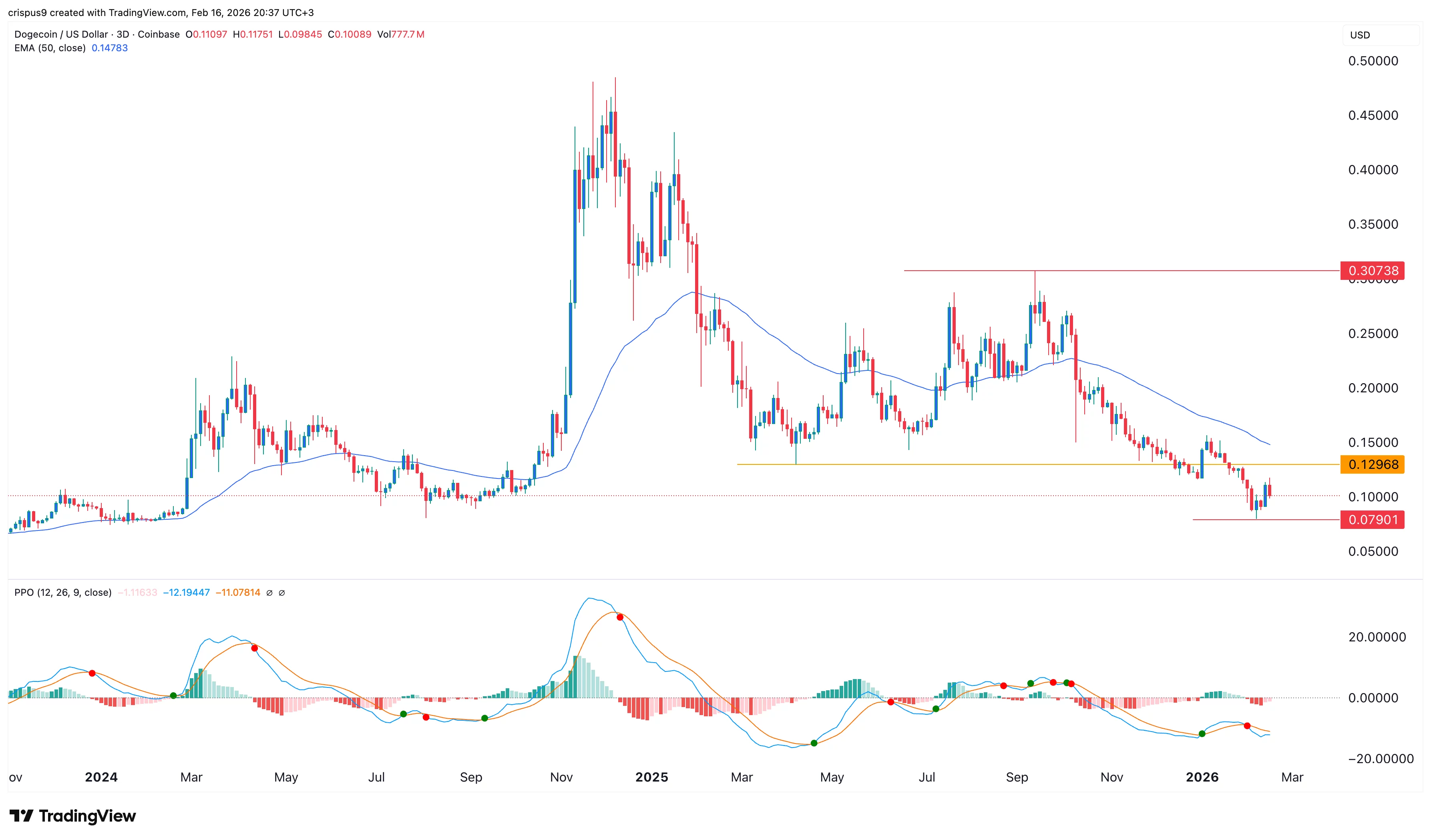
The daily timeframe chart shows that the DOGE price has been in a strong downward trend in the past few months, moving from a high of $0.3073 in September last year.

Dogecoin price has dropped below the key support level at $0.1295, its lowest level on April 7 last year. It has fallen below all moving averages, while the Percentage Price Oscillator remains below the zero line.

Therefore, the most likely scenario is where the coin continues falling, potentially to the year-to-date low of $0.0790, its lowest level this month. A drop below that support level will signal more downside.


Market Opportunity
RISE Logo
RISE Price(RISE)
$0.003498
$0.003498$0.003498
-1.01%
USD
RISE (RISE) Live Price Chart
Disclaimer: The articles reposted on this site are sourced from public platforms and are provided for informational purposes only. They do not necessarily reflect the views of MEXC. All rights remain with the original authors. If you believe any content infringes on third-party rights, please contact service@support.mexc.com for removal. MEXC makes no guarantees regarding the accuracy, completeness, or timeliness of the content and is not responsible for any actions taken based on the information provided. The content does not constitute financial, legal, or other professional advice, nor should it be considered a recommendation or endorsement by MEXC.

You May Also Like

SEC Clears the Way for Spot Crypto ETFs with New Generic Rules

SEC Clears the Way for Spot Crypto ETFs with New Generic Rules

The post SEC Clears the Way for Spot Crypto ETFs with New Generic Rules appeared first on Coinpedia Fintech News The U.S. SEC has approved new listing standards that simplify the process for launching spot crypto ETFs under the ’33 Act. Cryptocurrencies with listed futures on Coinbase, currently about 12 to 15 coins, will now qualify automatically, removing the need for separate case-by-case approvals. This change streamlines regulatory procedures, cutting delays and hurdles, while opening …
Share
CoinPedia2025/09/18 14:35
Raydium’s 200% volume spike tests RAY’s breakout strength – Here’s why

Raydium’s 200% volume spike tests RAY’s breakout strength – Here’s why

The post Raydium’s 200% volume spike tests RAY’s breakout strength – Here’s why appeared on BitcoinEthereumNews.com. RAY surged over 11% in 24 hours to $0.69 as
Share
BitcoinEthereumNews2026/02/17 18:10
Bitcoin devs cheer block reconstruction stats, ignore security budget concerns

Bitcoin devs cheer block reconstruction stats, ignore security budget concerns

The post Bitcoin devs cheer block reconstruction stats, ignore security budget concerns appeared on BitcoinEthereumNews.com. This morning, Bitcoin Core developers celebrated improved block reconstruction statistics for node operators while conveniently ignoring the reason for these statistics — the downward trend in fees for Bitcoin’s security budget. Reacting with heart emojis and thumbs up to a green chart showing over 80% “successful compact block reconstructions without any requested transactions,” they conveniently omitted red trend lines of the fees that Bitcoin users pay for mining security which powered those green statistics. Block reconstructions occur when a node requests additional information about transactions within a compact block. Although compact blocks allow nodes to quickly relay valid bundles of transactions across the internet, the more frequently that nodes can reconstruct without extra, cumbersome transaction requests from their peers is a positive trend. Because so many nodes switched over in August to relay transactions bidding 0.1 sat/vB across their mempools, nodes now have to request less transaction data to reconstruct blocks containing sub-1 sat/vB transactions. After nodes switched over in August to accept and relay pending transactions bidding less than 1 sat/vB, disparate mempools became harmonized as most nodes had a better view of which transactions would likely join upcoming blocks. As a result, block reconstruction times improved, as nodes needed less information about these sub-1 sat/vB transactions. In July, several miners admitted that user demand for Bitcoin blockspace had persisted at such a low that they were willing to accept transaction fees of just 0.1 satoshi per virtual byte — 90% lower than their prior 1 sat/vB minimum. With so many blocks partially empty, they succumbed to the temptation to accept at least something — even 1 billionth of one bitcoin (BTC) — rather than $0 to fill up some of the excess blockspace. Read more: Bitcoin’s transaction fees have fallen to a multi-year low Green stats for block reconstruction after transaction fees crash After…
Share
BitcoinEthereumNews2025/09/18 04:07