The end of Stock Music: Top 5 Best AI Music Generators in 2026
If you are a content creator, a video editor, or a game developer in 2026, you know the struggle of finding the right audio.
For years, we were trapped in the “Stock Music Purgatory.” You would spend hours browsing libraries like Epidemic Sound or Artlist, only to find tracks that sounded… generic. They lacked soul. They didn’t fit the emotional arc of your video. And worse, even “royalty-free” tracks sometimes triggered copyright claims on platforms like YouTube and TikTok due to licensing disputes.
The game has changed.
We have officially moved from the era of Search and Download to the era of Prompt and Generate. Artificial Intelligence now allows you to be the composer. You can generate a unique, copyright-safe, studio-quality track that perfectly matches your project’s duration and mood in seconds.
But with new AI tools launching every week, which ones are actually production-ready? We tested the leading platforms based on Audio Fidelity, Copyright Safety, and Vocal Realism.
Here are the top 5 AI music generators you need to use in 2026.
1. Wave Music
The Verdict: The Best for Video Editors & Background Music (BGM)
The biggest pain point for YouTubers and filmmakers isn’t “making a hit song”—it’s finding background music that doesn’t distract from the voiceover.
Most early AI tools failed here. They created music that was too busy, too loud, or too chaotic. Wave Music has solved this by engineering its model specifically for media production.
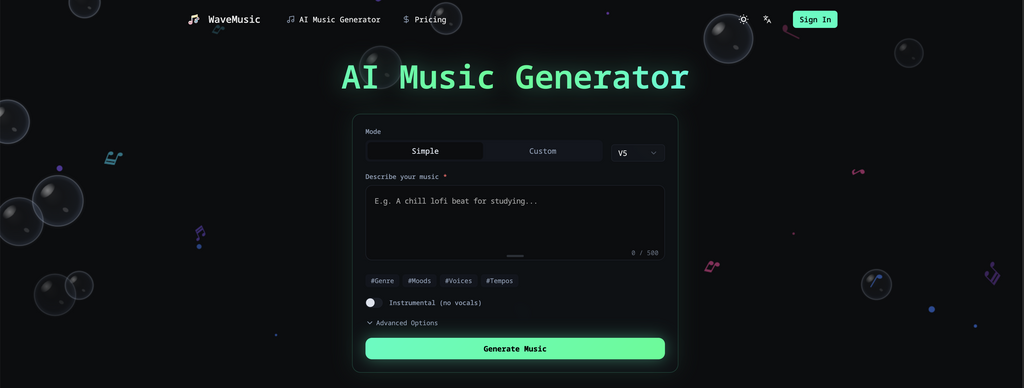
It functions as a specialized AI Music Generator that prioritizes “Sonic Space.” When you generate a track—whether it’s a Lo-Fi hip-hop beat for a study stream or a tense orchestral swell for a horror short—Wave Music ensures the frequencies are balanced. It leaves room in the mid-range for the human voice to cut through.
Why Creators Love It:
- Duration Matching: If your video intro is exactly 12.5 seconds, Wave Music generates a track that has a natural beginning and end within exactly 12.5 seconds. No more awkward fade-outs.
- Stem Separation: It allows you to download the drums, bass, and melody separately. This gives editors granular control—you can drop the drums when the dialogue starts and bring them back for the montage.
- Copyright Safety: Every track is generated from scratch. It creates a unique fingerprint, meaning you own the license and are safe from Content ID strikes.
Best Use Case: YouTube videos, Podcasts, Corporate Presentations, Game Development.
2. Luna Music
The Verdict: The Best for Songwriters & Vocal Tracks
While Wave Music dominates the instrumental side, Luna Music is the undisputed king of the “Full Song.”
If Wave Music is for the background, Luna Music is for the foreground. It was designed to solve the hardest problem in generative audio: Human Emotion.
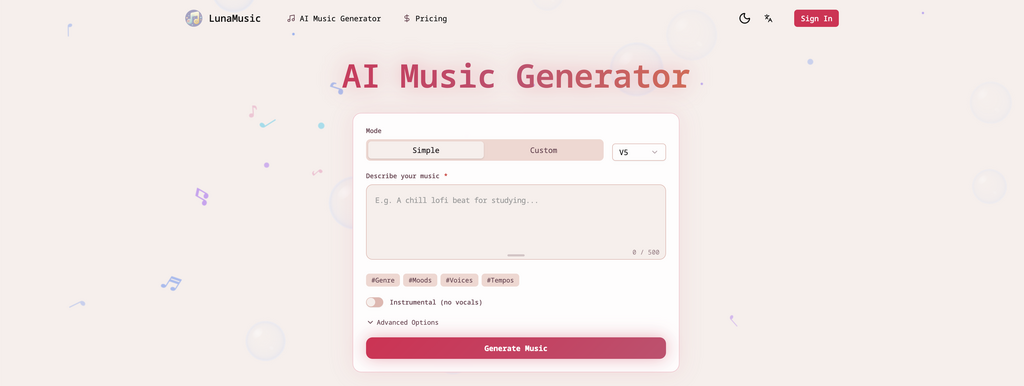
Critics often say AI music sounds “robotic” or “cold.” Luna Music destroys this stereotype. It acts as a comprehensive AI Song Generator that understands the nuances of a pop ballad, a rock anthem, or an R&B slow jam.
The “Ghost in the Machine”: What sets Luna apart is its Vocal Synthesis Engine. Most tools create vocals that sound like bad autotune. Luna’s vocals have “breath,” “vibrato,” and dynamic range. You can hear the “singer” strain for a high note or whisper a quiet verse.
It also understands Song Structure. When you prompt it, it doesn’t just loop a beat; it builds a narrative:
- Verse 1: Sets the scene with sparse instrumentation.
- Chorus: Explodes with energy and catchy hooks.
- Bridge: Changes the rhythm to create tension.
- Outro: Resolves the melody.
Best Use Case: Creating original songs, jingles, theme songs with vocals, and demoing songwriting ideas.
3. Suno
The Verdict: The Viral Heavyweight
You cannot talk about AI music without mentioning Suno. It is the tool that arguably started the mainstream craze. In 2026, Suno remains a powerhouse for High Fidelity.
Suno is famous for its “Wildcard” creativity. It is less of a precise tool for editors (like Wave) and more of a creative playground. You can type in the most absurd prompt imaginable—“A death metal song about a cute kitten eating a pancake”—and Suno will generate a track that sounds shockingly professional.
Pros:
- Audio Quality: The V4 model produces crisp, radio-ready audio.
- Creativity: Excellent at blending genres (e.g., “Operatic Rap”).
Cons:
- Control: It can be hard to get exactly what you want. It’s a bit of a slot machine—sometimes you get a hit, sometimes a miss.
4. Udio
The Verdict: The Musician’s Workbench
Udio targets a slightly different audience: the music prosumer. If you know what a “chord progression” or a “key change” is, Udio is likely the tool you will enjoy most.
Its standout feature is Inpainting. Let’s say you generate a great song, but the lyrics in the second verse are wrong. In other tools, you have to regenerate the whole song. In Udio, you can highlight just that 10-second section and say, “Redo this part but make it more intense.” This granular control makes it a favorite for producers who want to co-author with the AI.
Pros:
- Extensions: You can build a song 30 seconds at a time, steering the direction.
- Technical Control: More options for remixing and variation.
5. Soundraw
The Verdict: The Quick Fix for Layouts
Finally, we have Soundraw. While it lacks the vocal generation capabilities of Luna or Suno, it remains a staple for video editors because of its Interface.
Soundraw allows you to customize the arrangement of a track visually. You see blocks representing “Energy” levels (Low, Medium, High). You can click to change a section from High Energy to Low Energy instantly. It’s not generating a new song; it’s re-arranging the stems on the fly.
Pros:
- Speed: The fastest way to get a background track that fits a specific energy curve.
- Simplicity: No complex prompting required.
Comparison Guide: Which Tool is Right for You?
Choosing the best AI music generator depends entirely on your end goal. Here is the cheat sheet:
- “I am a Video Editor.” You need safe, high-quality background music that fits your edit. Go with: Wave Music. Its focus on BGM and instrumental clarity makes it the perfect AI Music Generator for content.
- “I am a Songwriter / I need Vocals.” You need a track with emotional depth, lyrics, and a human-sounding voice. Go with: Luna Music. Its structural understanding makes it the superior AI Song Generator for full compositions.
- “I just want to have fun / Make a meme.” You want the highest fidelity for a crazy idea. Go with: Suno or Udio.
The Future of Copyright
One final note for 2026: Ownership is King.
The biggest advantage of using tools like Wave and Luna over traditional stock libraries is the concept of “Zero-History Assets.” When you use a stock song, 10,000 other YouTubers might be using it too. If one of them gets a false claim, your video could be collateral damage.
When you generate a track with AI, that asset comes into existence the moment you hit “Generate.” It has no history, no baggage, and no previous copyright owner. For the serious creator, that peace of mind is worth the subscription alone.


You May Also Like

PMI-ACP Exam Preparation: How to Use a Simulator and Practice Questions Effectively

What a $900 Investment in New Crypto Protocols Could Become by Late 2027