

ETF Outflows Signal Weak Crypto Demand at Start of 2026
Early 2026 has opened with a visible contraction in crypto demand, particularly across spot Bitcoin ETFs. According to a recent report shared by Grawlls, liquidity conditions are tightening as investors adopt a more defensive posture.
After two years characterized by strong capital inflows and expanding speculative participation, the beginning of 2026 reflects risk reduction rather than renewed expansion.
ETF Flows Turn Negative
Recent data indicates that cumulative spot Bitcoin ETF flows have turned negative this year, with approximately $1.8 billion in net outflows recorded so far in 2026.
This marks a notable contrast with 2024 and early 2025, periods defined by consistent inflows and significant liquidity expansion. During those phases, ETF demand acted as a structural driver for spot market stability.
However, momentum had already begun fading before the year closed. Cumulative ETF inflows declined from roughly $27 billion to $20 billion by the end of 2025, signaling deceleration prior to the new year. In that context, current weakness appears more like continuation than abrupt reversal.
Liquidity Channel Weakens
ETF flows have played a meaningful role in absorbing supply and stabilizing price structure. With that channel currently subdued, spot markets are becoming more sensitive to selling pressure and short-term volatility.
Reduced ETF participation removes a consistent source of demand that previously supported higher liquidity conditions. As a result, price movements may become more reactive until institutional flows return.
Structural Outlook
The early 2026 environment reflects caution amid macroeconomic and geopolitical uncertainty. Investors appear to be reassessing exposure rather than aggressively deploying capital.
A sustained return of ETF inflows would likely serve as a key structural catalyst. Without that liquidity support, market structure remains fragile and flow-dependent rather than expansionary.
The post ETF Outflows Signal Weak Crypto Demand at Start of 2026 appeared first on ETHNews.
You May Also Like
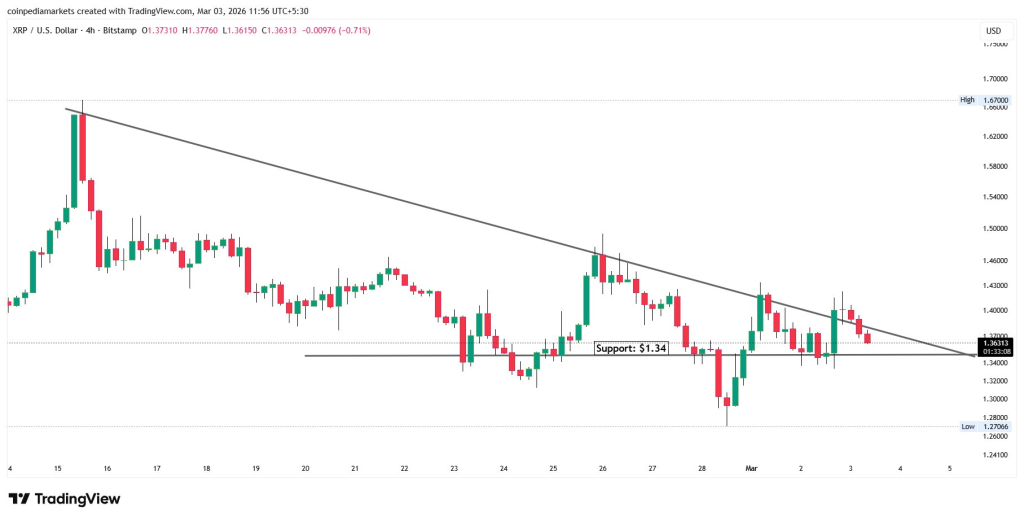
Warning Signs Flash for $XRP as $1.34 Support Gets Tested

PiDex Testnet Launch: What It Means for Pi Network and Picoin Value
