By Bill Qian This article is a companion piece to "How to Protect Wealth in War." Let’s discuss the following questions: First, what exactly is wealth storage; second, why has gold become the winner in modern times; and third, why Bitcoin will be the better “gold” in the 21st century and beyond. For the past 5,000 years, competition for the "best store of value" has persisted. Gold, thanks to its scarcity and millennia-old consensus on value, has gradually become the king of wealth storage. Meanwhile, Bitcoin is slowly undermining and challenging gold's market dominance, and in the process, it is bringing our generation an opportunity for epic wealth creation and transfer. The History of Money To compare gold and Bitcoin, let’s first talk about the largest category in the category: money. Money has three core functions: a medium of exchange, a unit of account, and a store of value. From shells and copper coins to modern fiat currencies like the US dollar and the euro, these two functions have evolved over time. Gold, silver, land, and blue-chip stocks have long served as the mainstream store of value. In monetary history, the US dollar during the Bretton Woods era was one of the few currencies to simultaneously fulfill the three functions of medium of exchange, unit of account, and store of wealth. However, this was a unique case, not a common one. Furthermore, the dollar's trifecta of functions gradually disintegrated after Nixon's 1971 televised address. Some might ask, "Why then do so many people in emerging markets want to use and save in US dollars, even though data shows a continuous depreciation of the dollar?" I believe the answer is: they have no better alternatives; their own currencies are even worse. This topic brings us to the topic of stablecoins, which we'll discuss in the next issue. How did gold become the “gold” it is today? A good store of wealth must meet five characteristics: scarcity, durability, portability, divisibility, and social consensus. Silver, land, and diamonds struggle to outperform gold on these five metrics. So, after tens of thousands of years, gold finally won the consensus and minds of mankind and became almost the only target for wealth storage. What are the limitations of gold? Storing gold requires expensive safe deposit boxes, insurance, and sometimes even transportation costs, and the larger the amount, the higher the cost. During World War II, the gold stored in the safes of the Bank of Paris was directly looted by the German army. The biggest lesson I learned from this incident is that what's safe in the bank is not safe at all. 2. In extreme times, the cost of converting gold into cash is high. Similar situations occurred during World War II. Whether trading in Shanghai, Paris, or Amsterdam, gold often comes at a steep discount, often 30-50% below the spot price. Discounts are even greater in high-risk environments. Even worse, trading gold in conflict zones often carries serious personal risks. Once others know you are holding gold bars, you could be robbed or even murdered at any time. 3. Governments can further undermine the reliability of gold holdings through confiscation and price controls. For example, in 1933, the United States required citizens to surrender most of their gold at a fixed price below market value, or face severe penalties. Note: At the time, the US government required all citizens to surrender their gold at a fixed price of $20.67 per troy ounce. Subsequently, with the passage of the Gold Reserve Act in 1934, the government revalued the official price of gold to $35 per troy ounce. This meant that the value of gold held by all citizens decreased by approximately 41% in just one year. The US confiscation of over 2,600 tons of gold directly altered monetary policy and laid the groundwork for the final end of the gold standard in 1971. All of this took place in the 20th century in the United States, arguably the world's most revered beacon of private property. 4. In addition, in today's digital economy, the limitations of gold's lack of "digitalization" are also obvious. For example, you cannot send a kilogram of gold to your friend or to another address through any electronic wallet. “In 2009, Bitcoin appeared! What is it?” Bitcoin, created in 2009 by the pseudonymous Satoshi Nakamoto, is the first decentralized digital currency. It runs on a global, public, and open computer network (commonly known as a blockchain, a name I've always found puzzling)—a shared digital ledger that anyone can participate in and verify. New bitcoins are generated through "mining": computers solve complex mathematical puzzles to package transactions into new "blocks" and add them to the blockchain. Miners are rewarded with newly generated bitcoins. This process ensures the security and smooth operation of the entire system.By Bill Qian This article is a companion piece to "How to Protect Wealth in War." Let’s discuss the following questions: First, what exactly is wealth storage; second, why has gold become the winner in modern times; and third, why Bitcoin will be the better “gold” in the 21st century and beyond. For the past 5,000 years, competition for the "best store of value" has persisted. Gold, thanks to its scarcity and millennia-old consensus on value, has gradually become the king of wealth storage. Meanwhile, Bitcoin is slowly undermining and challenging gold's market dominance, and in the process, it is bringing our generation an opportunity for epic wealth creation and transfer. The History of Money To compare gold and Bitcoin, let’s first talk about the largest category in the category: money. Money has three core functions: a medium of exchange, a unit of account, and a store of value. From shells and copper coins to modern fiat currencies like the US dollar and the euro, these two functions have evolved over time. Gold, silver, land, and blue-chip stocks have long served as the mainstream store of value. In monetary history, the US dollar during the Bretton Woods era was one of the few currencies to simultaneously fulfill the three functions of medium of exchange, unit of account, and store of wealth. However, this was a unique case, not a common one. Furthermore, the dollar's trifecta of functions gradually disintegrated after Nixon's 1971 televised address. Some might ask, "Why then do so many people in emerging markets want to use and save in US dollars, even though data shows a continuous depreciation of the dollar?" I believe the answer is: they have no better alternatives; their own currencies are even worse. This topic brings us to the topic of stablecoins, which we'll discuss in the next issue. How did gold become the “gold” it is today? A good store of wealth must meet five characteristics: scarcity, durability, portability, divisibility, and social consensus. Silver, land, and diamonds struggle to outperform gold on these five metrics. So, after tens of thousands of years, gold finally won the consensus and minds of mankind and became almost the only target for wealth storage. What are the limitations of gold? Storing gold requires expensive safe deposit boxes, insurance, and sometimes even transportation costs, and the larger the amount, the higher the cost. During World War II, the gold stored in the safes of the Bank of Paris was directly looted by the German army. The biggest lesson I learned from this incident is that what's safe in the bank is not safe at all. 2. In extreme times, the cost of converting gold into cash is high. Similar situations occurred during World War II. Whether trading in Shanghai, Paris, or Amsterdam, gold often comes at a steep discount, often 30-50% below the spot price. Discounts are even greater in high-risk environments. Even worse, trading gold in conflict zones often carries serious personal risks. Once others know you are holding gold bars, you could be robbed or even murdered at any time. 3. Governments can further undermine the reliability of gold holdings through confiscation and price controls. For example, in 1933, the United States required citizens to surrender most of their gold at a fixed price below market value, or face severe penalties. Note: At the time, the US government required all citizens to surrender their gold at a fixed price of $20.67 per troy ounce. Subsequently, with the passage of the Gold Reserve Act in 1934, the government revalued the official price of gold to $35 per troy ounce. This meant that the value of gold held by all citizens decreased by approximately 41% in just one year. The US confiscation of over 2,600 tons of gold directly altered monetary policy and laid the groundwork for the final end of the gold standard in 1971. All of this took place in the 20th century in the United States, arguably the world's most revered beacon of private property. 4. In addition, in today's digital economy, the limitations of gold's lack of "digitalization" are also obvious. For example, you cannot send a kilogram of gold to your friend or to another address through any electronic wallet. “In 2009, Bitcoin appeared! What is it?” Bitcoin, created in 2009 by the pseudonymous Satoshi Nakamoto, is the first decentralized digital currency. It runs on a global, public, and open computer network (commonly known as a blockchain, a name I've always found puzzling)—a shared digital ledger that anyone can participate in and verify. New bitcoins are generated through "mining": computers solve complex mathematical puzzles to package transactions into new "blocks" and add them to the blockchain. Miners are rewarded with newly generated bitcoins. This process ensures the security and smooth operation of the entire system.

Beyond Consensus and Mind: Why Bitcoin is a Better "Gold"

2025/08/22 08:00

By Bill Qian

This article is a companion piece to "How to Protect Wealth in War."

Let’s discuss the following questions: First, what exactly is wealth storage; second, why has gold become the winner in modern times; and third, why Bitcoin will be the better “gold” in the 21st century and beyond.

For the past 5,000 years, competition for the "best store of value" has persisted. Gold, thanks to its scarcity and millennia-old consensus on value, has gradually become the king of wealth storage. Meanwhile, Bitcoin is slowly undermining and challenging gold's market dominance, and in the process, it is bringing our generation an opportunity for epic wealth creation and transfer.

The History of Money

To compare gold and Bitcoin, let’s first talk about the largest category in the category: money.

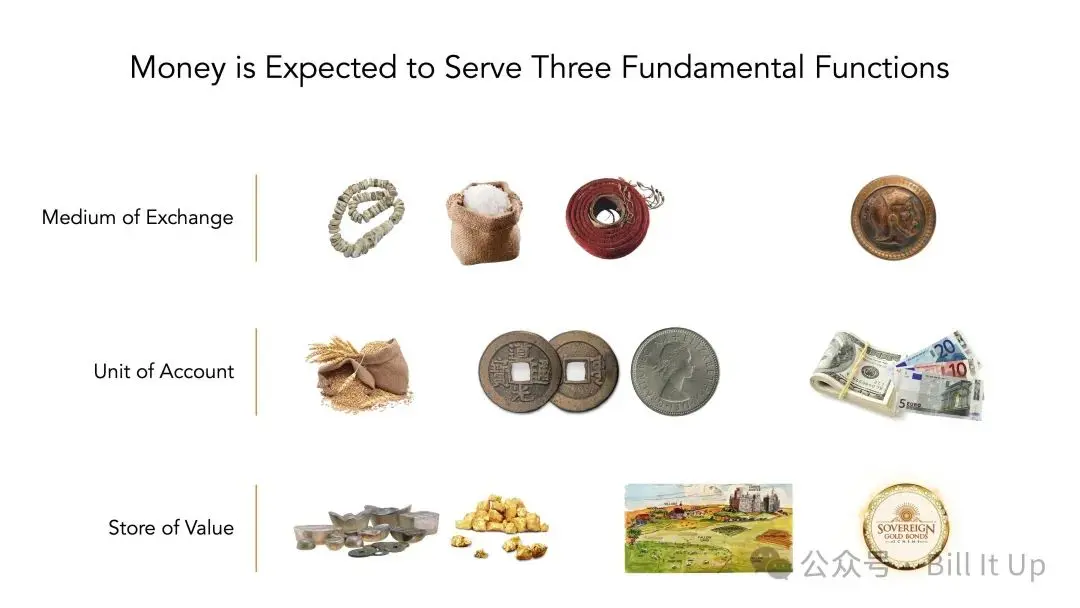
Money has three core functions: a medium of exchange, a unit of account, and a store of value. From shells and copper coins to modern fiat currencies like the US dollar and the euro, these two functions have evolved over time. Gold, silver, land, and blue-chip stocks have long served as the mainstream store of value.

In monetary history, the US dollar during the Bretton Woods era was one of the few currencies to simultaneously fulfill the three functions of medium of exchange, unit of account, and store of wealth. However, this was a unique case, not a common one. Furthermore, the dollar's trifecta of functions gradually disintegrated after Nixon's 1971 televised address. Some might ask, "Why then do so many people in emerging markets want to use and save in US dollars, even though data shows a continuous depreciation of the dollar?" I believe the answer is: they have no better alternatives; their own currencies are even worse. This topic brings us to the topic of stablecoins, which we'll discuss in the next issue.
How did gold become the “gold” it is today?

A good store of wealth must meet five characteristics: scarcity, durability, portability, divisibility, and social consensus. Silver, land, and diamonds struggle to outperform gold on these five metrics.

So, after tens of thousands of years, gold finally won the consensus and minds of mankind and became almost the only target for wealth storage.

What are the limitations of gold?

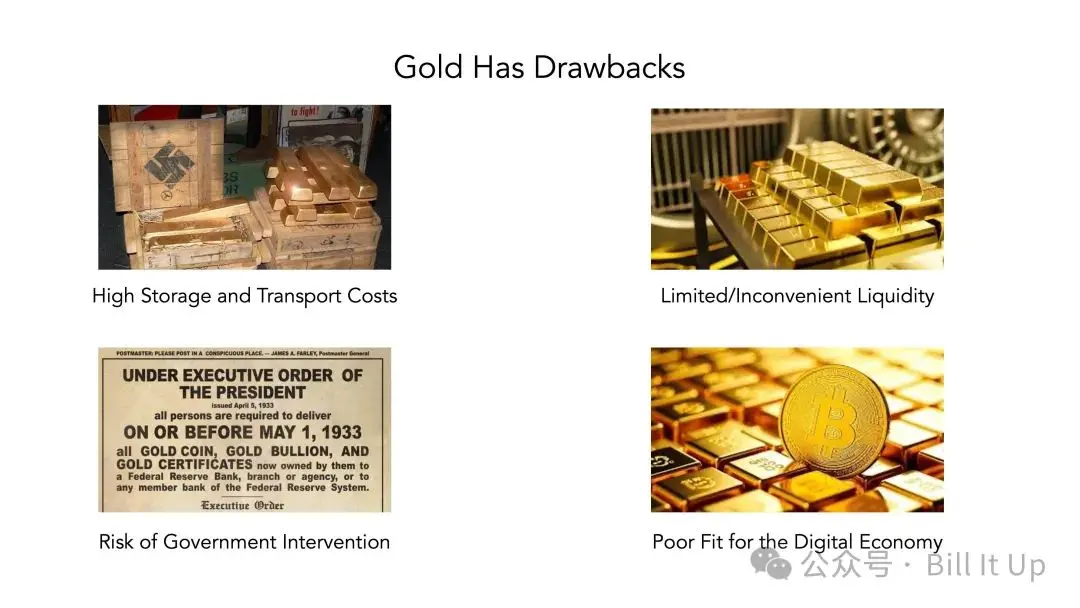
Storing gold requires expensive safe deposit boxes, insurance, and sometimes even transportation costs, and the larger the amount, the higher the cost. During World War II, the gold stored in the safes of the Bank of Paris was directly looted by the German army. The biggest lesson I learned from this incident is that what's safe in the bank is not safe at all.

2. In extreme times, the cost of converting gold into cash is high. Similar situations occurred during World War II. Whether trading in Shanghai, Paris, or Amsterdam, gold often comes at a steep discount, often 30-50% below the spot price. Discounts are even greater in high-risk environments. Even worse, trading gold in conflict zones often carries serious personal risks. Once others know you are holding gold bars, you could be robbed or even murdered at any time.

3. Governments can further undermine the reliability of gold holdings through confiscation and price controls. For example, in 1933, the United States required citizens to surrender most of their gold at a fixed price below market value, or face severe penalties. Note: At the time, the US government required all citizens to surrender their gold at a fixed price of $20.67 per troy ounce. Subsequently, with the passage of the Gold Reserve Act in 1934, the government revalued the official price of gold to $35 per troy ounce. This meant that the value of gold held by all citizens decreased by approximately 41% in just one year. The US confiscation of over 2,600 tons of gold directly altered monetary policy and laid the groundwork for the final end of the gold standard in 1971. All of this took place in the 20th century in the United States, arguably the world's most revered beacon of private property.

4. In addition, in today's digital economy, the limitations of gold's lack of "digitalization" are also obvious. For example, you cannot send a kilogram of gold to your friend or to another address through any electronic wallet.
“In 2009, Bitcoin appeared! What is it?”

Bitcoin, created in 2009 by the pseudonymous Satoshi Nakamoto, is the first decentralized digital currency. It runs on a global, public, and open computer network (commonly known as a blockchain, a name I've always found puzzling)—a shared digital ledger that anyone can participate in and verify. New bitcoins are generated through "mining": computers solve complex mathematical puzzles to package transactions into new "blocks" and add them to the blockchain. Miners are rewarded with newly generated bitcoins. This process ensures the security and smooth operation of the entire system.


Market Opportunity
Safe Road Club Logo
Safe Road Club Price(SRC)
$0.001785
$0.001785$0.001785
-0.16%
USD
Safe Road Club (SRC) Live Price Chart
Disclaimer: The articles reposted on this site are sourced from public platforms and are provided for informational purposes only. They do not necessarily reflect the views of MEXC. All rights remain with the original authors. If you believe any content infringes on third-party rights, please contact service@support.mexc.com for removal. MEXC makes no guarantees regarding the accuracy, completeness, or timeliness of the content and is not responsible for any actions taken based on the information provided. The content does not constitute financial, legal, or other professional advice, nor should it be considered a recommendation or endorsement by MEXC.

You May Also Like

Is Putnam Global Technology A (PGTAX) a strong mutual fund pick right now?

Is Putnam Global Technology A (PGTAX) a strong mutual fund pick right now?

The post Is Putnam Global Technology A (PGTAX) a strong mutual fund pick right now? appeared on BitcoinEthereumNews.com. On the lookout for a Sector – Tech fund? Starting with Putnam Global Technology A (PGTAX – Free Report) should not be a possibility at this time. PGTAX possesses a Zacks Mutual Fund Rank of 4 (Sell), which is based on various forecasting factors like size, cost, and past performance. Objective We note that PGTAX is a Sector – Tech option, and this area is loaded with many options. Found in a wide number of industries such as semiconductors, software, internet, and networking, tech companies are everywhere. Thus, Sector – Tech mutual funds that invest in technology let investors own a stake in a notoriously volatile sector, but with a much more diversified approach. History of fund/manager Putnam Funds is based in Canton, MA, and is the manager of PGTAX. The Putnam Global Technology A made its debut in January of 2009 and PGTAX has managed to accumulate roughly $650.01 million in assets, as of the most recently available information. The fund is currently managed by Di Yao who has been in charge of the fund since December of 2012. Performance Obviously, what investors are looking for in these funds is strong performance relative to their peers. PGTAX has a 5-year annualized total return of 14.46%, and is in the middle third among its category peers. But if you are looking for a shorter time frame, it is also worth looking at its 3-year annualized total return of 27.02%, which places it in the middle third during this time-frame. It is important to note that the product’s returns may not reflect all its expenses. Any fees not reflected would lower the returns. Total returns do not reflect the fund’s [%] sale charge. If sales charges were included, total returns would have been lower. When looking at a fund’s performance, it…
Share
BitcoinEthereumNews2025/09/18 04:05
The whale "pension-usdt.eth" has reduced its ETH long positions by 10,000 coins, and its futures account has made a profit of $4.18 million in the past day.

The whale "pension-usdt.eth" has reduced its ETH long positions by 10,000 coins, and its futures account has made a profit of $4.18 million in the past day.

PANews reported on January 14th that, according to Hyperbot data monitoring, the whale "pension-usdt.eth" reduced its ETH long positions by 10,000 ETH in the past
Share
PANews2026/01/14 13:45
Kalshi debuts ecosystem hub with Solana and Base

Kalshi debuts ecosystem hub with Solana and Base

The post Kalshi debuts ecosystem hub with Solana and Base appeared on BitcoinEthereumNews.com. Kalshi, the US-regulated prediction market exchange, rolled out a new program on Wednesday called KalshiEco Hub. The initiative, developed in partnership with Solana and Coinbase-backed Base, is designed to attract builders, traders, and content creators to a growing ecosystem around prediction markets. By combining its regulatory footing with crypto-native infrastructure, Kalshi said it is aiming to become a bridge between traditional finance and onchain innovation. The hub offers grants, technical assistance, and marketing support to selected projects. Kalshi also announced that it will support native deposits of Solana’s SOL token and USDC stablecoin, making it easier for users already active in crypto to participate directly. Early collaborators include Kalshinomics, a dashboard for market analytics, and Verso, which is building professional-grade tools for market discovery and execution. Other partners, such as Caddy, are exploring ways to expand retail-facing trading experiences. Kalshi’s move to embrace blockchain partnerships comes at a time when prediction markets are drawing fresh attention for their ability to capture sentiment around elections, economic policy, and cultural events. Competitor Polymarket recently acquired QCEX — a derivatives exchange with a CFTC license — to pave its way back into US operations under regulatory compliance. At the same time, platforms like PredictIt continue to push for a clearer regulatory footing. The legal terrain remains complex, with some states issuing cease-and-desist orders over whether these event contracts count as gambling, not finance. This is a developing story. This article was generated with the assistance of AI and reviewed by editor Jeffrey Albus before publication. Get the news in your inbox. Explore Blockworks newsletters: Source: https://blockworks.co/news/kalshi-ecosystem-hub-solana-base
Share
BitcoinEthereumNews2025/09/18 04:40