By Marie Poteriaieva Source: Cointelegraph Compiled by: Shan Ouba, Golden Finance Key Takeaways Web3 daily active users: Remain at 24 million in the second quarter of 2025, but the compositionBy Marie Poteriaieva Source: Cointelegraph Compiled by: Shan Ouba, Golden Finance Key Takeaways Web3 daily active users: Remain at 24 million in the second quarter of 2025, but the composition

How to scientifically evaluate the quality of an altcoin?

2025/08/20 11:00

By Marie Poteriaieva

Source: Cointelegraph

Compiled by: Shan Ouba, Golden Finance

Key Takeaways

  • Web3 daily active users: Remain at 24 million in the second quarter of 2025, but the composition of each track is changing.
  • DeFi: ranks first with 240 million transactions per week, but Ethereum gas consumption is now mainly occupied by RWA, DePIN and AI.
  • Outperforming assets: Smart contract platform tokens, yield-generating DeFi and RWA tokens outperformed the market; AI and DePIN lagged despite strong narratives.

Altcoins are more than just speculative assets in lieu of Bitcoin. In most cases, they represent, or attempt to represent, specific areas of activity within the Web3 ecosystem, which is seen as a decentralized alternative to the traditional internet and its services.

To assess the current state and potential of the altcoin market, look beyond price alone. Metrics such as gas consumption, transaction volume, and unique active wallets (UAWs) can gauge activity and adoption, while token price performance reveals whether the market is following on-chain trends.

AI and social DApps are gaining widespread adoption

UAW (Unique Active Wallets) counts the number of unique addresses interacting with DApps, which can measure the breadth of user adoption to a certain extent (but may be overestimated due to multiple wallets or automated operations).

DappRadar's Q2 2025 report shows that daily wallet activity has stabilized at approximately 24 million. However, sector dominance is shifting. Crypto games remain the largest category, holding over 20% of the market, but this has declined compared to Q1. DeFi has also declined, from over 26% to less than 19%.

In contrast, social and AI-related DApps are gaining momentum. Farcaster leads the social space, with approximately 40,000 daily active users (UAWs). In the AI sector, agent-based protocols like Virtuals Protocol (VIRTUAL $1.18) are performing well, attracting approximately 1,900 UAWs weekly.
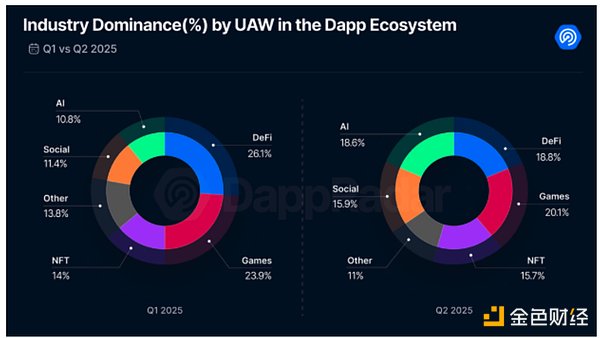
 UAW dominates the DApp industry. Source: DappRadar

DeFi attracts “big players”

The number of transactions shows how often smart contracts are triggered, but are vulnerable to bots and automation.

DeFi's transaction footprint is somewhat contradictory. Despite a decline in its user base, it still generates over 240 million transactions per week—more than any other Web3 category. Exchange-related activity (which may overlap with DeFi) further solidifies DeFi's dominance, while crypto games account for 100 million weekly transactions and the "Other" category (which excludes social but includes AI) accounts for 57 million transactions.
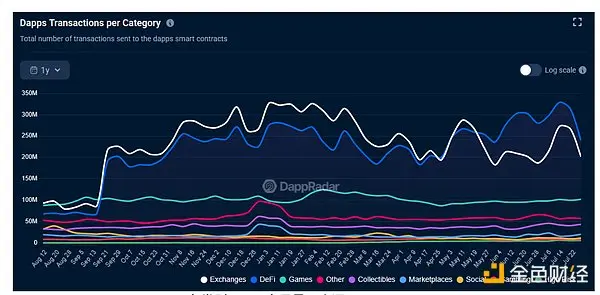
 DApp transaction volume by category. Source: DappRadar

The total value locked (TVL) is even more powerful. According to DefiLlama, DeFi TVL has reached $137 billion, a 150% increase since January 2024, but still below the peak of $177 billion at the end of 2021.

The divergence between rising TVL and declining UAW reflects a key theme of this cryptocurrency cycle: institutionalization. Capital is concentrating in fewer, larger wallets, and now also funds. This trend remains nascent due to regulatory uncertainty surrounding DeFi in many jurisdictions.

Still, institutions are testing the waters by providing liquidity to permissioned pools, lending through tokenized treasuries on platforms like Ondo Finance and Maple (SYROP), the latter also known for its partnership with investment bank Cantor Fitzgerald.

Meanwhile, as DeFi evolves into a capital-efficient layer geared towards large-scale yield generation rather than retail participation, protocol-level automation offered by DeFi services like Lido (LIDO) or EigenLayer further dampens wallet activity.

Other use cases are dominating Ethereum’s gas consumption

Transaction data alone cannot fully present the full picture of Web3, but Ethereum's gas usage can reveal the true distribution of economic and computing loads.

Data from Glassnode shows that although DeFi has always been a core sector of Ethereum, its gas consumption now accounts for only 11%; NFT once occupied a considerable share in 2022, but now it has dropped to 4%.

In contrast, the “Other” category has soared from approximately 25% in 2022 to over 58% today. This category encompasses services such as tokenized real-world assets (RWAs), decentralized physical infrastructure (DePINs), AI-driven DApps, and other more or less novel services that have the potential to define the next phase of Web3 growth.
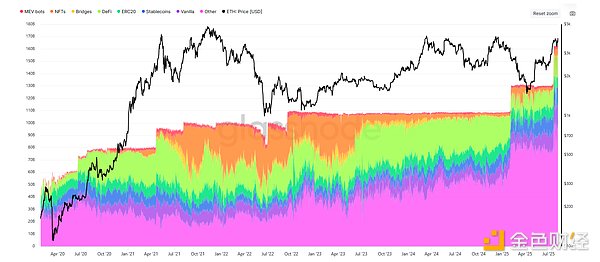
 Ethereum gas usage by category. Source: Glassnode

In particular, RWA is often regarded as one of the most promising crypto areas. Excluding stablecoins, its total size has jumped from $15.8 billion at the beginning of 2024 to $25.4 billion today, involving approximately 346,000 token holders.

Will prices follow the Web3 narrative?

Asset prices rarely keep pace with on-chain activity. Hype can drive price spikes in the short term, but sustained growth tends to align with sectors demonstrating real utility and adoption. Over the past year, infrastructure and yield-oriented projects have significantly outperformed sectors driven solely by narrative.

Smart contract platform tokens saw the strongest gains, with the top ten coin offerings averaging a 142% increase. HBAR saw a 360% surge, while XLM saw a 334% increase. As the foundational building blocks of Web3, the price growth of these tokens demonstrates investor confidence in the long-term development of the sector. DeFi tokens also performed well, averaging a 77% year-over-year increase, with Curve DAO (CRV) up 308% and Pendle (PENDLE) up 110%.

The top ten RWA tokens saw an average gain of 65%, primarily driven by XDC (+237%) and OUSG (+137%). DePIN sector highlights JasmyCoin (+72%) and Aethir (+39%) still saw average gains hovering around 10%.

AI tokens lagged significantly behind: the top ten pure AI projects saw a 25% year-over-year decline, with Bittensor (TAO) alone posting a 34% gain. Gaming tokens mostly declined, with SuperVerse (SUPER) alone experiencing a 750% surge over the past 12 months. Social tokens remain virtually absent from the crypto landscape, with major protocols still lacking native assets.

Overall, Web3 investment remains concentrated in mature sectors, driving up the native currencies of major smart contract platforms. Yield-oriented DeFi and RWA tokens have also delivered impressive returns. In contrast, the most hyped narratives—AI, Decentralized PINs, and social—have yet to translate this buzz into tangible token returns.

As adoption grows and more sectors mature, the gap between narrative and performance may narrow, but for now, investor confidence remains firmly rooted in the foundation of the decentralized economy.


Disclaimer: The articles reposted on this site are sourced from public platforms and are provided for informational purposes only. They do not necessarily reflect the views of MEXC. All rights remain with the original authors. If you believe any content infringes on third-party rights, please contact service@support.mexc.com for removal. MEXC makes no guarantees regarding the accuracy, completeness, or timeliness of the content and is not responsible for any actions taken based on the information provided. The content does not constitute financial, legal, or other professional advice, nor should it be considered a recommendation or endorsement by MEXC.

You May Also Like

Wormhole launches reserve tying protocol revenue to token

Wormhole launches reserve tying protocol revenue to token

The post Wormhole launches reserve tying protocol revenue to token appeared on BitcoinEthereumNews.com. Wormhole is changing how its W token works by creating a new reserve designed to hold value for the long term. Announced on Wednesday, the Wormhole Reserve will collect onchain and offchain revenues and other value generated across the protocol and its applications (including Portal) and accumulate them into W, locking the tokens within the reserve. The reserve is part of a broader update called W 2.0. Other changes include a 4% targeted base yield for tokenholders who stake and take part in governance. While staking rewards will vary, Wormhole said active users of ecosystem apps can earn boosted yields through features like Portal Earn. The team stressed that no new tokens are being minted; rewards come from existing supply and protocol revenues, keeping the cap fixed at 10 billion. Wormhole is also overhauling its token release schedule. Instead of releasing large amounts of W at once under the old “cliff” model, the network will shift to steady, bi-weekly unlocks starting October 3, 2025. The aim is to avoid sharp periods of selling pressure and create a more predictable environment for investors. Lockups for some groups, including validators and investors, will extend an additional six months, until October 2028. Core contributor tokens remain under longer contractual time locks. Wormhole launched in 2020 as a cross-chain bridge and now connects more than 40 blockchains. The W token powers governance and staking, with a capped supply of 10 billion. By redirecting fees and revenues into the new reserve, Wormhole is betting that its token can maintain value as demand for moving assets and data between chains grows. This is a developing story. This article was generated with the assistance of AI and reviewed by editor Jeffrey Albus before publication. Get the news in your inbox. Explore Blockworks newsletters: Source: https://blockworks.co/news/wormhole-launches-reserve
Share
BitcoinEthereumNews2025/09/18 01:55
The man accused of stealing $11 million in XRP has filed a countersuit against the widow of American country music singer George Jones.

The man accused of stealing $11 million in XRP has filed a countersuit against the widow of American country music singer George Jones.

PANews reported on January 14th that Kirk West, the man suspected of stealing over $11 million worth of XRP from Nancy Jones, the widow of the late American country
Share
PANews2026/01/14 10:51
Crucial Fed Rate Cut: October Probability Surges to 94%

Crucial Fed Rate Cut: October Probability Surges to 94%

BitcoinWorld Crucial Fed Rate Cut: October Probability Surges to 94% The financial world is buzzing with a significant development: the probability of a Fed rate cut in October has just seen a dramatic increase. This isn’t just a minor shift; it’s a monumental change that could ripple through global markets, including the dynamic cryptocurrency space. For anyone tracking economic indicators and their impact on investments, this update from the U.S. interest rate futures market is absolutely crucial. What Just Happened? Unpacking the FOMC Statement’s Impact Following the latest Federal Open Market Committee (FOMC) statement, market sentiment has decisively shifted. Before the announcement, the U.S. interest rate futures market had priced in a 71.6% chance of an October rate cut. However, after the statement, this figure surged to an astounding 94%. This jump indicates that traders and analysts are now overwhelmingly confident that the Federal Reserve will lower interest rates next month. Such a high probability suggests a strong consensus emerging from the Fed’s latest communications and economic outlook. A Fed rate cut typically means cheaper borrowing costs for businesses and consumers, which can stimulate economic activity. But what does this really signify for investors, especially those in the digital asset realm? Why is a Fed Rate Cut So Significant for Markets? When the Federal Reserve adjusts interest rates, it sends powerful signals across the entire financial ecosystem. A rate cut generally implies a more accommodative monetary policy, often enacted to boost economic growth or combat deflationary pressures. Impact on Traditional Markets: Stocks: Lower interest rates can make borrowing cheaper for companies, potentially boosting earnings and making stocks more attractive compared to bonds. Bonds: Existing bonds with higher yields might become more valuable, but new bonds will likely offer lower returns. Dollar Strength: A rate cut can weaken the U.S. dollar, making exports cheaper and potentially benefiting multinational corporations. Potential for Cryptocurrency Markets: The cryptocurrency market, while often seen as uncorrelated, can still react significantly to macro-economic shifts. A Fed rate cut could be interpreted as: Increased Risk Appetite: With traditional investments offering lower returns, investors might seek higher-yielding or more volatile assets like cryptocurrencies. Inflation Hedge Narrative: If rate cuts are perceived as a precursor to inflation, assets like Bitcoin, often dubbed “digital gold,” could gain traction as an inflation hedge. Liquidity Influx: A more accommodative monetary environment generally means more liquidity in the financial system, some of which could flow into digital assets. Looking Ahead: What Could This Mean for Your Portfolio? While the 94% probability for a Fed rate cut in October is compelling, it’s essential to consider the nuances. Market probabilities can shift, and the Fed’s ultimate decision will depend on incoming economic data. Actionable Insights: Stay Informed: Continue to monitor economic reports, inflation data, and future Fed statements. Diversify: A diversified portfolio can help mitigate risks associated with sudden market shifts. Assess Risk Tolerance: Understand how a potential rate cut might affect your specific investments and adjust your strategy accordingly. This increased likelihood of a Fed rate cut presents both opportunities and challenges. It underscores the interconnectedness of traditional finance and the emerging digital asset space. Investors should remain vigilant and prepared for potential volatility. The financial landscape is always evolving, and the significant surge in the probability of an October Fed rate cut is a clear signal of impending change. From stimulating economic growth to potentially fueling interest in digital assets, the implications are vast. Staying informed and strategically positioned will be key as we approach this crucial decision point. The market is now almost certain of a rate cut, and understanding its potential ripple effects is paramount for every investor. Frequently Asked Questions (FAQs) Q1: What is the Federal Open Market Committee (FOMC)? A1: The FOMC is the monetary policymaking body of the Federal Reserve System. It sets the federal funds rate, which influences other interest rates and economic conditions. Q2: How does a Fed rate cut impact the U.S. dollar? A2: A rate cut typically makes the U.S. dollar less attractive to foreign investors seeking higher returns, potentially leading to a weakening of the dollar against other currencies. Q3: Why might a Fed rate cut be good for cryptocurrency? A3: Lower interest rates can reduce the appeal of traditional investments, encouraging investors to seek higher returns in alternative assets like cryptocurrencies. It can also be seen as a sign of increased liquidity or potential inflation, benefiting assets like Bitcoin. Q4: Is a 94% probability a guarantee of a rate cut? A4: While a 94% probability is very high, it is not a guarantee. Market probabilities reflect current sentiment and data, but the Federal Reserve’s final decision will depend on all available economic information leading up to their meeting. Q5: What should investors do in response to this news? A5: Investors should stay informed about economic developments, review their portfolio diversification, and assess their risk tolerance. Consider how potential changes in interest rates might affect different asset classes and adjust strategies as needed. Did you find this analysis helpful? Share this article with your network to keep others informed about the potential impact of the upcoming Fed rate cut and its implications for the financial markets! To learn more about the latest crypto market trends, explore our article on key developments shaping Bitcoin price action. This post Crucial Fed Rate Cut: October Probability Surges to 94% first appeared on BitcoinWorld.
Share
Coinstats2025/09/18 02:25