Swan’s CEO Cory Klippsten has highlighted past Bitcoin crashes, proving that this latest crash isn’t the worst in BTC’s history. This comes as the leading cryptoSwan’s CEO Cory Klippsten has highlighted past Bitcoin crashes, proving that this latest crash isn’t the worst in BTC’s history. This comes as the leading crypto

Contrary To Popular Belief, This Is Not The Worst Bitcoin Crash In History – Here’s The List

2026/02/09 22:00
3 min read

Swan’s CEO Cory Klippsten has highlighted past Bitcoin crashes, proving that this latest crash isn’t the worst in BTC’s history. This comes as the leading crypto looks to recover, although experts warn that the crash may not be over yet. 

Crypto CEO Shares List Of Worst Bitcoin Crashes Ever

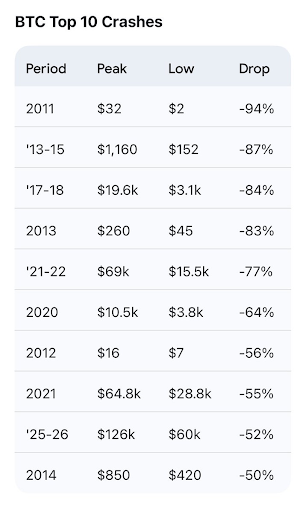
In an X post, the Swan CEO described the Bitcoin crash from its current all-time high (ATH) of $126,000 to $60,000 as the 9th-largest in its history. He shared a list of all the major crashes that the leading crypto has suffered since its inception. The largest crash was in 2011, when BTC dropped from a peak of $32 to $2, representing a 94% drawdown. 

The second-largest Bitcoin crash occurred between 2013 and 2015, when BTC fell 87% from a peak of $1,160 to a low of $152. The leading crypto suffered its third-largest crash between 2017 and 2018 when it dropped from $19,600 to $3,100, representing an 84% crash. The crash from $260 to $45 in 2013 and from $69,000 to $15,500 complete the top five largest crashes in Bitcoin’s history. 
Bitcoin

The Bitcoin crash from a peak of $126,000 to a low of $60,000 represents a 52% drawdown, which is why it ranks as the 9th-largest crash, just below the crash from $64,800 to $28,800 and above the crash from $850 to $420. However, based on predictions from experts such as veteran trader Peter Brandt, this recent sell-off may not yet be over. Brandt predicted that BTC could still drop to as low as $42,000, which could mark the bottom based on past bear cycles. 

Analyst Highlights Capitulation Candle on Bitcoin

Crypto analyst Michaël van de Poppe stated in an X post that the weekly BTC chart shows that the market has just witnessed the capitulation candle following the latest Bitcoin crash. He warned that this doesn’t mean that BTC can’t consolidate here and then test some lower levels. The analyst added that holding above the 2021 ATH of $69,000 is key, and that the capitulation candle indicates buying pressure that likely contributed to the rebound above $70,000. 

Michaël Van De Poppe also mentioned that the reversal for Bitcoin might not be quick, but given the sudden upside bounce, he believes the range between $65,000 and $70,000 is the bottom area for the coming weeks. As such, the analyst is confident that a BTC rally to as high as $85,000 is definitely on the cards. He also remarked that the leading crypto is closer to the bottom than the top. 

At the time of writing, the Bitcoin price is trading at around $71,000, up over 2% in the last 24 hours, according to data from CoinMarketCap.


Bitcoin
Market Opportunity
Notcoin Logo
Notcoin Price(NOT)
$0.0004008
$0.0004008$0.0004008
+0.37%
USD
Notcoin (NOT) Live Price Chart
Disclaimer: The articles reposted on this site are sourced from public platforms and are provided for informational purposes only. They do not necessarily reflect the views of MEXC. All rights remain with the original authors. If you believe any content infringes on third-party rights, please contact service@support.mexc.com for removal. MEXC makes no guarantees regarding the accuracy, completeness, or timeliness of the content and is not responsible for any actions taken based on the information provided. The content does not constitute financial, legal, or other professional advice, nor should it be considered a recommendation or endorsement by MEXC.
Tags:

You May Also Like

Hadron Labs Launches Bitcoin Summer on Neutron, Offering 5–10% BTC Yield

Hadron Labs Launches Bitcoin Summer on Neutron, Offering 5–10% BTC Yield

Hadron Labs launches 'Bitcoin Summer' on Neutron, BTC vaults for WBTC, eBTC, solvBTC, uniBTC and USDC. Earn 5–10% BTC via maxBTC, with up to 10x looping.
Share
Blockchainreporter2025/09/18 02:00
South Korea Launches First Won-Backed Stablecoin KRW1 on Avalanche

South Korea Launches First Won-Backed Stablecoin KRW1 on Avalanche

South Korea made history this week by launching its first Korean won-backed stablecoin.
Share
Brave Newcoin2025/09/19 03:15
Curve Finance votes on revenue-sharing model for CRV holders

Curve Finance votes on revenue-sharing model for CRV holders

The post Curve Finance votes on revenue-sharing model for CRV holders appeared on BitcoinEthereumNews.com. Curve Finance has proposed a new protocol called Yield Basis that would share revenue directly with CRV holders, marking a shift from one-off incentives to sustainable income. Summary Curve Finance has put forward a revenue-sharing protocol to give CRV holders sustainable income beyond emissions and fees. The plan would mint $60M in crvUSD to seed three Bitcoin liquidity pools (WBTC, cbBTC, tBTC), with 35–65% of revenue distributed to veCRV stakers. The DAO vote runs from up to Sept. 24, with the proposal seen as a major step to strengthen CRV tokenomics after past liquidity and governance challenges. Curve Finance founder Michael Egorov has introduced a proposal to give CRV token holders a more direct way to earn income, launching a system called Yield Basis that aims to turn the governance token into a sustainable, yield-bearing asset.  The proposal has been published on the Curve DAO (CRV) governance forum, with voting open until Sept. 24. A new model for CRV rewards Yield Basis is designed to distribute transparent and consistent returns to CRV holders who lock their tokens for veCRV governance rights. Unlike past incentive programs, which relied heavily on airdrops and emissions, the protocol channels income from Bitcoin-focused liquidity pools directly back to token holders. To start, Curve would mint $60 million worth of crvUSD, its over-collateralized stablecoin, with proceeds allocated across three pools — WBTC, cbBTC, and tBTC — each capped at $10 million. 25% of Yield Basis tokens would be reserved for the Curve ecosystem, and between 35% and 65% of Yield Basis’s revenue would be given to veCRV holders. By emphasizing Bitcoin (BTC) liquidity and offering yields without the short-term loss risks associated with automated market makers, the protocol hopes to draw in professional traders and institutions. Context and potential impact on Curve Finance The proposal comes as Curve continues to modify…
Share
BitcoinEthereumNews2025/09/18 14:37