Cardano’s first full‐cycle ecosystem budget has reached its finish line. On August 19, 2025, Intersect—Cardano’s member-based organization that facilitated the process—announced: “Our ecosystem budget and withdrawal process has now reached its conclusion… DReps have approved ₳264m in ecosystem funding.” In the same statement, Intersect said the pipeline began with 194 proposals submitted through GovTool and […]Cardano’s first full‐cycle ecosystem budget has reached its finish line. On August 19, 2025, Intersect—Cardano’s member-based organization that facilitated the process—announced: “Our ecosystem budget and withdrawal process has now reached its conclusion… DReps have approved ₳264m in ecosystem funding.” In the same statement, Intersect said the pipeline began with 194 proposals submitted through GovTool and […]

Cardano Closes 264 Million ADA Budget Cycle, IOG Takes Lead

Cardano’s first full‐cycle ecosystem budget has reached its finish line. On August 19, 2025, Intersect—Cardano’s member-based organization that facilitated the process—announced: “Our ecosystem budget and withdrawal process has now reached its conclusion… DReps have approved ₳264m in ecosystem funding.” In the same statement, Intersect said the pipeline began with 194 proposals submitted through GovTool and the Ekklesia poll, was refined off-chain to 40, and ultimately produced 39 on-chain treasury withdrawals—37 of which cleared the required thresholds.

First Cardano Budget Cycle Closes

Intersect added that “more than 30 vendors have now signed contracts,” with those agreements being published for public review. The live “Intersect Administered Contracts” ledger confirms a growing roster of counterparties and amounts—ranging from the ₳64.3 million “Catalyst 2025” program to infrastructure and tooling efforts such as a ZK bridge and maintenance of key developer libraries. Intersect says additional contracts will be posted in the days ahead “together with the funding of related smart contracts.”

The conclusion caps a months-long governance sequence that combined off-chain deliberation and on-chain ratification. In July, Intersect submitted 39 Treasury Withdrawal governance actions for DRep and Constitutional Committee scrutiny; throughout late July and early August, proposals began surpassing the 67% DRep supermajority threshold that marks passage under CIP-1694’s current regime. Intersect’s development updates documented the first wave of supermajorities and directed participants to follow each proposal’s progression epoch by epoch.

With votes cast and thresholds met, Intersect has outlined what happens next. After a proposal passes, it is ratified at the epoch boundary, then enacted one epoch later, moving funds from the Treasury to designated smart-contract holding addresses. Intersect’s administration team finalizes legal agreements, deploys vendor-specific contracts with milestone schedules, and co-signs them alongside an oversight committee. Intersect’s August guidance emphasized the three-stage sequence—ratification, enactment, administration—and pledged status updates as each vendor’s contract goes live on-chain.

The mechanics behind those disbursements have been built for transparency. Intersect’s knowledge base details an end-to-end flow: withdrawals fund partitioned “Treasury Contracts”; vendors sign written agreements; “Vendor Contracts” encode milestones and payment dates; the oversight committee holds keys to provide checks and balances; and vendors withdraw only as milestones mature. Funds sit effectively in escrow, are auditable on-chain, and unclaimed balances time out back to the Treasury.

To monitor the delivery phase, Intersect points the community to two public dashboards. A Smart Contract dashboard exposes milestone breakdowns, dates, and payment events for each funded project, while a Cardano Treasury dashboard tracks flows from the Treasury into the reserve and project contracts.

The now-published contract catalog provides a first look at how the approved ₳264 million will be administered across core infrastructure, governance tooling, developer experience, and ecosystem programs. Entries include continued development for the AdaStat explorer, ongoing maintenance of PyCardano, and a ZK bridge prototype—illustrating the mix of large-scale programs and targeted technical workstreams that made it through the final on-chain filters.

IOG Takes The Lead

Cardano’s single largest allocation goes to Input Output’s core protocol program. Intersect’s contract ledger lists ₳96,817,080 for the “2025 Input Output Engineering Core Development” proposal, dedicated to “engineering, maintenance, and development services to enhance and secure the Cardano protocol and its core infrastructure,” explicitly framed as delivery of the community-endorsed technical roadmap. A companion research track, “Input Output Research (IOR): Cardano Vision – Work Program 2025,” adds ₳26,840,000 for multi-year research and technology validation.

Intersect also shows two further IOG-administered items—₳5,159,000 to overhaul Project Catalyst’s technical stack and ₳1,300,000 to decentralize the Blockfrost API via a gateway and “Icebreaker” network—bringing Input Output–family contracts to roughly ₳130.1 million, just under half of the approved ₳264 million budget.

Input Output characterizes the engineering mandate as the first community-authorized core development program in Cardano’s history, approved with 73.93% support. In its newsroom statement, IOE says the funded roadmap will advance scalability, developer experience, and interoperability through initiatives including Ouroboros Leios, Hydra, Mithril enhancements, nested transactions, and Project Acropolis—a modular re-architecture of the node—with “faster sync times, lower RAM usage, and reduced operational costs for stake pool operators.”

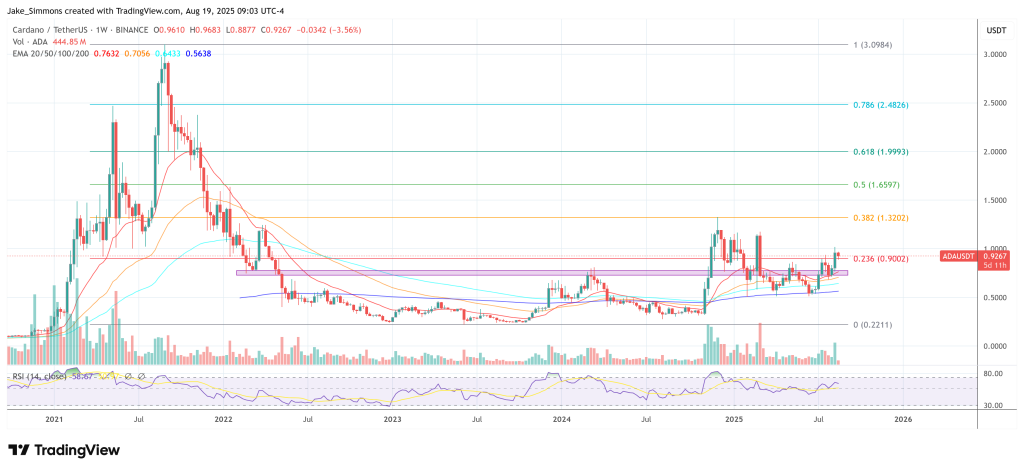
At press time, ADA traded at $0.92.
Cardano price
Market Opportunity
Cardano Logo
Cardano Price(ADA)
$0.4253
$0.4253$0.4253
+4.75%
USD
Cardano (ADA) Live Price Chart
Disclaimer: The articles reposted on this site are sourced from public platforms and are provided for informational purposes only. They do not necessarily reflect the views of MEXC. All rights remain with the original authors. If you believe any content infringes on third-party rights, please contact service@support.mexc.com for removal. MEXC makes no guarantees regarding the accuracy, completeness, or timeliness of the content and is not responsible for any actions taken based on the information provided. The content does not constitute financial, legal, or other professional advice, nor should it be considered a recommendation or endorsement by MEXC.

You May Also Like

Is Putnam Global Technology A (PGTAX) a strong mutual fund pick right now?

Is Putnam Global Technology A (PGTAX) a strong mutual fund pick right now?

The post Is Putnam Global Technology A (PGTAX) a strong mutual fund pick right now? appeared on BitcoinEthereumNews.com. On the lookout for a Sector – Tech fund? Starting with Putnam Global Technology A (PGTAX – Free Report) should not be a possibility at this time. PGTAX possesses a Zacks Mutual Fund Rank of 4 (Sell), which is based on various forecasting factors like size, cost, and past performance. Objective We note that PGTAX is a Sector – Tech option, and this area is loaded with many options. Found in a wide number of industries such as semiconductors, software, internet, and networking, tech companies are everywhere. Thus, Sector – Tech mutual funds that invest in technology let investors own a stake in a notoriously volatile sector, but with a much more diversified approach. History of fund/manager Putnam Funds is based in Canton, MA, and is the manager of PGTAX. The Putnam Global Technology A made its debut in January of 2009 and PGTAX has managed to accumulate roughly $650.01 million in assets, as of the most recently available information. The fund is currently managed by Di Yao who has been in charge of the fund since December of 2012. Performance Obviously, what investors are looking for in these funds is strong performance relative to their peers. PGTAX has a 5-year annualized total return of 14.46%, and is in the middle third among its category peers. But if you are looking for a shorter time frame, it is also worth looking at its 3-year annualized total return of 27.02%, which places it in the middle third during this time-frame. It is important to note that the product’s returns may not reflect all its expenses. Any fees not reflected would lower the returns. Total returns do not reflect the fund’s [%] sale charge. If sales charges were included, total returns would have been lower. When looking at a fund’s performance, it…
Share
BitcoinEthereumNews2025/09/18 04:05
The whale "pension-usdt.eth" has reduced its ETH long positions by 10,000 coins, and its futures account has made a profit of $4.18 million in the past day.

The whale "pension-usdt.eth" has reduced its ETH long positions by 10,000 coins, and its futures account has made a profit of $4.18 million in the past day.

PANews reported on January 14th that, according to Hyperbot data monitoring, the whale "pension-usdt.eth" reduced its ETH long positions by 10,000 ETH in the past
Share
PANews2026/01/14 13:45
Kalshi debuts ecosystem hub with Solana and Base

Kalshi debuts ecosystem hub with Solana and Base

The post Kalshi debuts ecosystem hub with Solana and Base appeared on BitcoinEthereumNews.com. Kalshi, the US-regulated prediction market exchange, rolled out a new program on Wednesday called KalshiEco Hub. The initiative, developed in partnership with Solana and Coinbase-backed Base, is designed to attract builders, traders, and content creators to a growing ecosystem around prediction markets. By combining its regulatory footing with crypto-native infrastructure, Kalshi said it is aiming to become a bridge between traditional finance and onchain innovation. The hub offers grants, technical assistance, and marketing support to selected projects. Kalshi also announced that it will support native deposits of Solana’s SOL token and USDC stablecoin, making it easier for users already active in crypto to participate directly. Early collaborators include Kalshinomics, a dashboard for market analytics, and Verso, which is building professional-grade tools for market discovery and execution. Other partners, such as Caddy, are exploring ways to expand retail-facing trading experiences. Kalshi’s move to embrace blockchain partnerships comes at a time when prediction markets are drawing fresh attention for their ability to capture sentiment around elections, economic policy, and cultural events. Competitor Polymarket recently acquired QCEX — a derivatives exchange with a CFTC license — to pave its way back into US operations under regulatory compliance. At the same time, platforms like PredictIt continue to push for a clearer regulatory footing. The legal terrain remains complex, with some states issuing cease-and-desist orders over whether these event contracts count as gambling, not finance. This is a developing story. This article was generated with the assistance of AI and reviewed by editor Jeffrey Albus before publication. Get the news in your inbox. Explore Blockworks newsletters: Source: https://blockworks.co/news/kalshi-ecosystem-hub-solana-base
Share
BitcoinEthereumNews2025/09/18 04:40