Bitcoin has had its share of ups and downs this year. After breaking a new all-time high above $124K, it now hovers closer to $118K. Traders call it a cooldown, a moment where the sprinter slows to catch their breath before the next surge. In the middle of this pause, one new crypto project is […]Bitcoin has had its share of ups and downs this year. After breaking a new all-time high above $124K, it now hovers closer to $118K. Traders call it a cooldown, a moment where the sprinter slows to catch their breath before the next surge. In the middle of this pause, one new crypto project is […]

Bitcoin Hyper ($HYPER) Defies Market Dip and Raises $10.6M in Presale

Bitcoin has had its share of ups and downs this year. After breaking a new all-time high above $124K, it now hovers closer to $118K.

Traders call it a cooldown, a moment where the sprinter slows to catch their breath before the next surge.

In the middle of this pause, one new crypto project is making waves.

Bitcoin Hyper ($HYPER), a brand-new Layer 2 solution, has already raised more than $10.6M in its presale, at a current price of just $0.012755 per token.

Backed by a big vision and some very big whale buys, it is quickly being called one of the best presale events of 2025.

The Challenge: Bitcoin’s Speed Bumps

Bitcoin is the king of crypto. It’s the oldest, the most secure, and the most recognized name in the digital asset world. But even kings have flaws.

Ask anyone who has tried sending Bitcoin on a busy day, and you’ll hear the same story: slow confirmations and fees that make small payments nearly pointless.

A single on-chain transaction can take several minutes to settle. During peak periods, fees jump so high that sending $20 of $BTC could cost $10 in fees.
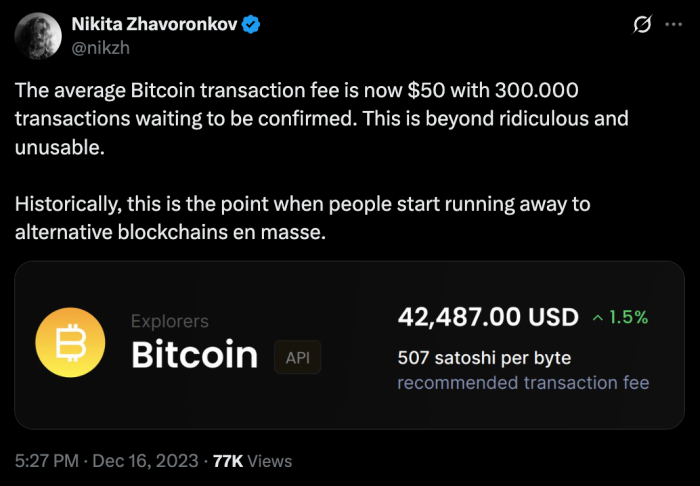
bitcoin transaction fees post on x.

That’s like paying a taxi driver double the fare just to start the meter.

And while Bitcoin can handle around seven transactions per second, modern payment systems process thousands per second. Visa averages more than 1,7K. That gap means Bitcoin, as it stands, can’t serve the daily needs of billions of people.

The other problem is programmability. Unlike Ethereum or Solana, Bitcoin doesn’t natively support smart contracts or decentralized apps.

Developers have to build clunky workarounds or rely entirely on other chains.

That has left Bitcoin sitting comfortably as a store of value, but largely sidelined from the DeFi boom, NFT markets, and even the meme coins craze that has dominated headlines.

The Solution: Bitcoin Hyper ($HYPER) Steps In

Bitcoin Hyper ($HYPER) was designed to make Bitcoin usable again as digital money, not just digital gold. It does this by introducing a fast, scalable Layer 2 that runs on top of the Bitcoin blockchain.

At its core is something called the Canonical Bridge. This bridge allows users to lock up their $BTC on Bitcoin’s base layer, mint wrapped Bitcoin (WBTC) on Bitcoin Hyper’s Layer 2.

how bitcoin layer 2 works.

When they want their native $BTC back, they burn the wrapped tokens and unlock their coins on the main chain.

What makes Bitcoin Hyper different is speed and power. The project integrates the Solana Virtual Machine (SVM), which means it can run Solana programs natively.

Imagine strapping a rocket booster onto Bitcoin’s reliable but slow engine. The result is lightning-fast, low-cost transactions and the ability to run scalable smart contracts.

Developers who know Solana can now bring their dApps directly into the Bitcoin ecosystem, something that was never possible before.

This solution could help Bitcoin rise even higher in relevance.

Right now, Bitcoin dominates as a store of value. But with Bitcoin Hyper, it can also become the backbone of everyday payments and programmable money.

That’s huge. If Bitcoin can finally combine security, scarcity, and usability, the upside for the whole ecosystem is massive.

Why Investors Are Buying $HYPER Now

The presale numbers speak for themselves.

More than $10.6M has already been raised, and you can buy $HYPER for just $0.012755.

bitcoin hyper $10M post on X.

Investors are not just retail buyers either. Whales have been making major moves, including single transactions of $161K and $100K.

That kind of heavy accumulation is a strong signal that deep-pocketed players see the project’s potential. But what makes this one of the best altcoins of 2025 isn’t only the hype. The $HYPER token has real utility.

It is used for transaction fees, staking rewards, unlocking premium dApp features, developer grants, and will eventually power governance through a DAO.

The financial case is just as compelling. The Bitcoin payments market is projected to reach $3.7T by 2031.

Bitcoin Hyper doesn’t need to dominate that market to win big. Even capturing a small slice of it could make the project worth billions.

On top of that, staking is already live, with early buyers earning an eye-catching 110% annual yield. And with a total supply of 21B tokens, transparency is built into the system.
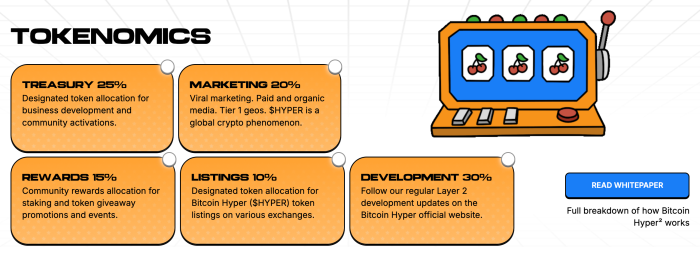
bitcoin hyper tokenomics.

For investors who are tired of chasing meme coins or looking for the next new crypto to back, Bitcoin Hyper looks like one of the best presale opportunities in the space right now.

It’s listed in Best Wallet’s ‘Upcoming Tokens’ section, a curated list of projects expected to make a splash, which adds another layer of credibility.

Bitcoin Hyper’s Big Moment

Bitcoin Hyper has captured attention at the perfect time.

With over $10.6M raised in its presale and whales making six-figure buys, it’s proving there’s serious demand for a faster, more usable Bitcoin.

The project’s Layer 2 design tackles Bitcoin’s biggest flaws – speed, fees, and programmability – while keeping its core security intact.

If it delivers, Bitcoin could evolve from being just digital gold to becoming the backbone of everyday payments, DeFi, and Web3.

For investors scanning the altcoin space, $HYPER is emerging as one of the best crypto presales in 2025.

This article is for informational purposes only and not financial advice. Always do your own research (DYOR) before investing in crypto.


Market Opportunity
Hyperlane Logo
Hyperlane Price(HYPER)
$0.13723
$0.13723$0.13723
-3.20%
USD
Hyperlane (HYPER) Live Price Chart
Disclaimer: The articles reposted on this site are sourced from public platforms and are provided for informational purposes only. They do not necessarily reflect the views of MEXC. All rights remain with the original authors. If you believe any content infringes on third-party rights, please contact service@support.mexc.com for removal. MEXC makes no guarantees regarding the accuracy, completeness, or timeliness of the content and is not responsible for any actions taken based on the information provided. The content does not constitute financial, legal, or other professional advice, nor should it be considered a recommendation or endorsement by MEXC.

You May Also Like

Ethereum Fusaka Upgrade Set for December 3 Mainnet Launch, Blob Capacity to Double

Ethereum Fusaka Upgrade Set for December 3 Mainnet Launch, Blob Capacity to Double

Ethereum developers confirmed the Fusaka upgrade will activate on mainnet on December 3, 2025, following a systematic testnet rollout beginning on October 1 on Holesky. The major hard fork will implement around 11-12 Ethereum Improvement Proposals targeting scalability, node efficiency, and data availability improvements without adding new user-facing features. According to Christine Kim, the upgrade introduces a phased blob capacity expansion through Blob Parameter Only forks occurring two weeks after Fusaka activation. Initially maintaining current blob limits of 6/9 target/max, the first BPO fork will increase capacity to 10/15 blobs one week later. A second BPO fork will further expand limits to 14/21 blobs, more than doubling total capacity within two weeks. Strategic Infrastructure Overhaul Fusaka prioritizes backend protocol improvements over user-facing features, focusing on making Ethereum faster and less resource-intensive. The upgrade includes PeerDAS implementation through EIP-7594, allowing validator nodes to verify data by sampling small pieces rather than downloading entire blobs. This reduces bandwidth and storage requirements while enhancing Layer 2 rollup scalability. The upgrade builds on recent gas limit increases from 30 million to 45 million gas, with ongoing discussions for further expansion. EIP-7935 proposes increasing limits to 150 million gas, potentially enabling significantly higher transaction throughput. These improvements complement broader scalability efforts, including EIP-9698, which suggests a 100x gas limit increase over two years to reach 2,000 transactions per second. Fusaka removes the previously planned EVM Object Format redesign to reduce complexity while maintaining focus on essential infrastructure improvements. The upgrade introduces bounded base fees for blob transactions via EIP-7918, creating more predictable transaction costs for data-heavy applications. Enhanced spam resistance and security improvements strengthen network resilience against scalability bottlenecks and attacks. Technical Implementation and Testing Timeline The Fusaka rollout follows a conservative four-phase approach across Ethereum testnets before mainnet deployment. Holesky upgrade occurs October 1, followed by Sepolia on October 14 and Hoodi on October 28. Each testnet will undergo the complete BPO fork sequence to validate the blob capacity expansion mechanism. BPO forks activate automatically based on predetermined epochs rather than requiring separate hard fork processes. On mainnet, the first BPO fork launches December 17, increasing blob capacity to 10/15 target/max. The second BPO fork activates January 7, 2026, reaching the final capacity of 14/21 blobs. This automated approach enables flexible blob scaling without requiring full network upgrades. Notably, node operators face release deadlines ranging from September 25 for Holesky to November 3 for mainnet preparation. The staggered timeline, according to the developers, allows comprehensive testing while giving infrastructure providers sufficient preparation time. Speculatively, the developers use this backward-compatible approach to ensure smooth transitions with minimal disruption to existing applications. PeerDAS implementation reduces node resource demands, potentially increasing network decentralization by lowering barriers for smaller operators. The technology enables more efficient data availability sampling, crucial for supporting growing Layer 2 rollup adoption. Overall, these improvements, combined with increased gas limits, will enable Ethereum to handle higher transaction volumes while maintaining security guarantees. Addressing Network Scalability Pressures The Fusaka upgrade addresses mounting pressure for Ethereum base layer improvements amid criticism of Layer 2 fragmentation strategies. Critics argue that reliance on rollups has created isolated chains with limited interoperability, complicating user experiences. The upgrade’s focus on infrastructure improvements aims to enhance base layer capacity while supporting continued Layer 2 growth. The recent validator queue controversy particularly highlights ongoing network scalability challenges. According to a Cryptonews report covered yesterday, currently, over 2M ETH sits in exit queues facing 43-day delays, while entry queues process in just 7 days.Ethereum Validator Queue (Source: ValidatorQueue) However, Vitalik Buterin defended these delays as essential for network security, comparing validator commitments to military service requiring “friction in quitting.” The upgrade coincides with growing institutional interest in Ethereum infrastructure, with VanEck predicting that Layer 2 networks could reach $1 trillion market capitalization within six years. Fusaka’s emphasis on data availability and node efficiency supports Ethereum’s evolution toward seamless cross-chain interoperability. The upgrade complements initiatives like the Open Intents Framework, where Coinbase Payments recently joined as a core contributor. The initiative, if successful, will address the $21B surge in cross-chain crime. These coordinated efforts aim to unify the fragmented multichain experience while maintaining Ethereum’s security and decentralization principles
Share
CryptoNews2025/09/19 16:37
Eyes nine-day EMA barrier near 1.3450

Eyes nine-day EMA barrier near 1.3450

The post Eyes nine-day EMA barrier near 1.3450 appeared on BitcoinEthereumNews.com. GBP/USD remains steady for the second successive session, trading around 1.3430
Share
BitcoinEthereumNews2026/01/15 11:59
Why Bitcoin Is Rising Despite Hot US Inflation Data

Why Bitcoin Is Rising Despite Hot US Inflation Data

Bitcoin is showing renewed strength, climbing close to $97,000 and reaching its highest level in nearly two months. What makes the move notable is not just the
Share
Coinstats2026/01/15 11:53