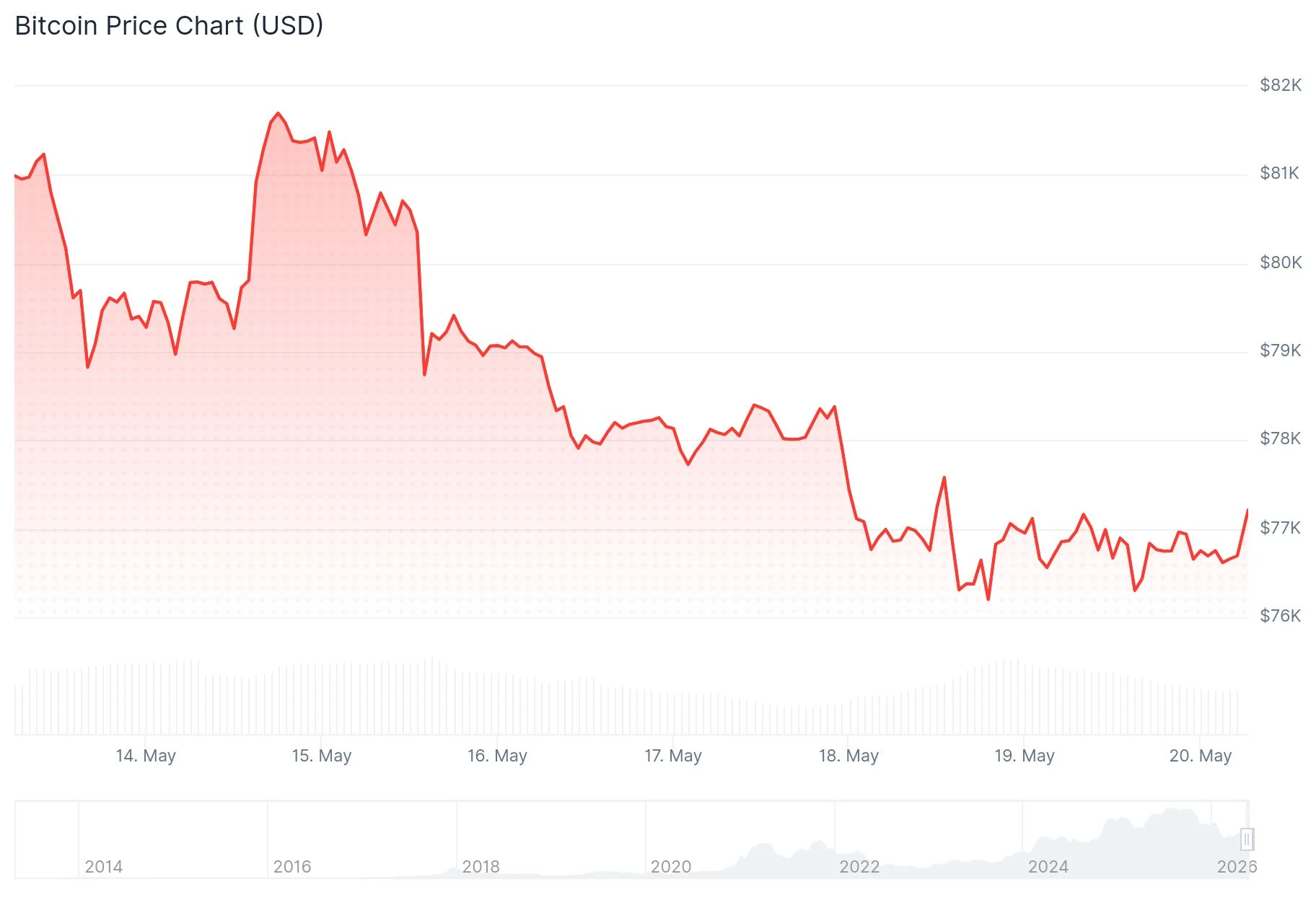
Bitcoin dropped 53% in 120 days as derivatives markets, global risk-off flows, and liquidity shifts pressured prices globally now. Bitcoin has fallen about 53% Bitcoin dropped 53% in 120 days as derivatives markets, global risk-off flows, and liquidity shifts pressured prices globally now. Bitcoin has fallen about 53%

Why Bitcoin Fell 53% in 120 Days Without Any Major Bad News

2026/02/08 15:00
3 min read
For feedback or concerns regarding this content, please contact us at crypto.news@mexc.com

Bitcoin dropped 53% in 120 days as derivatives markets, global risk-off flows, and liquidity shifts pressured prices globally now.

Bitcoin has fallen about 53% over the past 120 days, dropping from around $126,000 to near $60,000.

The decline occurred without a single major negative headline or market shock.

This unusual move has drawn attention from market participants trying to understand the forces behind the sustained downside pressure.

Derivatives and Synthetic Exposure Reshape Price Behavior

Bitcoin price discovery has changed as derivatives now dominate trading activity.

A growing share of volume comes from futures, perpetual swaps, options, and exchange-traded products. These instruments allow exposure to Bitcoin without moving coins on-chain.

Because of this structure, price pressure can come from positioning rather than spot selling.

Large short positions in futures can push prices lower without physical Bitcoin changing hands.

Forced liquidations of leveraged long positions can also accelerate declines through automated selling.

Recent market data shows repeated liquidation waves and sharp drops in open interest.

Funding rates have turned negative during sell-offs, signaling stress among leveraged traders.

These patterns suggest derivatives positioning has played a central role in recent price moves.

Global Risk-Off Conditions Add Downside Pressure

According to Bull Theory Bitcoin decline has occurred alongside broader weakness in global markets.

Stocks have faced sustained selling pressure, and precious metals have seen sharp volatility. This environment reflects a broader shift toward risk reduction.

During risk-off periods, capital often exits volatile assets first. Bitcoin sits at the higher end of the risk spectrum, so price reactions tend to be stronger.

Correlation with other risk assets has increased during recent market stress.

Economic data has also contributed to caution. Indicators tied to employment, housing demand, and credit conditions have shown signs of slowing growth.

When recession concerns rise, exposure to speculative assets often declines across portfolios.

Related Reading: Why Google Searches for Bitcoin Are Spiking During Market Volatility

Liquidity Expectations and Institutional Positioning

Market expectations around future liquidity conditions have shifted in recent months.

Investors had priced in a more supportive policy backdrop earlier in the cycle. Those assumptions have since weakened.

Uncertainty around future central bank leadership and policy direction has added to caution.

Even if interest rates fall, tighter liquidity conditions can pressure asset valuations. This shift has weighed on Bitcoin alongside other risk assets.

The recent sell-off has shown signs of structured positioning changes rather than panic. Price action has featured controlled declines and limited rebound attempts.

Such patterns often appear when large entities reduce exposure gradually instead of rushing to exit.

This type of selling can suppress recovery attempts. Dip buyers often wait for stability before re-entering markets.

Until positioning pressure eases, upside momentum can remain limited despite short-term bounces.

Bitcoin fixed supply has not changed, but the effective supply influencing price has expanded through synthetic exposure.

Price movements now reflect leverage, hedging flows, and global risk sentiment. These combined factors help explain the sharp decline without a single defining negative event.

The post Why Bitcoin Fell 53% in 120 Days Without Any Major Bad News appeared first on Live Bitcoin News.


Market Opportunity
Major Logo
Major Price(MAJOR)
$0.06259
$0.06259$0.06259
-1.61%
USD
Major (MAJOR) Live Price Chart
Disclaimer: The articles reposted on this site are sourced from public platforms and are provided for informational purposes only. They do not necessarily reflect the views of MEXC. All rights remain with the original authors. If you believe any content infringes on third-party rights, please contact crypto.news@mexc.com for removal. MEXC makes no guarantees regarding the accuracy, completeness, or timeliness of the content and is not responsible for any actions taken based on the information provided. The content does not constitute financial, legal, or other professional advice, nor should it be considered a recommendation or endorsement by MEXC.

You May Also Like

USD/CHF Exchange Rate Surges Toward Critical 0.8000 Level as Dollar Dominance Intensifies

USD/CHF Exchange Rate Surges Toward Critical 0.8000 Level as Dollar Dominance Intensifies

BitcoinWorld USD/CHF Exchange Rate Surges Toward Critical 0.8000 Level as Dollar Dominance Intensifies The USD/CHF currency pair maintains strong bullish momentum
Share
bitcoinworld2026/03/30 10:10
Grayscale Sees Digital Asset Treasuries Staging a Comeback After Surviving Harsh Market Reset – Featured Bitcoin News

Grayscale Sees Digital Asset Treasuries Staging a Comeback After Surviving Harsh Market Reset – Featured Bitcoin News

The post Grayscale Sees Digital Asset Treasuries Staging a Comeback After Surviving Harsh Market Reset – Featured Bitcoin News appeared on BitcoinEthereumNews.com
Share
BitcoinEthereumNews2026/03/30 10:35
China Blocks Nvidia’s RTX Pro 6000D as Local Chips Rise

China Blocks Nvidia’s RTX Pro 6000D as Local Chips Rise

The post China Blocks Nvidia’s RTX Pro 6000D as Local Chips Rise appeared on BitcoinEthereumNews.com. China Blocks Nvidia’s RTX Pro 6000D as Local Chips Rise China’s internet regulator has ordered the country’s biggest technology firms, including Alibaba and ByteDance, to stop purchasing Nvidia’s RTX Pro 6000D GPUs. According to the Financial Times, the move shuts down the last major channel for mass supplies of American chips to the Chinese market. Why Beijing Halted Nvidia Purchases Chinese companies had planned to buy tens of thousands of RTX Pro 6000D accelerators and had already begun testing them in servers. But regulators intervened, halting the purchases and signaling stricter controls than earlier measures placed on Nvidia’s H20 chip. Image: Nvidia An audit compared Huawei and Cambricon processors, along with chips developed by Alibaba and Baidu, against Nvidia’s export-approved products. Regulators concluded that Chinese chips had reached performance levels comparable to the restricted U.S. models. This assessment pushed authorities to advise firms to rely more heavily on domestic processors, further tightening Nvidia’s already limited position in China. China’s Drive Toward Tech Independence The decision highlights Beijing’s focus on import substitution — developing self-sufficient chip production to reduce reliance on U.S. supplies. “The signal is now clear: all attention is focused on building a domestic ecosystem,” said a representative of a leading Chinese tech company. Nvidia had unveiled the RTX Pro 6000D in July 2025 during CEO Jensen Huang’s visit to Beijing, in an attempt to keep a foothold in China after Washington restricted exports of its most advanced chips. But momentum is shifting. Industry sources told the Financial Times that Chinese manufacturers plan to triple AI chip production next year to meet growing demand. They believe “domestic supply will now be sufficient without Nvidia.” What It Means for the Future With Huawei, Cambricon, Alibaba, and Baidu stepping up, China is positioning itself for long-term technological independence. Nvidia, meanwhile, faces…
Share
BitcoinEthereumNews2025/09/18 01:37