Swift is building a blockchain-based shared ledger with 30+ global banks to support real-time, always-on cross-border payments and regulated tokenized value settlementSwift is building a blockchain-based shared ledger with 30+ global banks to support real-time, always-on cross-border payments and regulated tokenized value settlement

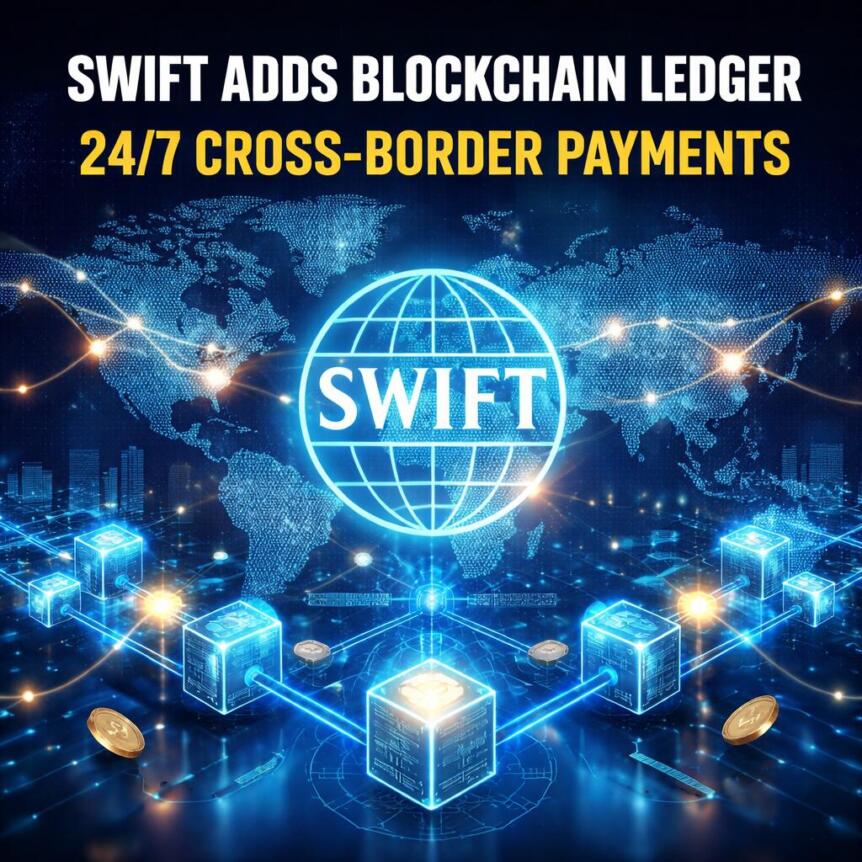
Swift Adds Blockchain Ledger to Enable 24/7 Cross-Border Payments
For feedback or concerns regarding this content, please contact us at crypto.news@mexc.com
Swift Adds Blockchain Ledger To Enable 24/7 Cross-Border Payments

Swift has unveiled plans to integrate a blockchain-based shared ledger into its core infrastructure, marking one of the most significant evolutions of the global payments network in decades. Announced at Sibos 2025 in Frankfurt, the initiative aims to enable real-time, 24/7 cross-border payments and the regulated movement of tokenized value at global scale. The project brings together more than 30 financial institutions from 16 countries and starts with a conceptual prototype developed alongside Consensys. Rather than replacing existing rails, the ledger is designed to extend Swift’s trusted role into digital finance while preserving compliance, resilience, and operational rigor.

Key takeaways

  • Swift plans to add a blockchain-based shared ledger to support instant, always-on cross-border payments.
  • The initiative was announced at Sibos 2025 in Frankfurt and involves over 30 global banks from 16 countries.
  • The first use case focuses on real-time, 24/7 interbank cross-border payments.
  • The ledger will be interoperable with existing payment rails and emerging digital networks.
  • Smart contracts will be used to embed compliance, controls, and transaction rules directly into payment flows.

Market context: The move comes as financial institutions globally face pressure to modernize cross-border payments amid growing demand for instant settlement, tokenized assets, and regulated digital money, while central banks and regulators push for higher transparency and resilience.

Why it matters

Cross-border payments remain one of the most complex and costly parts of the financial system, often constrained by time zones, batch processing, and fragmented infrastructure. By introducing a shared digital ledger, Swift is signaling that legacy financial infrastructure can evolve without abandoning regulatory discipline.

For banks, the initiative promises improved transparency, faster settlement, and reduced operational friction, all while maintaining compatibility with existing correspondent banking models. For the broader market, it represents a pragmatic bridge between traditional finance and distributed ledger technology.

The project also highlights a broader industry shift toward tokenized value and programmable money, with Swift positioning itself as a neutral orchestrator rather than a competing blockchain network.

What to watch next

  • Progress of the conceptual prototype being developed with Consensys.
  • Expansion of use cases beyond cross-border payments into other forms of tokenized value.
  • Governance frameworks and compliance standards agreed by participating banks.
  • Further announcements on interoperability with public and private blockchain networks.

Sources & verification

  • Official Swift announcement detailing the blockchain-based ledger initiative.
  • Statements from Swift CEO Javier Pérez-Tasso delivered at Sibos 2025.
  • Public comments from participating global banks on their involvement.
  • Swift’s published FAQs outlining scope, benefits, and development phases.

Swift’s blockchain ledger and the future of cross-border payments

Swift’s decision to incorporate a blockchain-based shared ledger into its technology stack represents a strategic response to a rapidly changing payments landscape. For decades, Swift has served as the backbone of global financial messaging, connecting institutions across more than 200 countries and territories. The new ledger does not replace that role but extends it into a digital environment where value can move instantly and continuously.

The initiative was formally announced during the opening plenary of Sibos 2025, where Swift CEO Javier Pérez-Tasso acknowledged that the move might surprise parts of the market. He framed the development as a convergence rather than a contradiction, arguing that traditional finance and blockchain technology can coexist within a regulated system. According to Pérez-Tasso, banks are increasingly prepared for this transition and are asking Swift to take on a broader coordinating role.

At the core of the project is a shared digital ledger designed to record, sequence, and validate transactions between financial institutions in real time. Built with interoperability as a guiding principle, the ledger is intended to connect seamlessly with both established payment rails and emerging digital networks. Smart contracts will enforce transaction rules, embedding compliance and risk controls directly into payment flows rather than layering them on afterward.

The first use case under development is real-time, 24/7 cross-border payments, an area where inefficiencies have long persisted. Current systems often rely on batch processing and reconciliation across multiple intermediaries, leading to delays and uncertainty. A shared ledger, accessible around the clock, could significantly improve predictability and transparency while reducing settlement times.

Swift has emphasized that operational excellence remains central to the design. The ledger is being developed in parallel with ongoing enhancements to existing rails, APIs, and ISO 20022 messaging standards. This layered approach reflects Swift’s view that innovation should strengthen, not undermine, the reliability and security that global finance depends on.

Collaboration is another defining feature of the initiative. Financial institutions from regions spanning Europe, North America, Asia-Pacific, the Middle East, and Latin America are actively involved in shaping the ledger’s functionality and governance. Participating banks include major global and regional players such as Bank of America, HSBC, JP Morgan Chase, Deutsche Bank, BNP Paribas, Citi, BBVA, and many others.

Executives from these institutions have described the project as a foundational upgrade rather than an incremental change. Many point to the importance of interoperability and common standards, particularly as tokenized assets and digital currencies gain traction. A shared ledger coordinated through Swift’s neutral network could help avoid fragmentation and support multi-currency, atomic settlement across jurisdictions.

Several banks highlighted the relevance of the initiative for liquidity management and always-on payments. In a global economy that increasingly operates beyond traditional business hours, the ability to move regulated value in real time is becoming a competitive necessity. The ledger is positioned as an enabler of this shift, supporting both wholesale and, eventually, broader client-facing use cases.

Swift has also linked the project to its broader work on digital assets and interoperability. Alongside the ledger, the organization is developing solutions that allow value to move between private and public networks without compromising compliance. This reflects an understanding that the future financial system will likely consist of multiple interconnected platforms rather than a single dominant rail.

From a governance perspective, the initiative is being developed in stages, beginning with a prototype. Timelines for broader availability will depend on testing, regulatory alignment, and industry adoption. Swift has been clear that the ledger will evolve in close consultation with its community, maintaining alignment with global regulatory standards.

The broader significance of the project lies in its signal to the market. By embracing blockchain-based infrastructure while reaffirming its commitment to trust and resilience, Swift is attempting to chart a middle path between innovation and stability. If successful, the shared ledger could become a key component of next-generation global payments, supporting tokenized value, instant settlement, and interoperability at scale.

As Pérez-Tasso concluded during Sibos, the ledger represents a platform not just for today’s needs but for future transformation. Its ultimate impact will depend on execution, collaboration, and the industry’s willingness to converge on shared standards. For now, it marks a notable step in the gradual modernization of global financial infrastructure.

This article was originally published as Swift Adds Blockchain Ledger to Enable 24/7 Cross-Border Payments on Crypto Breaking News – your trusted source for crypto news, Bitcoin news, and blockchain updates.

Market Opportunity
CROSS Logo
CROSS Price(CROSS)
$0.05992
$0.05992$0.05992
-4.12%
USD
CROSS (CROSS) Live Price Chart
Disclaimer: The articles reposted on this site are sourced from public platforms and are provided for informational purposes only. They do not necessarily reflect the views of MEXC. All rights remain with the original authors. If you believe any content infringes on third-party rights, please contact crypto.news@mexc.com for removal. MEXC makes no guarantees regarding the accuracy, completeness, or timeliness of the content and is not responsible for any actions taken based on the information provided. The content does not constitute financial, legal, or other professional advice, nor should it be considered a recommendation or endorsement by MEXC.

You May Also Like

Dow Jones futures gain on easing risk aversion, lower oil prices

Dow Jones futures gain on easing risk aversion, lower oil prices

The post Dow Jones futures gain on easing risk aversion, lower oil prices appeared on BitcoinEthereumNews.com. Dow Jones futures rise, up by 0.81%, above 45,800
Share
BitcoinEthereumNews2026/03/31 17:14
Brent Crude Forecast: Societe Generale Issues Stark $150 Risk Warning Amid Market Turbulence

Brent Crude Forecast: Societe Generale Issues Stark $150 Risk Warning Amid Market Turbulence

BitcoinWorld Brent Crude Forecast: Societe Generale Issues Stark $150 Risk Warning Amid Market Turbulence Global energy markets face renewed volatility as Societe

Share
bitcoinworld2026/03/31 16:50
Revolutionary: CME SOL XRP Futures Options Set to Transform Crypto Trading

Revolutionary: CME SOL XRP Futures Options Set to Transform Crypto Trading

BitcoinWorld Revolutionary: CME SOL XRP Futures Options Set to Transform Crypto Trading Exciting news is rippling through the cryptocurrency world! The U.S. Chicago Mercantile Exchange (CME), a titan in traditional finance, is reportedly planning to launch CME SOL XRP futures options. This significant development, initially reported by Walter Bloomberg, marks a pivotal moment for institutional involvement in the altcoin market. It signals a new era for how Solana (SOL) and Ripple (XRP) might be traded, potentially opening doors to broader adoption and increased market maturity. What Does the Launch of CME SOL XRP Futures Mean for Crypto? When an institution like CME, known for its rigorous standards and vast trading volume, enters a new market, it brings a wave of legitimacy. The introduction of CME SOL XRP futures options indicates a growing acceptance of these digital assets within mainstream finance. This move could fundamentally change how investors perceive and interact with SOL and XRP. Futures options are financial derivatives that give traders the right, but not the obligation, to buy or sell an underlying asset at a specific price on or before a certain date. For SOL and XRP, this means: Enhanced Price Discovery: More participants and trading volume can lead to more efficient and accurate pricing. Institutional Access: It provides regulated avenues for large institutional investors to gain exposure to SOL and XRP without directly owning the underlying assets. Risk Management: Traders can use these options to hedge against potential price fluctuations in their existing SOL and XRP holdings. Why Are SOL and XRP Chosen for CME SOL XRP Futures? The selection of Solana (SOL) and Ripple (XRP) for these new futures options is not arbitrary. Both cryptocurrencies hold significant positions in the market and offer distinct value propositions: Solana (SOL): Known for its high-performance blockchain, offering fast transaction speeds and low costs. Its robust ecosystem supports numerous decentralized applications (dApps), NFTs, and DeFi projects, attracting considerable developer and user interest. Ripple (XRP): Primarily focused on facilitating fast, low-cost international payments for financial institutions. Despite ongoing regulatory discussions, XRP maintains a strong market presence and a dedicated community, highlighting its potential for cross-border transactions. Their substantial market capitalization and existing liquidity make them attractive candidates for institutional-grade derivative products. This choice reflects a strategic assessment by CME of assets that can sustain significant trading interest and volume. Navigating the Landscape: Opportunities and Considerations for CME SOL XRP Futures The introduction of CME SOL XRP futures options presents a wealth of opportunities, yet it also comes with important considerations. On the opportunity front, we can expect increased liquidity, which benefits all market participants by making it easier to buy and sell without significant price impact. Moreover, it could attract new capital from traditional financial players who prefer regulated products. However, traders and investors should also consider the implications: Market Volatility: While derivatives can offer hedging, they can also amplify market movements. Regulatory Clarity: The regulatory landscape for cryptocurrencies, particularly for XRP, continues to evolve. CME’s move might encourage further clarity but also means ongoing scrutiny. Learning Curve: Understanding futures options requires a certain level of financial literacy, which new entrants to the crypto market may need to develop. These products offer sophisticated tools for managing exposure and speculating on price movements, but they demand a careful approach. What’s Next for the Crypto Market with CME SOL XRP Futures? The reported launch of CME SOL XRP futures options is more than just a new product offering; it represents a significant milestone in the ongoing convergence of traditional finance and the digital asset space. It underscores the growing maturity of the cryptocurrency market and its increasing integration into global financial systems. As institutional interest continues to surge, we can anticipate further innovation and a broader range of regulated products for other altcoins. This development is poised to offer sophisticated tools for investors and traders, potentially stabilizing market dynamics while simultaneously introducing new avenues for growth and investment. The crypto market is evolving rapidly, and CME’s latest initiative is a clear indicator of this exciting trajectory. To learn more about the latest crypto market trends, explore our article on key developments shaping the cryptocurrency market institutional adoption. Frequently Asked Questions (FAQs) What is the Chicago Mercantile Exchange (CME)? The CME is one of the world’s largest and most diverse derivatives marketplaces, offering a wide range of futures and options products across various asset classes, including equities, commodities, and now, expanding into specific cryptocurrencies. What are futures options in the context of SOL and XRP? Futures options for SOL and XRP are financial contracts that give the holder the right, but not the obligation, to buy or sell SOL or XRP futures contracts at a predetermined price on or before a specific date. They allow for hedging and speculation on price movements. Why are Solana (SOL) and Ripple (XRP) chosen for these new options? SOL and XRP were likely chosen due to their significant market capitalization, established liquidity, and distinct use cases within the crypto ecosystem, making them attractive for institutional-grade derivative products. How might CME SOL XRP futures options affect the prices of SOL and XRP? The introduction of these options could lead to increased liquidity and institutional participation, potentially influencing price discovery and stability. However, like all derivatives, they can also contribute to market volatility. When are these CME SOL XRP futures options expected to launch? While Walter Bloomberg reported CME’s plans, an official launch date has not yet been publicly announced by CME. Market participants should monitor official CME channels for updates. If you found this article insightful, please consider sharing it with your network! Help us spread the word about the exciting developments in the crypto space by sharing this article on your social media platforms. This post Revolutionary: CME SOL XRP Futures Options Set to Transform Crypto Trading first appeared on BitcoinWorld.
Share
Coinstats2025/09/18 00:45