Ethereum’s Vitalik Buterin Goes All-In on Zcash With New Privacy Bet
Ethereum founder Vitalik Buterin has donated to Shielded Labs, backing development of Crosslink, a proposed consensus upgrade for Zcash.
The move signals a deepening commitment by Buterin to privacy-preserving infrastructure, as well as growing interest in strengthening finality and settlement guarantees in proof-of-work blockchains.
Vitalik Doubles Down on Privacy Infranstructure in Crypto
Shielded Labs is developing Crosslink, a parallel finality layer designed to sit on top of Zcash’s existing proof-of-work consensus.
In simple terms, Crosslink adds a second confirmation system that locks in transactions faster and more decisively. This reduces the risk of chain reorganizations, rollbacks, and double-spend attacks.
As a result, exchanges can shorten confirmation times, cross-chain bridges gain stronger security guarantees, and applications become easier to build on Zcash.
What Shielded Labs Does for Zcash
Shielded Labs is a Zcash-focused research and engineering group working on core protocol upgrades rather than applications or tooling.
Its mandate centers on improving Zcash’s long-term security, usability, and cryptographic guarantees—especially around shielded transactions and privacy-first design.
Buterin’s support comes amid a broader shift in his public advocacy toward privacy and resilience over growth metrics or convenience.
In recent months, he has repeatedly argued that blockchains must optimize for worst-case scenarios, not best-case user experience.
That includes resisting censorship, minimizing trust assumptions, and protecting users even under hostile conditions.
Privacy, in that framing, is not optional. It is core infrastructure.
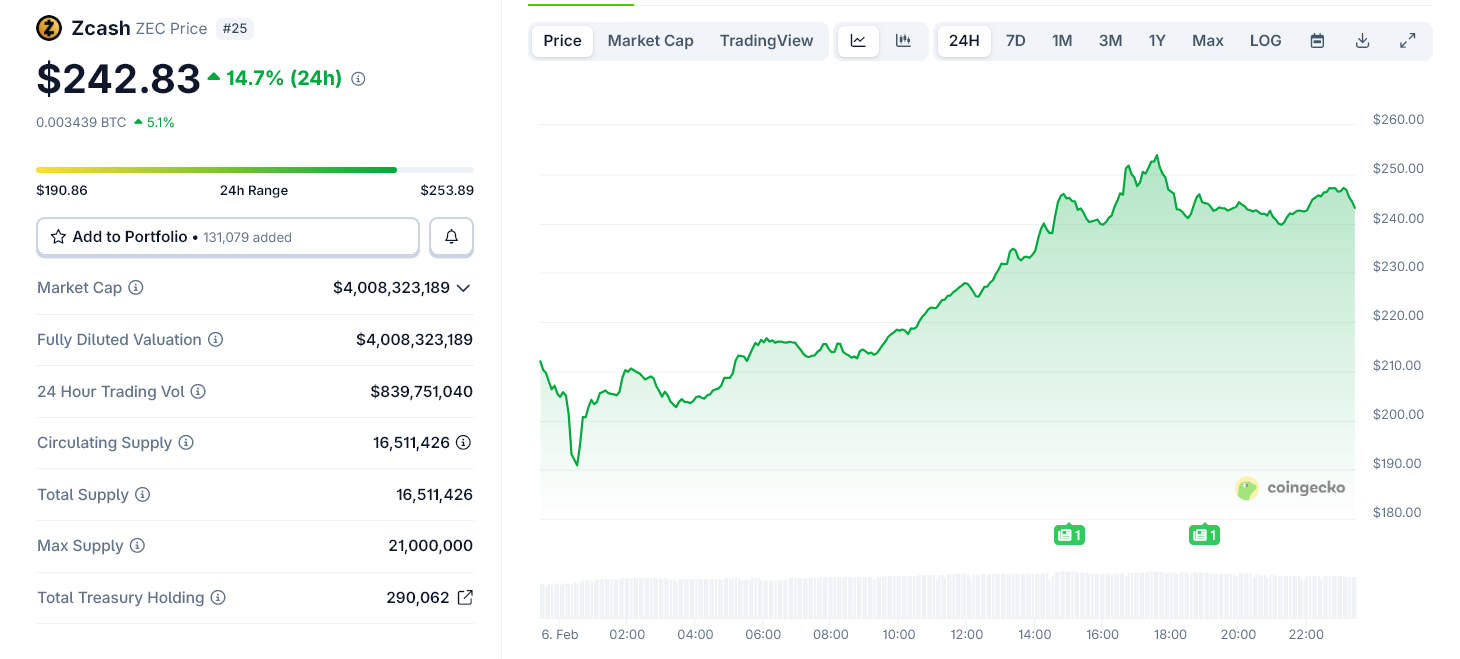 ZCash Daily Price Chart. Source: CoinGecko
The Privacy Push Is More Critical Than Ever
Buterin has warned that financial transparency without strong cryptographic privacy creates long-term risks, including surveillance, coercion, and systemic fragility.
He has increasingly praised systems that embed privacy at the protocol level rather than layering it on as an optional feature. Zcash’s shielded transaction model aligns closely with that philosophy.
By backing Shielded Labs, Buterin is effectively endorsing privacy-preserving design paired with stronger settlement guarantees—two areas he sees as underinvested across the industry.
A Signal to the Broader Crypto Ecosystem
The donation also lands at a moment when Ethereum itself is reassessing parts of its scaling and security roadmap.
While Buterin has criticized superficial innovation and “copy-paste” infrastructure elsewhere, his support for Zcash highlights what he sees as meaningful progress: protocol-level upgrades that improve safety, finality, and user protection.
In that sense, the move is less about Ethereum versus Zcash—and more about the kind of blockchain architecture Buterin believes will survive long term.


You May Also Like

Moody’s Assigns First-Ever Rating to Bitcoin-Backed Municipal Bond in Historic Crypto Finance Move

Justice Department has 'gone off the rails' for Trump's 'pretzel logic': analysis