Pi Network price remains in a steep free fall that has cost long-term investors billions of dollars.  Pi Coin (PI) was trading at $0.3410 today, August 6, just above this month’s low of $0.3236. A potential catalyst for Pi is…Pi Network price remains in a steep free fall that has cost long-term investors billions of dollars.  Pi Coin (PI) was trading at $0.3410 today, August 6, just above this month’s low of $0.3236. A potential catalyst for Pi is…

Will the Stellar protocol 23 upgrade boost Pi Network price?

Pi Network price remains in a steep free fall that has cost long-term investors billions of dollars. 

Summary
  • Pi Network price is hovering near its lowest level on record.
  • It has ignored all the major announcements from the team.
  • The upcoming Stellar Protocol upgrade will have limited impact on the price.

Pi Coin (PI) was trading at $0.3410 today, August 6, just above this month’s low of $0.3236. A potential catalyst for Pi is the upcoming Stellar Protocol 23 upgrade.

Stellar Protocol 23 upgrade impact on Pi coin

Pi Network price has been in a sustained downtrend after peaking near $3 in February. The crash followed an increase in token supply due to daily emissions, while demand weakened.

The token has largely ignored major announcements, including the launch of Pi Network Ventures and Pi AI Studio. Pi Network Ventures is a $100 million fund aimed at allocating capital to qualified projects in the ecosystem.

Pi AI Studio is a recently launched product that allows users to build and deploy AI applications such as chatbots. Developers aim to position Pi as the leading platform for decentralized AI solutions.

A potential catalyst for Pi Coin is the upcoming Stellar Protocol 23 set to go live in September. The upgrade will bring enhancements such as faster transaction speeds, smart contract capabilities via Soroban, and bridging to other blockchains.

This upgrade could benefit Pi Network, which is built on the Stellar Consensus Protocol and its core infrastructure. According to Dr. Altcoin, Pi is currently in version 19, and will likely migrate to 23 directly. 

Such a migration would strengthen the Pi ecosystem, particularly through improved cross-chain compatibility. However, it is unlikely that Stellar’s upgrade alone will trigger a price surge in Pi Coin. A more probable catalyst would be a tier-1 exchange listing.

Pi Network price technical analysis
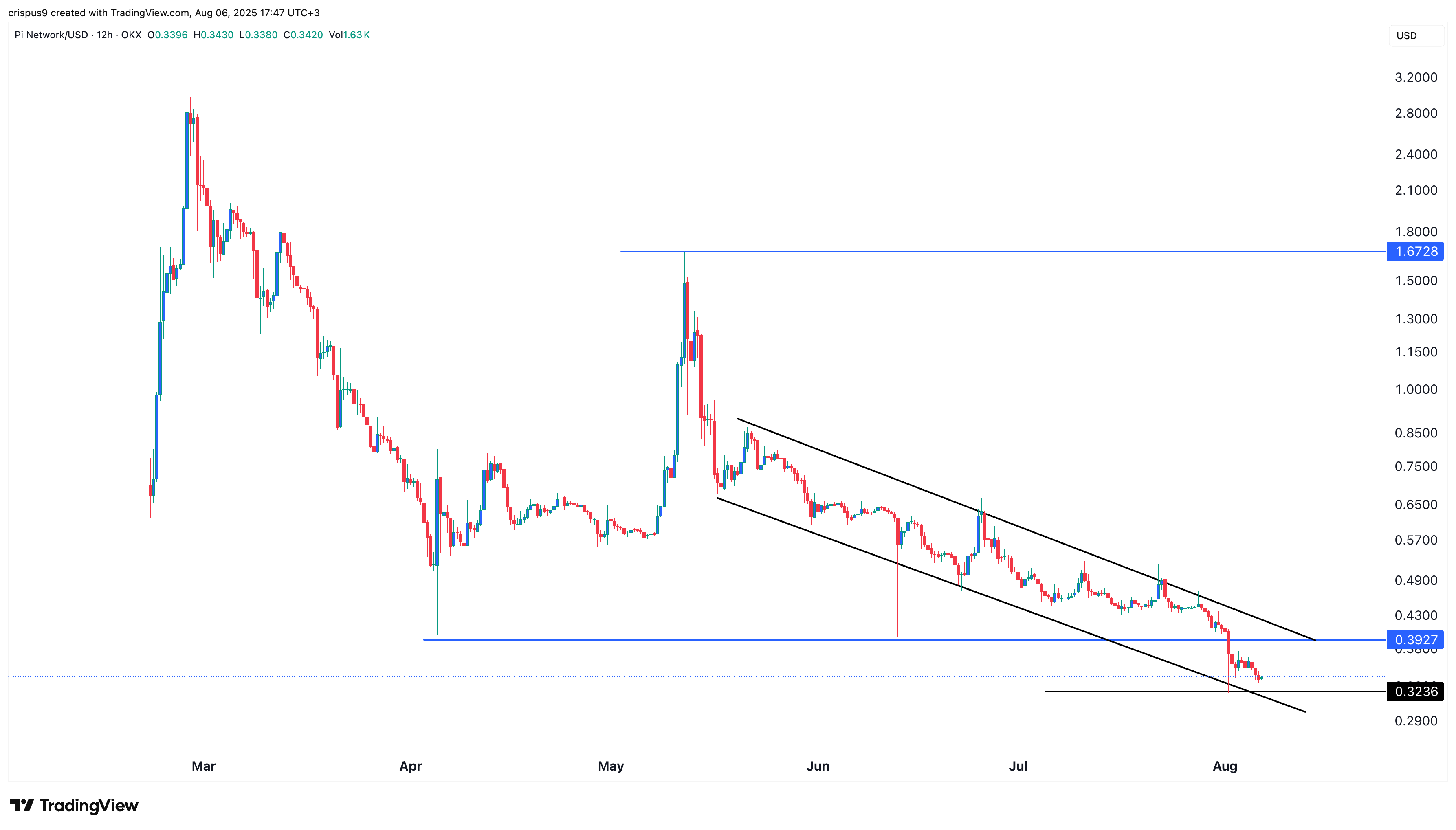
Pi network price

The 12-hour chart shows that Pi Network price has plunged over the past six months and is hovering near its all-time low. It has broken below key support at $0.3927, its lowest level in both June and April, invalidating a previously formed double-bottom pattern.

Pi Coin is now trading near the lower boundary of a descending channel and remains below all key moving averages. This setup suggests a high probability of further downside, potentially pushing the token below support at $0.300.

However, shorting Pi remains risky due to the possibility of a tier-1 exchange listing, which could trigger a short squeeze.


Market Opportunity
Pi Network Logo
Pi Network Price(PI)
$0.20752
$0.20752$0.20752
+0.02%
USD
Pi Network (PI) Live Price Chart
Disclaimer: The articles reposted on this site are sourced from public platforms and are provided for informational purposes only. They do not necessarily reflect the views of MEXC. All rights remain with the original authors. If you believe any content infringes on third-party rights, please contact service@support.mexc.com for removal. MEXC makes no guarantees regarding the accuracy, completeness, or timeliness of the content and is not responsible for any actions taken based on the information provided. The content does not constitute financial, legal, or other professional advice, nor should it be considered a recommendation or endorsement by MEXC.

You May Also Like

The Channel Factories We’ve Been Waiting For

The Channel Factories We’ve Been Waiting For

The post The Channel Factories We’ve Been Waiting For appeared on BitcoinEthereumNews.com. Visions of future technology are often prescient about the broad strokes while flubbing the details. The tablets in “2001: A Space Odyssey” do indeed look like iPads, but you never see the astronauts paying for subscriptions or wasting hours on Candy Crush.  Channel factories are one vision that arose early in the history of the Lightning Network to address some challenges that Lightning has faced from the beginning. Despite having grown to become Bitcoin’s most successful layer-2 scaling solution, with instant and low-fee payments, Lightning’s scale is limited by its reliance on payment channels. Although Lightning shifts most transactions off-chain, each payment channel still requires an on-chain transaction to open and (usually) another to close. As adoption grows, pressure on the blockchain grows with it. The need for a more scalable approach to managing channels is clear. Channel factories were supposed to meet this need, but where are they? In 2025, subnetworks are emerging that revive the impetus of channel factories with some new details that vastly increase their potential. They are natively interoperable with Lightning and achieve greater scale by allowing a group of participants to open a shared multisig UTXO and create multiple bilateral channels, which reduces the number of on-chain transactions and improves capital efficiency. Achieving greater scale by reducing complexity, Ark and Spark perform the same function as traditional channel factories with new designs and additional capabilities based on shared UTXOs.  Channel Factories 101 Channel factories have been around since the inception of Lightning. A factory is a multiparty contract where multiple users (not just two, as in a Dryja-Poon channel) cooperatively lock funds in a single multisig UTXO. They can open, close and update channels off-chain without updating the blockchain for each operation. Only when participants leave or the factory dissolves is an on-chain transaction…
Share
BitcoinEthereumNews2025/09/18 00:09
Buterin pushes Layer 2 interoperability as cornerstone of Ethereum’s future

Buterin pushes Layer 2 interoperability as cornerstone of Ethereum’s future

Ethereum founder, Vitalik Buterin, has unveiled new goals for the Ethereum blockchain today at the Japan Developer Conference. The plan lays out short-term, mid-term, and long-term goals touching on L2 interoperability and faster responsiveness among others. In terms of technology, he said again that he is sure that Layer 2 options are the best way […]
Share
Cryptopolitan2025/09/18 01:15
Markets await Fed’s first 2025 cut, experts bet “this bull market is not even close to over”

Markets await Fed’s first 2025 cut, experts bet “this bull market is not even close to over”

Will the Fed’s first rate cut of 2025 fuel another leg higher for Bitcoin and equities, or does September’s history point to caution? First rate cut of 2025 set against a fragile backdrop The Federal Reserve is widely expected to…
Share
Crypto.news2025/09/18 00:27