Stablecoin issuer Tether has surpassed South Korea in the number of U.S. treasury bond holders after it issued more assets with total exposure to U.S. Treasuries. How much U.S. debt does the firm hold? According to data from analysis firm…Stablecoin issuer Tether has surpassed South Korea in the number of U.S. treasury bond holders after it issued more assets with total exposure to U.S. Treasuries. How much U.S. debt does the firm hold? According to data from analysis firm…

Tether beats South Korea as one of the largest U.S. treasury bond holder

Stablecoin issuer Tether has surpassed South Korea in the number of U.S. treasury bond holders after it issued more assets with total exposure to U.S. Treasuries. How much U.S. debt does the firm hold?

Summary
  • Tether’s U.S. Treasury reserves surpass South Korea, Germany and United Arab Emirates.
  • Tether continues to generate net profit, reaching $4.9 billion in Q2 2025 alone.

According to data from analysis firm Messari, the Paolo Ardoino-led company has climbed the ranks and surpassed three sovereign states in the number of U.S. treasury bonds it holds. On August 1, the firm was able to surpass South Korea, which currently holds less than $127 billion in bonds.

In Q2 2025, the USDT stablecoin issuer firm significantly expanded its holdings of U.S. government debt, reporting over $127 billion in U.S. Treasuries, including $105.5 billion in direct holdings and $21.3 billion indirectly. This marks an $8 billion increase from Q1 and boosts Tether’s position as one of the largest holders of U.S. debt globally, rivaling sovereign nations.

Based on Messari’s analysis, the stablecoin firm remains the only company on the list with more U.S. treasuries than other states mentioned on the list. Aside from South Korea, Tether (USDT) also holds more U.S. treasury bonds compared to the United Arab Emirates and Germany.

Both nations hold slightly more than $100 billion in U.S. debt respectively.
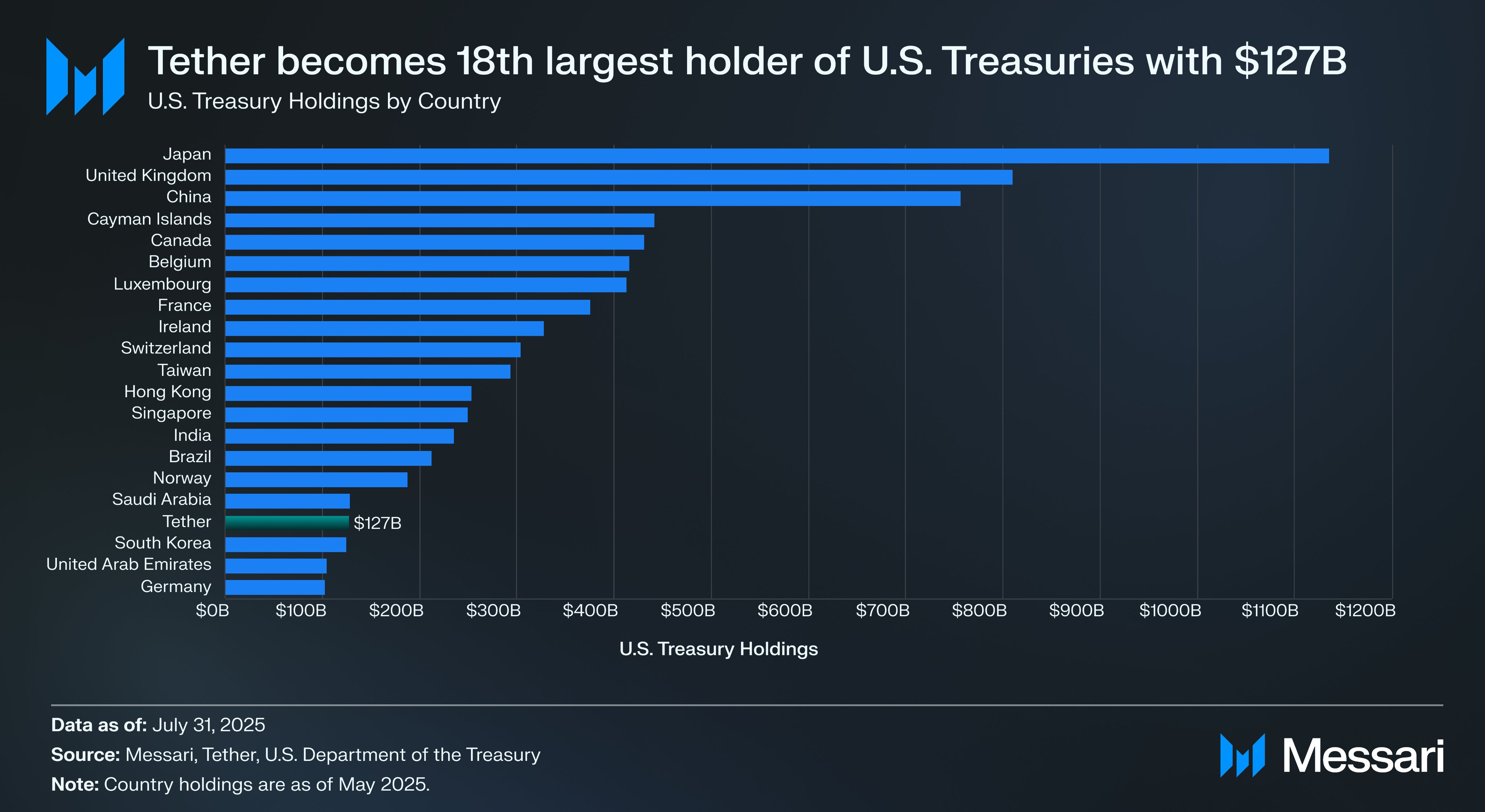
Tether becomes the 18th largest holder of U.S. Treasury bonds | Source: Messari

Tether’s reserves surpass liabilities in Q2

Aside from the milestone in U.S. treasury bonds held, the report also confirms that Tether’s reserves exceed its liabilities, with total assets at approximately $162.6 billion versus $157.1 billion in liabilities.

The company holds $5.47 billion in shareholder capital as a protective equity buffer, reinforcing its financial strength and solvency. More importantly, the $127 billion in U.S. Treasuries serves as the main backing for USD₮, ensuring high liquidity and low risk for token holders.

In the second quarter of 2025, USDT’s issuer generated a net profit of around $4.9 billion, driven by income from its U.S. Treasury holdings and strategic reserves in Bitcoin (BTC) and gold. Out of the $5.7 billion in total year-to-date profits, $3.1 billion came from stable recurring revenue, with the remaining $2.6 billion from mark-to-market gains.

This financial performance enables the firm to continually reinvest, with $4 billion already deployed in U.S. strategic initiatives, including projects like XXI Capital and Rumble Wallet.


Market Opportunity
BarnBridge Logo
BarnBridge Price(BOND)
$0.10593
$0.10593$0.10593
+0.87%
USD
BarnBridge (BOND) Live Price Chart
Disclaimer: The articles reposted on this site are sourced from public platforms and are provided for informational purposes only. They do not necessarily reflect the views of MEXC. All rights remain with the original authors. If you believe any content infringes on third-party rights, please contact service@support.mexc.com for removal. MEXC makes no guarantees regarding the accuracy, completeness, or timeliness of the content and is not responsible for any actions taken based on the information provided. The content does not constitute financial, legal, or other professional advice, nor should it be considered a recommendation or endorsement by MEXC.

You May Also Like

Franklin Templeton CEO Dismisses 50bps Rate Cut Ahead FOMC

Franklin Templeton CEO Dismisses 50bps Rate Cut Ahead FOMC

The post Franklin Templeton CEO Dismisses 50bps Rate Cut Ahead FOMC appeared on BitcoinEthereumNews.com. Franklin Templeton CEO Jenny Johnson has weighed in on whether the Federal Reserve should make a 25 basis points (bps) Fed rate cut or 50 bps cut. This comes ahead of the Fed decision today at today’s FOMC meeting, with the market pricing in a 25 bps cut. Bitcoin and the broader crypto market are currently trading flat ahead of the rate cut decision. Franklin Templeton CEO Weighs In On Potential FOMC Decision In a CNBC interview, Jenny Johnson said that she expects the Fed to make a 25 bps cut today instead of a 50 bps cut. She acknowledged the jobs data, which suggested that the labor market is weakening. However, she noted that this data is backward-looking, indicating that it doesn’t show the current state of the economy. She alluded to the wage growth, which she remarked is an indication of a robust labor market. She added that retail sales are up and that consumers are still spending, despite inflation being sticky at 3%, which makes a case for why the FOMC should opt against a 50-basis-point Fed rate cut. In line with this, the Franklin Templeton CEO said that she would go with a 25 bps rate cut if she were Jerome Powell. She remarked that the Fed still has the October and December FOMC meetings to make further cuts if the incoming data warrants it. Johnson also asserted that the data show a robust economy. However, she noted that there can’t be an argument for no Fed rate cut since Powell already signaled at Jackson Hole that they were likely to lower interest rates at this meeting due to concerns over a weakening labor market. Notably, her comment comes as experts argue for both sides on why the Fed should make a 25 bps cut or…
Share
BitcoinEthereumNews2025/09/18 00:36
Why Is Crypto Up Today? – January 13, 2026

Why Is Crypto Up Today? – January 13, 2026

The crypto market is trading slightly higher today, with total cryptocurrency market capitalization rising by around 1.7% over the past 24 hours to approximately
Share
CryptoNews2026/01/13 22:26
The Economics of Self-Isolation: A Game-Theoretic Analysis of Contagion in a Free Economy

The Economics of Self-Isolation: A Game-Theoretic Analysis of Contagion in a Free Economy

Exploring how the costs of a pandemic can lead to a self-enforcing lockdown in a networked economy, analyzing the resulting changes in network structure and the existence of stable equilibria.
Share
Hackernoon2025/09/17 23:00