

XRPL Permissioned Domains to Go Live Today — What It Means for XRP Price
The XRP Ledger (XRPL) will activate Permissioned Domains on February 4, 2026, after more than 91% of validators backed the XLS-80 amendment.
The milestone comes at a challenging time for XRP, which has dropped by double-digits over the past week amid a broader market downturn. With the network preparing a major infrastructure upgrade, the key question now is whether the launch of Permissioned Domains can meaningfully impact XRP’s price trajectory.
What are XRPL Permissioned Domains?
The XLS-80 proposal introduces Permissioned Domains. These are managed environments within XRPL, where access and user activity are dictated by rule-based credentials.
Rather than creating private blockchains, these domains operate as credential-gated access layers on the public XRPL, enabling controlled participation while still leveraging the shared ledger infrastructure.
Built on the XLS-70 Credentials framework, Permissioned Domains enable credential-based access control. Domain owners define rules by specifying a list of accepted credentials.
Accounts with accepted credentials become members automatically, with no extra joining steps required. The proposal introduces new technical components, including the PermissionedDomain ledger object and management transactions such as PermissionedDomainSet and PermissionedDomainDelete.
According to the proposal documentation, this amendment is foundational in nature. It does not deliver end-user functionality on its own, but instead enables future amendments and features, such as permissioned decentralized exchanges or other regulated applications, to build on top of it.
Security considerations are explicitly addressed in the proposal. The model relies on trust in credential issuers and domain owners, and acknowledges risks such as compromised credentials or the potential misuse of permissioned domains for unlawful activity, which must be mitigated at the application and governance levels.
XLS-80 surpassed the required validator supermajority threshold of over 80% in late January under the XRP Ledger amendment process. The amendment entered the standard two-week activation window, with activation scheduled for February 4.
 XRPL Permissioned Domains Amendment Rollout Timeline. Source: XRPSCAN
Permissioned Domains address a core challenge for financial institutions: meeting regulatory standards while leveraging the benefits of blockchain. Previously, institutions needed separate, isolated solutions. Now, they can use XRPL’s network within compliant zones.
Will Permissioned Domains Impact XRP’s Price?
The rollout of Permissioned Domains strengthens XRPL’s utility and institutional appeal. Whether that progress can translate into gains for XRP is another matter.
XRP has dropped 16% over the past seven days amid a broader market pullback. At press time, it was trading at $1.59, down 0.62% over the last 24 hours.
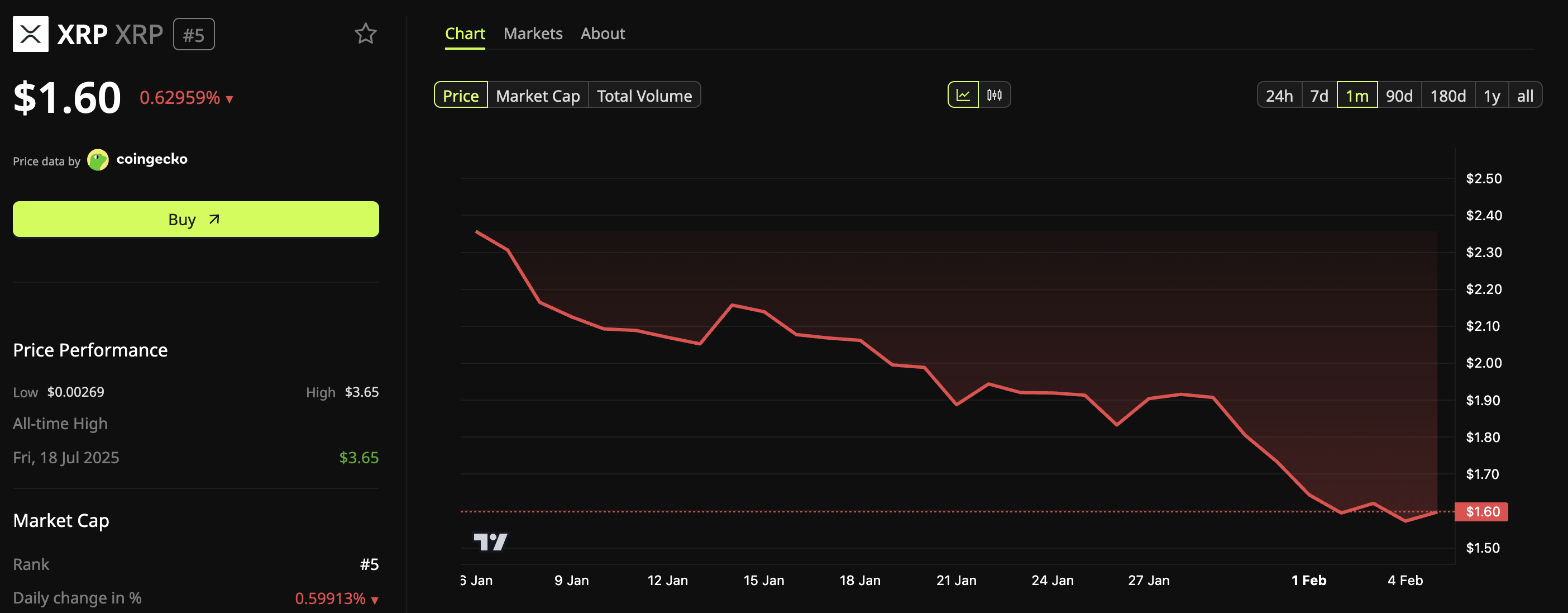 XRP Price Performance In February 2026. Source: BeInCrypto Markets
Despite the significance of the upgrade, Permissioned Domains are unlikely to act as an immediate catalyst for XRP’s price. The XLS-80 amendment does not change XRP’s supply, fee structure, or demand dynamics.
Instead, the potential benefit for XRP may be indirect. Permissioned Domains make it easier for regulated institutions to build on XRPL. If this leads to real adoption, such as permissioned decentralized exchanges or tokenized asset platforms, on-chain activity could increase.
In that case, XRP could benefit from higher network usage, as it remains the native asset used for transaction fees and settlement. For now, Permissioned Domains should be viewed as a long-term infrastructure upgrade rather than the push XRP needs to reverse its current market trend.
The real test will be whether institutions follow through with live deployments that drive sustained on-chain activity.


You May Also Like

GOP lawmakers want nothing to do with Trump's ballroom chaos: report

Iran’s army chief warns of ‘total destruction’ for ground invasion




