Author: Xiao Sa Lawyer Team In recent years, with the development of blockchain technology and the continuous improvement of the regulatory framework, the tokenization of RWA (Real World Assets) hasAuthor: Xiao Sa Lawyer Team In recent years, with the development of blockchain technology and the continuous improvement of the regulatory framework, the tokenization of RWA (Real World Assets) has

Should I choose IPO or RWA for financing? This is a question worth considering

2025/07/24 17:00

Author: Xiao Sa Lawyer Team

In recent years, with the development of blockchain technology and the continuous improvement of the regulatory framework, the tokenization of RWA (Real World Assets) has gradually become the focus of attention in the financial market. Hong Kong, the United States, Singapore and other places have responded and tried to varying degrees. At the same time, the traditional IPO (initial public offering) is still an important way for companies to raise funds. So, what are the similarities and differences between RWA and IPO? What are their respective advantages? How should companies choose? Today, the Sister Sa team will take you to talk about the relationship between the two, in order to provide a reference for companies with different needs when choosing a financing path.

01 Briefly talk about what is RWA and IPO

RWA, or the tokenization of real-world assets, refers to the use of blockchain technology to convert traditional financial assets such as debt, real estate, accounts receivable, fund shares, and bills into digital assets that can be circulated on the chain. This process can not only improve the liquidity of assets, but also reduce transaction costs and improve transparency. For example, a fund company can package the income rights of its real estate projects and issue them as virtual currencies on the chain, allowing investors around the world to participate in transactions with a lower threshold.

IPO, or initial public offering, is the first time a company issues shares to public investors and is listed on a stock exchange. It is the most formal, oldest, and most mature form of financing in the capital market, requiring the participation of three intermediaries: accounting firms, law firms, and securities firms. It must undergo strict financial audits, legal compliance reviews, and the preparation of prospectuses and other documents, marking the company's entry into the public market.

02 A table explains: the main differences between RWA and IPO
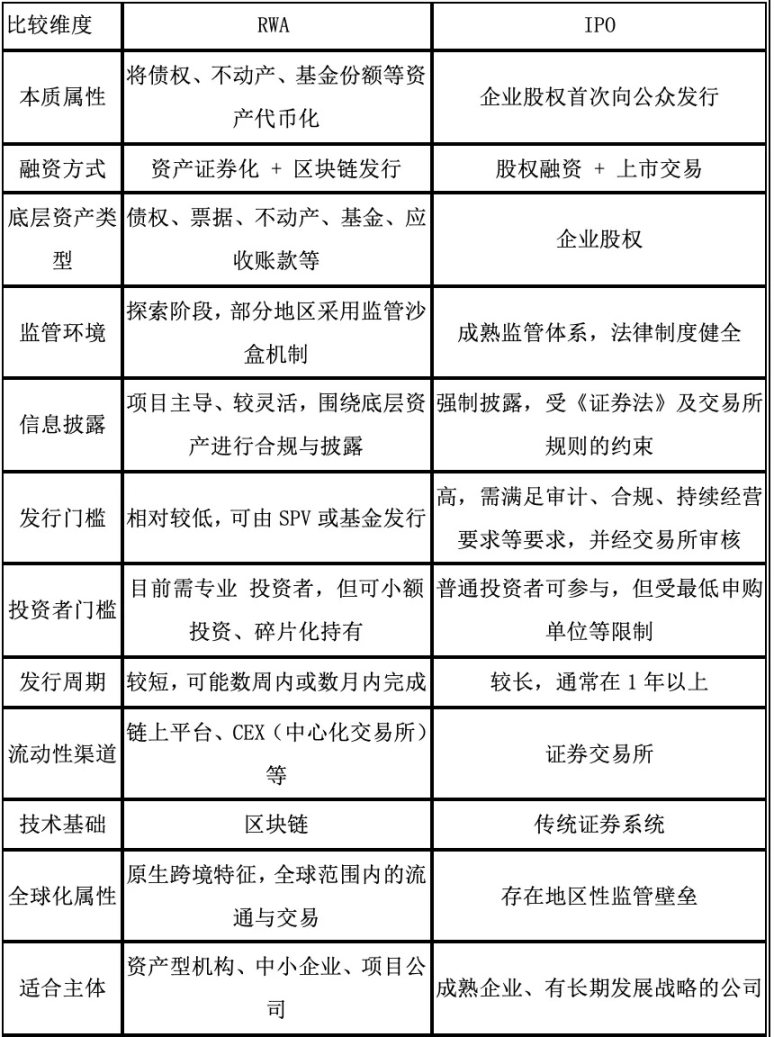
Should I choose IPO or RWA for financing? This is a question worth considering

03 The respective advantages and characteristics of IPO and RWA

RWA and IPO are similar to a certain extent, but due to their different financing logics, they actually each have their own advantages and characteristics.

As an emerging financing method with the help of blockchain technology, RWA has the following advantages: (1) Low threshold and high efficiency: RWA can split the investment amount as needed, and participation can be made with a few hundred yuan or even tens of yuan, which is suitable for a wider range of investors. (2) Improved liquidity: Assets that were originally difficult to circulate, such as accounts receivable or real estate income rights, can be traded globally on the chain. (3) High issuance efficiency: It does not rely on traditional brokerage processes, does not require long waiting periods, and can be issued quickly after the technology is mature. (4) On-chain transparency: All transaction records are traceable on the chain, enhancing the trust mechanism.

IPO is a traditional financing method for enterprises to enter the capital market. It has the following advantages: (1) High financing amount: Once successfully listed, enterprises can usually achieve hundreds of millions or even billions of financing. (2) Enhanced brand reputation: Listing means passing the strict review of the regulatory authorities, which has a great positive effect on the corporate brand image. (3) Large space for capital operation: Through subsequent additional issuance, mergers and acquisitions, equity incentives and other tools, the capital market can be used to enable corporate efficiency growth in multiple dimensions. (4) Perfect investor protection mechanism: A relatively standardized regulatory environment, mature system and rule of law protect the rights and interests of investors. (5) Broad investor group base: Covering various types of investors such as institutions and retail investors, and sufficient market liquidity.

04 Differences in regulatory preferences between IPO and RWA - Taking Hong Kong as an example

As an international financial center where East meets West, Hong Kong has always been trying to find a balance between traditional finance and emerging finance. In the supervision of RWA and IPO financing methods, Hong Kong has shown a clear "differentiated regulatory orientation": IPO emphasizes strict compliance, information disclosure and investor protection; RWA is relatively open, encouraging innovation but gradually bringing it under control.

Hong Kong's IPO system has long followed the strict framework of the Securities and Futures Ordinance. The listing process is jointly supervised by the Hong Kong Stock Exchange and the Securities and Futures Commission (SFC), covering multiple links such as sponsorship, due diligence, audit review, information disclosure, and public shareholding ratio, ensuring that listed companies have stable financial performance, sustainable operating capabilities, and good governance structures. This strong supervision not only protects the rights and interests of investors, but also enhances the credibility of the Hong Kong market.

In contrast, Hong Kong's regulation of RWAs demonstrates an experimental mindset of "inclusiveness and prudence". In recent years, the SFC has frequently issued regulatory circulars on tokenized assets, gradually established a regulatory sandbox and a licensing system for virtual asset service providers, and included RWA tokens in the category of qualified investment products for regulatory attempts. For example, the "Circular on Tokenized SFC-Approved Investment Products" issued in 2023 clarified for the first time that product providers must be responsible for the management and operational reliability of tokenized arrangements, ensure compatibility with service providers, etc., and should also explain the reliability of relevant arrangements as required by the SFC, and obtain third-party review and verification and legal opinions when necessary, indicating that Hong Kong is trying to achieve a balance between financial progress and investor protection.

05 One table explains: Which customer groups are suitable for IPO and RWA
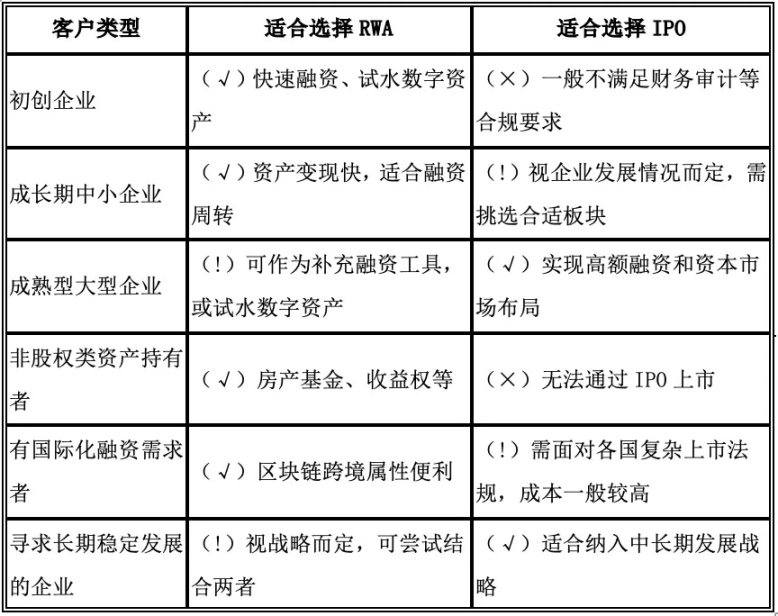
Should I choose IPO or RWA for financing? This is a question worth considering

06 Conclusion: IPO and RWA - Complementary rather than Substitute

We should realize that RWA is not a substitute for IPO, but a supplement and reshaping of the traditional financing system. It provides unprecedented financing channels for small and medium-sized enterprises and asset holders, and improves financial inclusion; while IPO is still the key path for enterprises to mature and embrace the public market and global capital. For enterprises, they should reasonably choose or combine RWA and IPO according to their own development stage, financing needs, asset structure and strategic layout. In the future, with the maturity of regulatory mechanisms, the reduction of technical barriers and the improvement of market acceptance, RWA and IPO are expected to jointly build a more diversified, transparent and efficient financing ecosystem.


Market Opportunity
RealLink Logo
RealLink Price(REAL)
$0.07577
$0.07577$0.07577
+0.30%
USD
RealLink (REAL) Live Price Chart
Disclaimer: The articles reposted on this site are sourced from public platforms and are provided for informational purposes only. They do not necessarily reflect the views of MEXC. All rights remain with the original authors. If you believe any content infringes on third-party rights, please contact service@support.mexc.com for removal. MEXC makes no guarantees regarding the accuracy, completeness, or timeliness of the content and is not responsible for any actions taken based on the information provided. The content does not constitute financial, legal, or other professional advice, nor should it be considered a recommendation or endorsement by MEXC.

You May Also Like

Stablecoin startup Bastion completes $14.6 million in new funding round, led by Coinbase Ventures

Stablecoin startup Bastion completes $14.6 million in new funding round, led by Coinbase Ventures

PANews reported on September 24 that according to Fortune magazine, the stablecoin startup Bastion completed a new round of financing of US$14.6 million led by Coinbase Ventures. Other investors in this round included the venture capital arm of Japanese technology giant Sony, the venture capital arm of South Korean mobile phone manufacturer Samsung, the cryptocurrency arm of venture capital firm Andreessen Horowitz (a16z), and cryptocurrency venture capital firm Hashed. Bastion is a white-label stablecoin issuer. Instead of hiring lawyers to obtain regulatory approvals or software developers to write code, companies can hire Bastion to more easily launch their own stablecoins. Bastion's differentiated advantage lies in its comprehensive stablecoin service offering, including a cryptocurrency wallet for clients to hold their tokens and channels for converting stablecoins into cash in 70 countries, including the United States.
Share
PANews2025/09/24 20:09
Jerome Powell’s Press Conference: Crucial Insights Unveiled for the Market’s Future

Jerome Powell’s Press Conference: Crucial Insights Unveiled for the Market’s Future

BitcoinWorld Jerome Powell’s Press Conference: Crucial Insights Unveiled for the Market’s Future The financial world, including the dynamic cryptocurrency market, often hangs on every word from the Federal Reserve. Recently, Jerome Powell’s press conference following the Federal Open Market Committee (FOMC) meeting concluded, leaving investors and analysts dissecting his remarks for clues about the future economic direction. This event is always a pivotal moment, shaping expectations for inflation, interest rates, and the overall stability of global markets. What Were the Key Takeaways from Jerome Powell’s Press Conference? During Jerome Powell’s press conference, the Fed Chair provided an update on the central bank’s monetary policy decisions and its economic outlook. His statements often reiterate the Fed’s dual mandate: achieving maximum employment and stable prices. This time was no different, with a strong emphasis on managing persistent inflation. Key points from the recent discussion included: Inflation Control: Powell emphasized the Fed’s unwavering commitment to bringing inflation back down to its 2% target. He reiterated that the fight against rising prices remains the top priority, even if it entails some economic slowdown. Interest Rate Policy: While the Fed’s stance on future interest rate adjustments was discussed, the path remains data-dependent. Powell indicated that decisions would continue to be made meeting-by-meeting, based on incoming economic data. Economic Projections: The updated Summary of Economic Projections (SEP) offered insights into the Fed’s forecasts for GDP growth, unemployment, and inflation. These projections help market participants gauge the central bank’s expectations for the economy’s trajectory. Quantitative Tightening (QT): The ongoing process of reducing the Fed’s balance sheet, known as quantitative tightening, was also a topic. This reduction in liquidity in the financial system has broad implications for asset prices. How Did Jerome Powell’s Remarks Impact Cryptocurrency Markets? The conclusion of Jerome Powell’s press conference often sends ripples through traditional financial markets, and cryptocurrencies are increasingly sensitive to these macroeconomic shifts. Digital assets, once thought to be uncorrelated, now frequently react to the Fed’s monetary policy signals. Higher interest rates, for instance, tend to make riskier assets like cryptocurrencies less attractive. This is because investors might prefer safer, interest-bearing investments. Consequently, we often see increased volatility in Bitcoin (BTC) and Ethereum (ETH) prices immediately following such announcements. The tightening of financial conditions, driven by the Fed, reduces overall liquidity in the system, which can put downward pressure on asset valuations across the board. However, some argue that this growing correlation signifies crypto’s increasing integration into the broader financial ecosystem. It suggests that institutional investors and mainstream finance are now paying closer attention to digital assets, treating them more like other risk-on investments. Navigating the Economic Landscape After Jerome Powell’s Press Conference For cryptocurrency investors, understanding the implications of Jerome Powell’s press conference is crucial for making informed decisions. The Fed’s policy trajectory directly influences the availability of capital and investor sentiment, which are key drivers for crypto valuations. Here are some actionable insights for navigating this environment: Stay Informed: Regularly monitor Fed announcements and economic data releases. Understanding the macroeconomic backdrop is as important as analyzing individual crypto projects. Assess Risk Tolerance: In periods of economic uncertainty and tighter monetary policy, a reassessment of personal risk tolerance is wise. Diversification within your crypto portfolio and across different asset classes can mitigate potential downsides. Focus on Fundamentals: While market sentiment can be swayed by macro news, projects with strong fundamentals, clear use cases, and robust development teams tend to perform better in the long run. Long-Term Perspective: Cryptocurrency markets are known for their volatility. Adopting a long-term investment horizon can help weather short-term fluctuations driven by macro events like Fed meetings. The challenges include potential continued volatility and reduced liquidity. However, opportunities may arise from market corrections, allowing strategic investors to accumulate assets at lower prices. In summary, Jerome Powell’s press conference provides essential guidance on the Fed’s economic strategy. Its conclusions have a profound impact on financial markets, including the dynamic world of cryptocurrencies. Staying informed, understanding the nuances of monetary policy, and maintaining a strategic investment approach are paramount for navigating the evolving economic landscape. The Fed’s actions underscore the interconnectedness of traditional finance and the burgeoning digital asset space. Frequently Asked Questions (FAQs) Q1: What is the Federal Open Market Committee (FOMC)? A1: The FOMC is the monetary policy-making body of the Federal Reserve System. It sets the federal funds rate target and directs open market operations, influencing the availability of money and credit in the U.S. economy. Q2: How do the Fed’s interest rate decisions typically affect cryptocurrency markets? A2: Generally, when the Fed raises interest rates, it makes borrowing more expensive and reduces liquidity in the financial system. This often leads investors to shy away from riskier assets like cryptocurrencies, potentially causing prices to decline. Conversely, lower rates can stimulate investment in riskier assets. Q3: What does “data-dependent” mean in the context of Fed policy? A3: “Data-dependent” means that the Federal Reserve’s future monetary policy decisions, such as interest rate adjustments, will primarily be based on the latest economic data. This includes inflation reports, employment figures, and GDP growth, rather than a predetermined schedule. Q4: Should I change my cryptocurrency investment strategy based on Jerome Powell’s press conference? A4: While it’s crucial to be aware of the macroeconomic environment shaped by Jerome Powell’s press conference, drastic changes to a well-researched investment strategy may not always be necessary. It’s recommended to review your portfolio, assess your risk tolerance, and consider if your strategy aligns with the current economic outlook, focusing on long-term fundamentals. If you found this analysis helpful, please consider sharing it with your network! Your insights and shares help us reach more readers interested in the intersection of traditional finance and the exciting world of cryptocurrencies. Spread the word! To learn more about the latest crypto market trends, explore our article on key developments shaping Bitcoin price action. This post Jerome Powell’s Press Conference: Crucial Insights Unveiled for the Market’s Future first appeared on BitcoinWorld.
Share
Coinstats2025/09/18 16:25
Best Crypto to Buy as Saylor & Crypto Execs Meet in US Treasury Council

Best Crypto to Buy as Saylor & Crypto Execs Meet in US Treasury Council

The post Best Crypto to Buy as Saylor & Crypto Execs Meet in US Treasury Council appeared on BitcoinEthereumNews.com. Michael Saylor and a group of crypto executives met in Washington, D.C. yesterday to push for the Strategic Bitcoin Reserve Bill (the BITCOIN Act), which would see the U.S. acquire up to 1M $BTC over five years. With Bitcoin being positioned yet again as a cornerstone of national monetary policy, many investors are turning their eyes to projects that lean into this narrative – altcoins, meme coins, and presales that could ride on the same wave. Read on for three of the best crypto projects that seem especially well‐suited to benefit from this macro shift:  Bitcoin Hyper, Best Wallet Token, and Remittix. These projects stand out for having a strong use case and high adoption potential, especially given the push for a U.S. Bitcoin reserve.   Why the Bitcoin Reserve Bill Matters for Crypto Markets The strategic Bitcoin Reserve Bill could mark a turning point for the U.S. approach to digital assets. The proposal would see America build a long-term Bitcoin reserve by acquiring up to one million $BTC over five years. To make this happen, lawmakers are exploring creative funding methods such as revaluing old gold certificates. The plan also leans on confiscated Bitcoin already held by the government, worth an estimated $15–20B. This isn’t just a headline for policy wonks. It signals that Bitcoin is moving from the margins into the core of financial strategy. Industry figures like Michael Saylor, Senator Cynthia Lummis, and Marathon Digital’s Fred Thiel are all backing the bill. They see Bitcoin not just as an investment, but as a hedge against systemic risks. For the wider crypto market, this opens the door for projects tied to Bitcoin and the infrastructure that supports it. 1. Bitcoin Hyper ($HYPER) – Turning Bitcoin Into More Than Just Digital Gold The U.S. may soon treat Bitcoin as…
Share
BitcoinEthereumNews2025/09/18 00:27