Blockchain technology is beginning to absorb traditional government assets at an alarming pace, with Ripple’s XRP Ledger (XRPL) now hosting US Treasury debt in Blockchain technology is beginning to absorb traditional government assets at an alarming pace, with Ripple’s XRP Ledger (XRPL) now hosting US Treasury debt in

US Treasury Debt Balloons On Ripple’s XRPL, You Should See The Figures

Blockchain technology is beginning to absorb traditional government assets at an alarming pace, with Ripple’s XRP Ledger (XRPL) now hosting US Treasury debt in digital form. The latest reports have revealed a massive increase in tokenized treasuries on the ledger, reflecting not just rising governmental interest in the blockchain but also growing institutional adoption. 

US Treasury Debt Skyrockets On Ripple’s XRPL

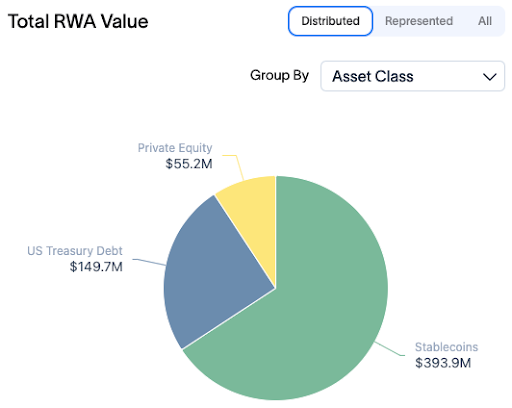
Over the past year, tokenized US Treasury debt on the XRP Ledger has skyrocketed to more than $150.19 million. Data from the tokenized asset analytics platform RWA.xyz shows that digital platforms such as OpenEden Digital, Zeconomy, Ondo, and Archax have been the primary drivers behind this latest surge in activity and volume. 

XRPL data also shows that US Treasury debt has not been the only asset class to experience growth on the network. Recent reports revealed that the XRP Ledger achieved a significant milestone, surpassing $1 billion in total tokenized assets. While tokenized US treasury debt contributed significantly to this growth, other asset classes, including stablecoins, private credit, commodities, and private equity, have also recorded substantial volume, reflecting the network’s expanding role in global digital finance. 

Stablecoins recorded the highest volume of over $338 million within the $1 billion tokenized asset growth, representing approximately 160% more than US Treasury debt. In comparison, private equity accounted for $55.2 million, reflecting less than 33% of tokenized treasuries. 
Ripple

Across all networks, tokenized US Treasury holdings have now reached about $10 billion. While the percentage held by the XRP Ledger is impressive, it still represents just 1.4% of the total. Nonetheless, the growth rate of US Treasury debt on XRPL is striking, showing a more than 2,900% increase from the roughly $5 million on the network in 2025. 

The recent surge in tokenized US Treasury debt on the XRP Ledger underscores the expanding integration of traditional finance with blockchain technology. It also reflects the rising demand for Real-World Asset (RWA) tokenization, which has become a fundamental aspect of Ripple and XRPL’s utility and key driver of the network’s growth and expansion into broader markets. 

Why This Is A Big Deal

Historically, US Treasury debt was tracked and recorded through conventional banking and government systems. As a result, trading relied heavily on intermediaries, transactions and settlements were slow, and most retail investors had limited access. At the same time, Paper records and centralized systems dominated the market, making processes less transparent and tedious.

However, the introduction of blockchain technology has significantly improved how debt is represented and managed. On the XRP Ledger, Treasury debt can now be tokenized, allowing near-instant settlement and real-time verification on a public network. This reduces the reliance on intermediaries and introduces a new level of transparency and security compared to traditional methods. 

The rise of tokenized Treasury debt also signals changes in investor behavior and broader market dynamics. It shows that blockchain-based assets can now compete with traditional markets, offering faster, more efficient, and accessible alternatives for institutions and governments.


Ripple
Disclaimer: The articles reposted on this site are sourced from public platforms and are provided for informational purposes only. They do not necessarily reflect the views of MEXC. All rights remain with the original authors. If you believe any content infringes on third-party rights, please contact service@support.mexc.com for removal. MEXC makes no guarantees regarding the accuracy, completeness, or timeliness of the content and is not responsible for any actions taken based on the information provided. The content does not constitute financial, legal, or other professional advice, nor should it be considered a recommendation or endorsement by MEXC.

You May Also Like

Franklin Templeton CEO Dismisses 50bps Rate Cut Ahead FOMC

Franklin Templeton CEO Dismisses 50bps Rate Cut Ahead FOMC

The post Franklin Templeton CEO Dismisses 50bps Rate Cut Ahead FOMC appeared on BitcoinEthereumNews.com. Franklin Templeton CEO Jenny Johnson has weighed in on whether the Federal Reserve should make a 25 basis points (bps) Fed rate cut or 50 bps cut. This comes ahead of the Fed decision today at today’s FOMC meeting, with the market pricing in a 25 bps cut. Bitcoin and the broader crypto market are currently trading flat ahead of the rate cut decision. Franklin Templeton CEO Weighs In On Potential FOMC Decision In a CNBC interview, Jenny Johnson said that she expects the Fed to make a 25 bps cut today instead of a 50 bps cut. She acknowledged the jobs data, which suggested that the labor market is weakening. However, she noted that this data is backward-looking, indicating that it doesn’t show the current state of the economy. She alluded to the wage growth, which she remarked is an indication of a robust labor market. She added that retail sales are up and that consumers are still spending, despite inflation being sticky at 3%, which makes a case for why the FOMC should opt against a 50-basis-point Fed rate cut. In line with this, the Franklin Templeton CEO said that she would go with a 25 bps rate cut if she were Jerome Powell. She remarked that the Fed still has the October and December FOMC meetings to make further cuts if the incoming data warrants it. Johnson also asserted that the data show a robust economy. However, she noted that there can’t be an argument for no Fed rate cut since Powell already signaled at Jackson Hole that they were likely to lower interest rates at this meeting due to concerns over a weakening labor market. Notably, her comment comes as experts argue for both sides on why the Fed should make a 25 bps cut or…
Share
BitcoinEthereumNews2025/09/18 00:36
Tether launches US-regulated stablecoin, banks warn of deposit flight risk

Tether launches US-regulated stablecoin, banks warn of deposit flight risk

Tether has launched USA₮, marking its first fully compliant offering for American users under the newly enacted GENIUS Act.
Share
Crypto.news2026/01/28 01:47
Edges higher ahead of BoC-Fed policy outcome

Edges higher ahead of BoC-Fed policy outcome

The post Edges higher ahead of BoC-Fed policy outcome appeared on BitcoinEthereumNews.com. USD/CAD gains marginally to near 1.3760 ahead of monetary policy announcements by the Fed and the BoC. Both the Fed and the BoC are expected to lower interest rates. USD/CAD forms a Head and Shoulder chart pattern. The USD/CAD pair ticks up to near 1.3760 during the late European session on Wednesday. The Loonie pair gains marginally ahead of monetary policy outcomes by the Bank of Canada (BoC) and the Federal Reserve (Fed) during New York trading hours. Both the BoC and the Fed are expected to cut interest rates amid mounting labor market conditions in their respective economies. Inflationary pressures in the Canadian economy have cooled down, emerging as another reason behind the BoC’s dovish expectations. However, the Fed is expected to start the monetary-easing campaign despite the United States (US) inflation remaining higher. Investors will closely monitor press conferences from both Fed Chair Jerome Powell and BoC Governor Tiff Macklem to get cues about whether there will be more interest rate cuts in the remainder of the year. According to analysts from Barclays, the Fed’s latest median projections for interest rates are likely to call for three interest rate cuts by 2025. Ahead of the Fed’s monetary policy, the US Dollar Index (DXY), which tracks the Greenback’s value against six major currencies, holds onto Tuesday’s losses near 96.60. USD/CAD forms a Head and Shoulder chart pattern, which indicates a bearish reversal. The neckline of the above-mentioned chart pattern is plotted near 1.3715. The near-term trend of the pair remains bearish as it stays below the 20-day Exponential Moving Average (EMA), which trades around 1.3800. The 14-day Relative Strength Index (RSI) slides to near 40.00. A fresh bearish momentum would emerge if the RSI falls below that level. Going forward, the asset could slide towards the round level of…
Share
BitcoinEthereumNews2025/09/18 01:23