

Ripple Links Up With $130 Billion Riyad Bank’s Innovation Arm Jeel
Ripple has signed a partnership with Jeel, the innovation and technology arm of Riyad Bank, to explore blockchain applications across cross-border payments, digital asset custody, and tokenization in Saudi Arabia. The collaboration positions Ripple inside a regulated testing environment as the Kingdom accelerates its Vision 2030 digital transformation agenda.
Ripple Expands In Saudi With Riyad Bank
Jeel announced the tie-up on X: “We are pleased to announce in Jil our partnership with Ripple to explore advanced applications aimed at enhancing the speed and efficiency of payments. This partnership focuses on studying use cases for the custody of digital assets, alongside developing prototypes within Jil’s regulatory sandbox, in support of the objectives of Vision 2030.”
In a press release dated January 26, 2026, Jeel said the partnership will evaluate how blockchain can improve the “speed, cost efficiency, and transparency of cross-border payments,” while also exploring digital asset custody and tokenization use cases. The firms plan to develop proofs-of-concept within Jeel’s sandbox to test Ripple’s technologies “in a controlled, compliant environment,” with an emphasis on scalable and interoperable infrastructure for financial services across the Kingdom.
Jeel CEO George Harrak positioned the sandbox as the core mechanism for turning blockchain concepts into regulated experimentation. “This partnership with Ripple reflects our strategy of using the Jeel Sandbox to responsibly explore next-generation financial infrastructure,” Harrak said. “By combining regulated experimentation with global blockchain expertise, we are building the foundations to evaluate scalable use cases that enhance cross-border payments and digital asset capabilities in line with the Kingdom’s long-term digital ambitions.”
Ripple’s Managing Director for the Middle East and Africa, Reece Merrick, described the work as an effort to integrate enterprise blockchain into Saudi financial architecture, explicitly tying it to the Vision 2030 roadmap.
“Saudi Arabia’s visionary leadership has established the Kingdom as a forward-thinking global hub for digital transformation,” Merrick said. “It is against this progressive backdrop that Ripple has signed an MOU with Jeel to explore integrating secure, efficient blockchain solutions into the national financial architecture. We are committed to demonstrating how Ripple’s enterprise-grade digital assets technology can unlock significant efficiencies in areas like cross-border payments, aligning directly with Saudi Arabia’s goal of building a world-leading, competitive fintech ecosystem.”
Merrick echoed that messaging in a separate post, saying the partners will explore use cases spanning “cross-border payments, digital asset custody, and tokenization,” and adding that he is “excited to help shape the future of Saudi Arabia’s financial infrastructure.”
For Jeel, the partnership is pitched as a step beyond conventional fintech acceleration into “regulated blockchain experimentation,” extending its innovation mandate while supporting Riyad Bank’s ambitions to evaluate next-generation digital financial services. For Ripple, Jeel’s sandbox and institutional network offer a pathway into the Kingdom’s fast-growing fintech landscape, with the press release noting that the arrangement creates a venue to showcase Ripple’s infrastructure in a “highly regulated and innovation-driven environment.”
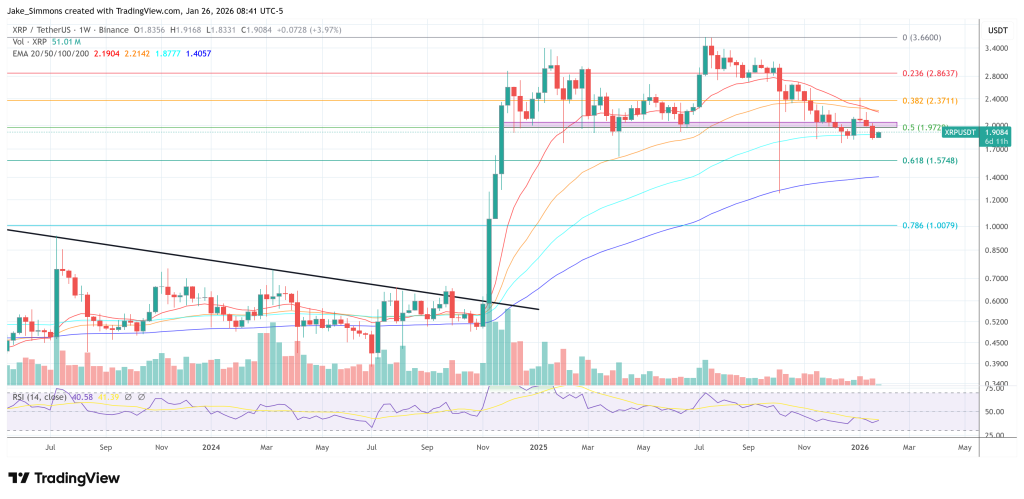
At press time, XRP traded at $1.90.


You May Also Like

Rheumatoid Arthritis Columbus: Personalized Treatment From Local Rheumatology Specialists

Australian Dollar Dips Below 0.7100 as Middle East Tensions Weigh on Risk Sentiment




