US Senate Crypto Bill Heads to Markup Without Democrat Support
The Senate Agriculture Committee has released updated crypto market structure legislation and scheduled a markup for January 27 despite failing to secure Democratic backing, marking a potential shift toward partisan passage after months of bipartisan negotiations stalled.
Chairman John Boozman announced the legislative text yesterday, acknowledging that “differences remain on fundamental policy issues” while expressing gratitude for collaboration with Senator Cory Booker.
“Although it’s unfortunate that we couldn’t reach an agreement, I am grateful for the collaboration that has made this legislation better,” Boozman said, noting the markup will proceed at 3 p.m. in the Russell Senate Office Building.
Legislative Path Narrows as Banking Panel Delays CLARITY Act
The Agriculture Committee’s decision to advance its Digital Commodity Intermediaries Act comes as the Senate Banking Committee postponed work on the parallel CLARITY Act until late February or March, according to sources.
The Banking panel has pivoted to housing legislation following President Trump’s push for affordability, with the president writing that he is taking “immediate steps” on the housing bill, which remains a priority and “American Dream.”
That delay followed Coinbase CEO Brian Armstrong’s public withdrawal of support over provisions he called “catastrophic,” including restrictions on tokenized equities and stablecoin yield.
Patrick Witt, White House Executive Director of the President’s Crypto Council, pushed back against Armstrong’s “no bill is better than a bad bill” stance, warning that delaying legislation risks future Democratic lawmakers writing “punitive legislation in the wake of a crisis, à la Dodd-Frank.”
“You might not love every part of the CLARITY Act, but I can guarantee you’ll hate a future Dem version even more,” Witt wrote.
Meanwhile, President Trump confirmed at Davos 2026 that he expects to sign crypto market structure legislation “very soon,” stating his administration is working to ensure “America remains the crypto capital of the world.“
Democratic opposition has intensified over ethics concerns, with Senator Adam Schiff demanding controls covering the White House and Senator Ruben Gallego calling ethics guardrails “a red line.”
Key Differences Between Competing Bills Shape Industry Response
The updated bill diverges from Banking’s CLARITY Act on several critical points, particularly regarding stablecoin yield, which has been the single biggest source of industry division.
CLARITY’s Section 404 explicitly prohibits digital asset service providers from paying interest or yield solely for holding payment stablecoins, though it permits “activity-based” rewards for transactions, loyalty programs, staking, or governance participation.
The new bill takes a fundamentally different approach by excluding “permitted payment stablecoins” from CFTC authority entirely, deferring regulation to frameworks like the GENIUS Act rather than setting specific yield rules.
Notably, the bill also explicitly classifies meme coins as digital commodities under CFTC jurisdiction, defining them as assets “inspired by internet memes, characters, or current events, where promoters seek to attract an enthusiastic community primarily for speculative purposes.“
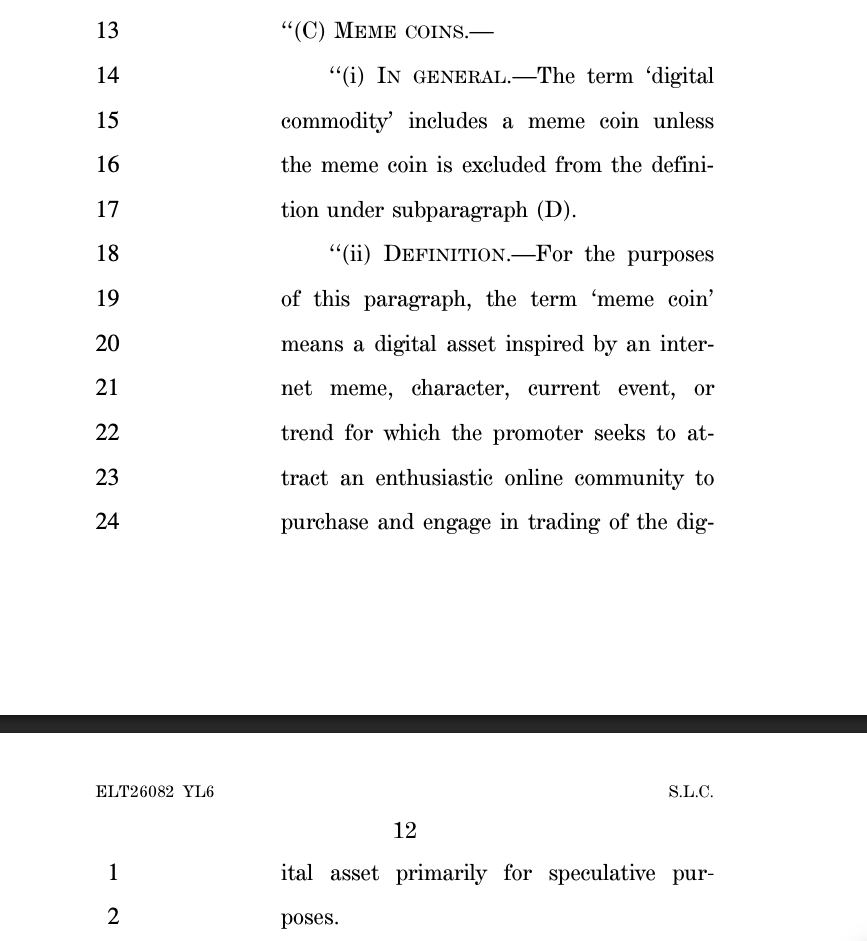 An excerpt of the Republican draft crypto bill. | ource: Senate Agriculture Committee
CLARITY instead introduces “ancillary assets” concepts with exemptions for tokens that were principal assets of ETFs listed as of January 1, 2026.
On developer protections, the bill establishes an Office of the Digital Commodity Retail Advocate within the CFTC, while CLARITY creates a CFTC-SEC Micro-Innovation Sandbox for small firms.
Both protect software developers from regulation, though CLARITY’s Section 604 sparked warnings from Judiciary Committee leaders Chuck Grassley and Dick Durbin that it could “materially limit prosecutors’ ability to pursue financial crime cases.“
Banking Lobby Secures Stablecoin Restrictions Amid Industry Split
The stablecoin yield debate has exposed deep rifts between crypto platforms and traditional banks.
Bank of America CEO Brian Moynihan recently warned that as much as $6 trillion in deposits (roughly 30% to 35% of US commercial bank deposits) could migrate into stablecoins, while JPMorgan CFO Jeremy Barnum called yield-bearing stablecoins “a parallel banking system that includes something that looks a lot like a deposit that pays interest, without the associated safeguards.“
Galaxy Digital also warned that Banking’s draft could grant Treasury “Patriot Act–style” surveillance powers, including authority to freeze transactions for up to 30 days without court orders.
Given this increasing friction with banks, Armstrong said Coinbase is exploring compromises with them during Davos talks, stating, “we’re going to continue to work on the market structure legislation, and meet with some of the bank CEOs to figure out how we can make this a win-win.“
Despite regulatory uncertainty, Clear Street analyst Owen Lau noted that “institutional use cases continue to expand even without a favorable Clarity Act,” pointing to continued blockchain adoption by major financial institutions.


You May Also Like

Upbit To Temporarily Halt ATOM Deposits And Withdrawals For Cosmos Network Upgrade

Goatseus Maximus (GOAT) Price Prediction 2026, 2027-2030