Iran's central bank acquired at least $507 million in USDT to counter a currency crisis and circumvent sanctions, routing funds through exchanges and DeFi protocolsIran's central bank acquired at least $507 million in USDT to counter a currency crisis and circumvent sanctions, routing funds through exchanges and DeFi protocols

Iran’s Central Bank Used $507M in USDT to Bypass Sanctions, Elliptic Reports

Iran’s central bank used at least half a billion dollars in USDT to ease a currency crisis and work around sanctions-driven limits on dollar access, according to a new Elliptic report.

The blockchain analytics firm reports that the Central Bank of Iran (CBI) acquired at least $507 million in USDT. Elliptic treats this as a lower estimate based on wallets confidently linked to the institution. Investigators began tracing the digital trail after leaked documents showed two USDT purchases in April and May 2025, paid in Emirati dirhams, leading them to a wider wallet network.

The firm concludes that the pattern reflects a deliberate strategy to build a sizeable dollar-linked reserve outside the conventional banking system. Elliptic links multiple addresses on TRON and other networks to the CBI.

From Nobitex to Bridges: Tracing the USDT Flow

Elliptic’s tracking shows that, until early June 2025, most of the CBI-linked USDT passed through Nobitex, Iran’s biggest crypto exchange, where people could hold USDT, trade it, or convert it to rials. Sending USDT through Nobitex shows the central bank used it to put dollars into Iran’s local markets.

After June 2025, flows shifted from Nobitex to a cross-chain bridge. This bridge moved USDT from TRON to Ethereum, then dispersed funds through decentralized exchanges, other blockchains, and centralized venues through late 2025. Since then, the firm hasn’t been tracking any additional USDT funds related to Iran.

This operational pivot occurred around the same time as the June 18, 2025, hack on Nobitex, when the pro-Israel group Gonjeshke Darande stole around $90 million in crypto and burned the assets by sending them to an unrecoverable address.

Elliptic links the buildup of USDT reserves to two pressures facing Tehran: a collapsing rial and the challenge of settling cross-border trade under sanctions. The report notes that the rial lost around half its value against the dollar in eight months. This prompted the central bank to seek tools to stabilize the FX market.
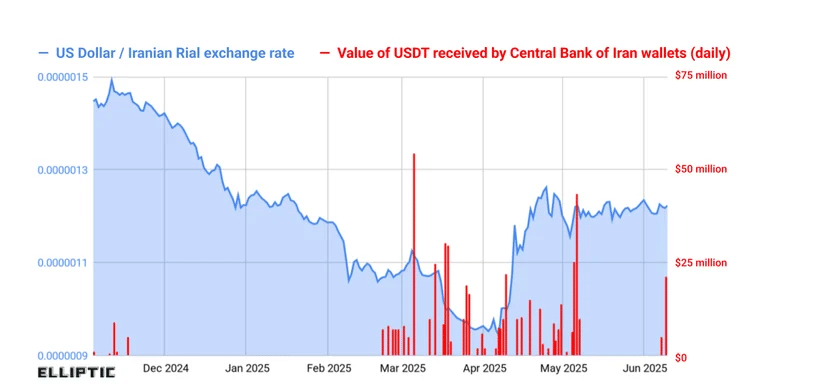
Graphic of the US Dollar / Iranian Rial exchange rate | Source: Elliptic

Graphic of the US Dollar / Iranian Rial exchange rate | Source: Elliptic

On-chain flows to Nobitex are consistent with the CBI’s use of USDT for open-market operations. The central bank bought rials with stablecoins to support the exchange rate without tapping official foreign reserves, which are constrained by sanctions. This is similar to what Venezuela has done since September 2025, due to dollar scarcity.

Sanctions Risks and Enforcement Response

Elliptic argues that this infrastructure is a sanctions-resistant shadow banking layer, but not an invisible one. Stablecoin transfers occur on public blockchains, leaving a visible trace. The firm stresses that, unlike cash or a traditional money exchange dealer, USDT on TRON and Ethereum leaves an auditable trail that regulators and compliance teams can monitor.

The report highlights how exchanges, custodians, and stablecoin issuers can still enforce sanctions by blocking or freezing high-risk wallets. Tether reportedly blacklisted several wallets linked to the CBI in the past. The company also freezes USDT wallets at the request of enforcement authorities worldwide. This demonstrates that stablecoin controls can be applied directly at the token level.

In addition to these controls and investigations, on January 11, 2026, TRM Labs, a blockchain analytics firm, published a report describing how Iran’s Islamic Revolutionary Guard Corps (IRGC) moved nearly $1 billion in cryptocurrency between 2023 and 2025. This demonstrates the challenges of enforcing sanctions on crypto transactions, even with advanced technology.

next

The post Iran’s Central Bank Used $507M in USDT to Bypass Sanctions, Elliptic Reports appeared first on Coinspeaker.


Market Opportunity
Lorenzo Protocol Logo
Lorenzo Protocol Price(BANK)
$0.05247
$0.05247$0.05247
+0.22%
USD
Lorenzo Protocol (BANK) Live Price Chart
Disclaimer: The articles reposted on this site are sourced from public platforms and are provided for informational purposes only. They do not necessarily reflect the views of MEXC. All rights remain with the original authors. If you believe any content infringes on third-party rights, please contact service@support.mexc.com for removal. MEXC makes no guarantees regarding the accuracy, completeness, or timeliness of the content and is not responsible for any actions taken based on the information provided. The content does not constitute financial, legal, or other professional advice, nor should it be considered a recommendation or endorsement by MEXC.

You May Also Like

The USDC Treasury burned $50 million worth of USDC on the Ethereum blockchain.

The USDC Treasury burned $50 million worth of USDC on the Ethereum blockchain.

PANews reported on January 22 that, according to Whale Alert monitoring, at 15:55 Beijing time, the USDC Treasury destroyed 50,000,000 USDC (approximately $50.01
Share
PANews2026/01/22 15:59
Crossmint Partners with MoneyGram for USDC Remittances in Colombia

Crossmint Partners with MoneyGram for USDC Remittances in Colombia

TLDR Crossmint enables MoneyGram’s new stablecoin payment app for cross-border transfers. The new app allows USDC transfers from the US to Colombia, boosting financial inclusion. MoneyGram offers USDC savings and Visa-linked spending for Colombian users. The collaboration simplifies cross-border payments with enterprise-grade blockchain tech. MoneyGram, a global leader in remittance services, launched its stablecoin-powered cross-border [...] The post Crossmint Partners with MoneyGram for USDC Remittances in Colombia appeared first on CoinCentral.
Share
Coincentral2025/09/18 21:02
Whales Dump 200 Million XRP in Just 2 Weeks – Is XRP’s Price on the Verge of Collapse?

Whales Dump 200 Million XRP in Just 2 Weeks – Is XRP’s Price on the Verge of Collapse?

Whales offload 200 million XRP leaving market uncertainty behind. XRP faces potential collapse as whales drive major price shifts. Is XRP’s future in danger after massive sell-off by whales? XRP’s price has been under intense pressure recently as whales reportedly offloaded a staggering 200 million XRP over the past two weeks. This massive sell-off has raised alarms across the cryptocurrency community, as many wonder if the market is on the brink of collapse or just undergoing a temporary correction. According to crypto analyst Ali (@ali_charts), this surge in whale activity correlates directly with the price fluctuations seen in the past few weeks. XRP experienced a sharp spike in late July and early August, but the price quickly reversed as whales began to sell their holdings in large quantities. The increased volume during this period highlights the intensity of the sell-off, leaving many traders to question the future of XRP’s value. Whales have offloaded around 200 million $XRP in the last two weeks! pic.twitter.com/MiSQPpDwZM — Ali (@ali_charts) September 17, 2025 Also Read: Shiba Inu’s Price Is at a Tipping Point: Will It Break or Crash Soon? Can XRP Recover or Is a Bigger Decline Ahead? As the market absorbs the effects of the whale offload, technical indicators suggest that XRP may be facing a period of consolidation. The Relative Strength Index (RSI), currently sitting at 53.05, signals a neutral market stance, indicating that XRP could move in either direction. This leaves traders uncertain whether the XRP will break above its current resistance levels or continue to fall as more whales sell off their holdings. Source: Tradingview Additionally, the Bollinger Bands, suggest that XRP is nearing the upper limits of its range. This often points to a potential slowdown or pullback in price, further raising concerns about the future direction of the XRP. With the price currently around $3.02, many are questioning whether XRP can regain its footing or if it will continue to decline. The Aftermath of Whale Activity: Is XRP’s Future in Danger? Despite the large sell-off, XRP is not yet showing signs of total collapse. However, the market remains fragile, and the price is likely to remain volatile in the coming days. With whales continuing to influence price movements, many investors are watching closely to see if this trend will reverse or intensify. The coming weeks will be critical for determining whether XRP can stabilize or face further declines. The combination of whale offloading and technical indicators suggest that XRP’s price is at a crossroads. Traders and investors alike are waiting for clear signals to determine if the XRP will bounce back or continue its downward trajectory. Also Read: Metaplanet’s Bold Move: $15M U.S. Subsidiary to Supercharge Bitcoin Strategy The post Whales Dump 200 Million XRP in Just 2 Weeks – Is XRP’s Price on the Verge of Collapse? appeared first on 36Crypto.
Share
Coinstats2025/09/17 23:42