Cryptocurrency’s traditional four-year cycle has collapsed, replaced by a new market structure where liquidity concentration and investor positioning now determineCryptocurrency’s traditional four-year cycle has collapsed, replaced by a new market structure where liquidity concentration and investor positioning now determine

Wintermute Says Crypto’s Bull Cycle Is Over – Three Forces Will Drive 2026

2026/01/20 19:24
4 min read
For feedback or concerns regarding this content, please contact us at crypto.news@mexc.com

Cryptocurrency’s traditional four-year cycle has collapsed, replaced by a new market structure where liquidity concentration and investor positioning now determine price action, according to a comprehensive year-end analysis from leading OTC desk Wintermute.

The firm’s proprietary trading data reveals that 2025 marked a fundamental shift in how digital assets trade, with the year’s muted performance indicating crypto’s transition from speculation-driven rallies to a more institutionally anchored asset class.

Wintermute’s OTC flow data shows the historic pattern of Bitcoin gains recycling into Ethereum, then blue chips, and finally altcoins has weakened dramatically.
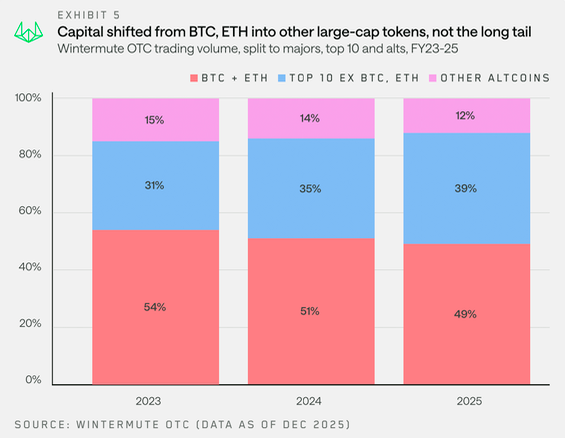
2026 Crypto's Bull Cycle - Wintermute ChartSource: Wintermute

Exchange-traded funds and digital asset treasury companies evolved into what the firm describes as “walled gardens,” providing sustained demand for large-cap assets without naturally rotating capital into the broader market.

With retail interest diverted toward equities, 2025 became a year of extreme concentration where a handful of major tokens absorbed the vast majority of new capital while the rest of the market struggled.

2026 Crypto's Bull Cycle - Wintermute ChartSource: Wintermute

Traditional Seasonality Shattered by Structural Shifts

Trading activity in 2025 followed a distinctly different pattern than previous years, breaking what had felt like seasonal rhythms.

Early-year optimism around the pro-crypto U.S. administration quickly disappointed as risk sentiment deteriorated sharply through the first quarter when memecoin and AI-agent narratives faded.

Trump’s tariff announcement on April 2 further pressured markets, concentrating activity early in the year before broad softening through spring and summer.

The late-year pickup seen in 2023 and 2024 failed to materialize, shattering narratives around “Uptober“ and year-end rallies.

Wintermute’s data reveals these were never true seasonal patterns but rather rallies driven by idiosyncratic catalysts like ETF approvals in 2023 and the new U.S. administration in 2024.

Markets became increasingly choppy as macro forces took control, with flows turning reactive and episodic around headlines without sustained momentum.

Altcoin rallies shortened dramatically, averaging roughly 19 days in 2025, down from 61 days the prior year.

2026 Crypto's Bull Cycle - Wintermute ChartSource: Wintermute

Themes including memecoin launchpads, perpetual DEXs, and the x402 meta sparked brief activity bursts but failed to develop into durable market-wide rallies, largely due to choppy macro conditions and market fatigue after 2024’s excesses.

2026 Crypto's Bull Cycle - Wintermute ChartSource: Wintermute

Institutional Engagement Deepens Despite Muted Returns

Despite modest price activity, institutional counterparties showed staying power through 2025.

Wintermute saw 23% year-over-year growth among institutional participants, including crypto-native funds, asset managers, and traditional financial institutions.

Source: Wintermute

Engagement deepened materially, with activity becoming more sustained and focused on deliberate execution rather than exploratory positioning.

The firm’s derivatives data also reveals options activity more than doubled year-over-year, with systematic yield and risk management strategies dominating flow for the first time rather than one-off directional bets.

Source: Wintermute

By the fourth quarter, options notional reached 3.8 times first-quarter levels, while trade counts doubled, indicating sustained growth across both ticket size and frequency.

Both institutional and retail investors rotated back into majors by year-end following the October 10 deleveraging event that triggered roughly $19 billion in liquidations over 24 hours.

Source: Wintermute

Altcoin open interest also collapsed by 55%, from around $70 billion to $30 billion by mid-December, as forced unwinding flushed out excess leverage concentrated outside Bitcoin and Ethereum.

Three Catalysts Could Broaden 2026 Recovery

Wintermute identifies three scenarios that would need to materialize for market breadth to recover beyond large-cap concentration.

First, ETFs and DATs must broaden their mandates, with early signs emerging in the Solana and XRP ETF filings.

Second, strong rallies in Bitcoin or Ethereum could generate wealth effects that spill over into the broader market, similar to 2024’s pattern, though capital recycling remains uncertain.

Third and least likely, retail investor mindshare could rotate back from equities and AI themes toward crypto, bringing fresh capital inflows and stablecoin minting.

2025 fell short of the expected rally, but it may mark the beginning of crypto’s transition from speculative to an established asset class,” Wintermute’s analysis concludes.

Independent analysis from Adler Asset Management reinforces the ongoing deleveraging theme, extending into 2026.

Adler pointed out that the Bitcoin Advanced Sentiment Index collapsed from the High Bull zone around 80% to 44.9%, breaking below neutral 50% and signaling a market regime shift.

2026 Crypto's Bull Cycle - Advanced Sentiment Index ChartSource: Axel Adler Jr

The largest long liquidation cascade over their entire observation period occurred on January 19, with over $205 million liquidated in a single hour as the price dropped from $95,400 to $92,600 within 24 hours.

Whether concentration persists or liquidity broadens beyond a handful of large-cap assets will determine 2026 outcomes, with understanding where capital can flow and what structural changes are needed proving critical for navigating the post-cycle crypto market.


Disclaimer: The articles reposted on this site are sourced from public platforms and are provided for informational purposes only. They do not necessarily reflect the views of MEXC. All rights remain with the original authors. If you believe any content infringes on third-party rights, please contact crypto.news@mexc.com for removal. MEXC makes no guarantees regarding the accuracy, completeness, or timeliness of the content and is not responsible for any actions taken based on the information provided. The content does not constitute financial, legal, or other professional advice, nor should it be considered a recommendation or endorsement by MEXC.

You May Also Like

Virginia Republicans rage against ex-GOP governor: 'Missing in action' while eyeing 2028

Virginia Republicans rage against ex-GOP governor: 'Missing in action' while eyeing 2028

Republicans in Virginia are turning on the state's former GOP governor, Glenn Youngkin, according to the Wall Street Journal, accusing him of being "missing in
Share
Alternet2026/03/10 00:31
Unprecedented Surge: Gold Price Hits Astounding New Record High

Unprecedented Surge: Gold Price Hits Astounding New Record High

BitcoinWorld Unprecedented Surge: Gold Price Hits Astounding New Record High While the world often buzzes with the latest movements in Bitcoin and altcoins, a traditional asset has quietly but powerfully commanded attention: gold. This week, the gold price has once again made headlines, touching an astounding new record high of $3,704 per ounce. This significant milestone reminds investors, both traditional and those deep in the crypto space, of gold’s enduring appeal as a store of value and a hedge against uncertainty. What’s Driving the Record Gold Price Surge? The recent ascent of the gold price to unprecedented levels is not a random event. Several powerful macroeconomic forces are converging, creating a perfect storm for the precious metal. Geopolitical Tensions: Escalating conflicts and global instability often drive investors towards safe-haven assets. Gold, with its long history of retaining value during crises, becomes a preferred choice. Inflation Concerns: Persistent inflation in major economies erodes the purchasing power of fiat currencies. Consequently, investors seek assets like gold that historically maintain their value against rising prices. Central Bank Policies: Many central banks globally are accumulating gold at a significant pace. This institutional demand provides a strong underlying support for the gold price. Furthermore, expectations around interest rate cuts in the future also make non-yielding assets like gold more attractive. These factors collectively paint a picture of a cautious market, where investors are looking for stability amidst a turbulent economic landscape. Understanding Gold’s Appeal in Today’s Market For centuries, gold has held a unique position in the financial world. Its latest record-breaking performance reinforces its status as a critical component of a diversified portfolio. Gold offers a tangible asset that is not subject to the same digital vulnerabilities or regulatory shifts that can impact cryptocurrencies. While digital assets offer exciting growth potential, gold provides a foundational stability that appeals to a broad spectrum of investors. Moreover, the finite supply of gold, much like Bitcoin’s capped supply, contributes to its perceived value. The current market environment, characterized by economic uncertainty and fluctuating currency values, only amplifies gold’s intrinsic benefits. It serves as a reliable hedge when other asset classes, including stocks and sometimes even crypto, face downward pressure. How Does This Record Gold Price Impact Investors? A soaring gold price naturally raises questions for investors. For those who already hold gold, this represents a significant validation of their investment strategy. For others, it might spark renewed interest in this ancient asset. Benefits for Investors: Portfolio Diversification: Gold often moves independently of other asset classes, offering crucial diversification benefits. Wealth Preservation: It acts as a robust store of value, protecting wealth against inflation and economic downturns. Liquidity: Gold markets are highly liquid, allowing for relatively easy buying and selling. Challenges and Considerations: Opportunity Cost: Investing in gold means capital is not allocated to potentially higher-growth assets like equities or certain cryptocurrencies. Volatility: While often seen as stable, gold prices can still experience significant fluctuations, as evidenced by its rapid ascent. Considering the current financial climate, understanding gold’s role can help refine your overall investment approach. Looking Ahead: The Future of the Gold Price What does the future hold for the gold price? While no one can predict market movements with absolute certainty, current trends and expert analyses offer some insights. Continued geopolitical instability and persistent inflationary pressures could sustain demand for gold. Furthermore, if global central banks continue their gold acquisition spree, this could provide a floor for prices. However, a significant easing of inflation or a de-escalation of global conflicts might reduce some of the immediate upward pressure. Investors should remain vigilant, observing global economic indicators and geopolitical developments closely. The ongoing dialogue between traditional finance and the emerging digital asset space also plays a role. As more investors become comfortable with both gold and cryptocurrencies, a nuanced understanding of how these assets complement each other will be crucial for navigating future market cycles. The recent surge in the gold price to a new record high of $3,704 per ounce underscores its enduring significance in the global financial landscape. It serves as a powerful reminder of gold’s role as a safe haven asset, a hedge against inflation, and a vital component for portfolio diversification. While digital assets continue to innovate and capture headlines, gold’s consistent performance during times of uncertainty highlights its timeless value. Whether you are a seasoned investor or new to the market, understanding the drivers behind gold’s ascent is crucial for making informed financial decisions in an ever-evolving world. Frequently Asked Questions (FAQs) Q1: What does a record-high gold price signify for the broader economy? A record-high gold price often indicates underlying economic uncertainty, inflation concerns, and geopolitical instability. Investors tend to flock to gold as a safe haven when they lose confidence in traditional currencies or other asset classes. Q2: How does gold compare to cryptocurrencies as a safe-haven asset? Both gold and some cryptocurrencies (like Bitcoin) are often considered safe havens. Gold has a centuries-long history of retaining value during crises, offering tangibility. Cryptocurrencies, while newer, offer decentralization and can be less susceptible to traditional financial system failures, but they also carry higher volatility and regulatory risks. Q3: Should I invest in gold now that its price is at a record high? Investing at a record high requires careful consideration. While the price might continue to climb due to ongoing market conditions, there’s also a risk of a correction. It’s crucial to assess your personal financial goals, risk tolerance, and consider diversifying your portfolio rather than putting all your capital into a single asset. Q4: What are the main factors that influence the gold price? The gold price is primarily influenced by global economic uncertainty, inflation rates, interest rate policies by central banks, the strength of the U.S. dollar, and geopolitical tensions. Demand from jewelers and industrial uses also play a role, but investment and central bank demand are often the biggest drivers. Q5: Is gold still a good hedge against inflation? Historically, gold has proven to be an effective hedge against inflation. When the purchasing power of fiat currencies declines, gold tends to hold its value or even increase, making it an attractive asset for preserving wealth during inflationary periods. To learn more about the latest crypto market trends, explore our article on key developments shaping Bitcoin’s price action. This post Unprecedented Surge: Gold Price Hits Astounding New Record High first appeared on BitcoinWorld.
Share
Coinstats2025/09/18 02:30
Wall Street Bull Warns! “US Stock Markets Could Collapse, Bitcoin (BTC) Could Fall Further!”

Wall Street Bull Warns! “US Stock Markets Could Collapse, Bitcoin (BTC) Could Fall Further!”

Wall Street bull Ed Yardeni raised the probability of a US stock market crash to 35 percent and warned of further selling pressure on Bitcoin. Continue Reading
Share
Bitcoinsistemi2026/03/10 00:34






