👨🏿🚀TechCabal Daily – Shop like a billionaire, wait like Job
TGIF. 
It’s Friday, log off after 4 PM GMT. Get some rest. The month still has 999 days left; you’ll beat that deadline. 
We’ve also got some cool contract roles open at Big Cabal Media. Come work with us. Make sure you read to the end of this newsletter and check the “Job Openings” section. Seriously, read every blurb. We’ll know whether you did (or not), and it will count toward your evaluation if you apply for any of those roles.
Let’s get to the fun parts.
- Quick Fire
 with Enor Izomor
 - Temu’s order fulfillment mishap
- Starlink’s gambit: pay in installments
- Who secured the bag?

- World Wide Web 3
- Job Openings
features
Quick Fire with Enor Izomor
 Image: Enor Izomor, Customer Experience Lead, Cowrywise
Enor Izomor is a customer experience leader with nearly 10 years of experience across the wealth management and healthcare sectors. Proven at designing and executing customer experience strategies that drive satisfaction, retention, and sustainable business growth. She’s also demonstrated success in scaling CX for rapidly growing customer bases, optimising end-to-end customer journeys, and building and leading high-performing teams. Enor is known for people-centric leadership, operational excellence, and leveraging technology to deliver efficient, impactful customer experiences at scale.
- Explain your job to a 5-year-old.
At the basic level, my job is to make sure people are happy when they use our company’s app or services. I help the people who work with customers learn how to be kind, helpful, and fast when someone needs help. If something is confusing or broken, I help fix it so it’s easier for many more people to use. I also make sure we listen to customers, understand what they like or don’t like, and make things better for them. So, my job is kind of like being a helper and a problem-fixer, making sure everyone has a good experience.
- You studied Medical Biochemistry and Genetics. What pulled you into tech?
The cute answer is curiosity. The real answer is a deep desire to make a meaningful impact without being emotionally worn out every single day.
I had always dreamed of working in public health and even started my career there, but the realities of the field and the constant exposure to illness made it clear, very early on, that it wasn’t sustainable for me. Medical practitioners who work closely with people battling all kinds of illnesses truly deserve our admiration. It takes an incredible amount of strength to do that work daily. Tech became my way of still solving meaningful problems at scale, improving people’s lives, and staying close to impact, without losing myself in the process.
- If someone wants to grow into a managerial CX role, what’s your step-by-step advice?
To grow into a managerial CX role, you first need to be excellent at the fundamentals. Deep product knowledge, strong problem-solving skills, great communication skills and consistent delivery. From there, start thinking beyond individual tickets and focus on patterns, root causes, and process improvements that create better experiences at scale.
Then take ownership early by leading small initiatives, improving workflows, or supporting teammates, even before you have a formal title. At the same time, invest heavily in people skills: communication, stakeholder management, coaching, and giving feedback. CX management often involves change and competing priorities.
Finally and most importantly, understand the business context. Learn how CX impacts the bottom line: customer acquisition and retention, growth (whatever that means for the business you represent), and, of course, revenue. Also, practice translating customer insights into clear, actionable input for stakeholders. When you combine operational excellence, people leadership, and business awareness, you’re already operating at a managerial level.
Your 2026 demands disciplined financial operations
Fincra powers the payments infrastructure businesses rely on to collect, pay, and settle across local and major African currencies with confidence. Get started.
companies
Temu orders are late in South Africa. Blame GFS Express
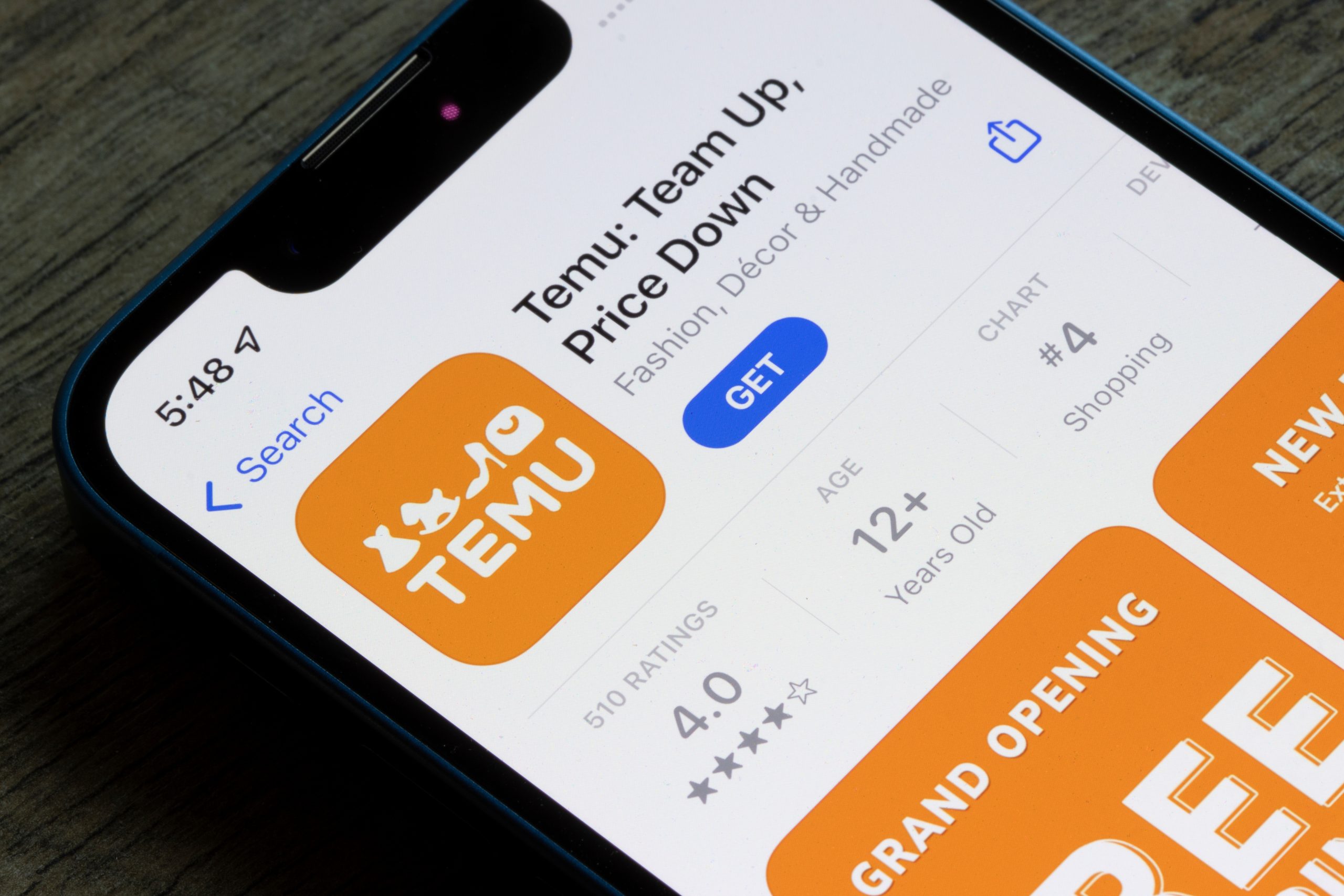 Image source: MSN
On Monday, Temu, the Chinese e-commerce company that expanded to South Africa in 2024, came under fire as locals vented frustration over late deliveries, shoddy order fulfillment, and near-radio silence from customer service. The real culprit turned out to be Temu’s rookie logistics partner, GFS Express, whose mishandling of orders during the peak holiday season turned a seasonal spike into a full-blown headache.
Shoppers reported weeks-long delays, drivers claiming deliveries that never happened, and unanswered calls that pushed customers to dig up contact info online, sometimes reaching the wrong GFS Express, the UK-based firm with a nearly identical name and logo. The confusion sparked rumours of fraud, but the problem was simple: Temu’s GFS Express is Saudi-based, overwhelmed, and underprepared for South Africa’s e-commerce tempo.
The logistics company says it is fixing the mess with more drivers, first-in-first-out delivery scheduling, extra customer service staff, and proactive text updates. It apologised, but Temu has remained cautious in its comments, framing delays as inevitable during holiday peaks.
Yet, the Chinese e-commerce company’s reputation has already taken a hit after South African customers, out of frustration, rated the company poorly. Chinese players like Temu and Shein are already viewed with suspicion by sceptics, even abroad. The low-cost, low-delivery model is a direct threat to local e-commerce players they undercut with access to Chinese manufacturing hubs. And regulators are finding ways to keep foreign e-commerce entrants from playing unfairly.
This episode shows how fragile cross-border e-commerce logistics still are in Africa. Global platforms can enter new markets fast, but without a local operations backbone, even small missteps quickly cascade into customer trust crises. South African shoppers got a crash course in the difference between brand and operator; Temu’s brand may be global, but service depends on the partner on the ground.
connectivity
Starlink now lets Kenyans pay installmentally for mini kits
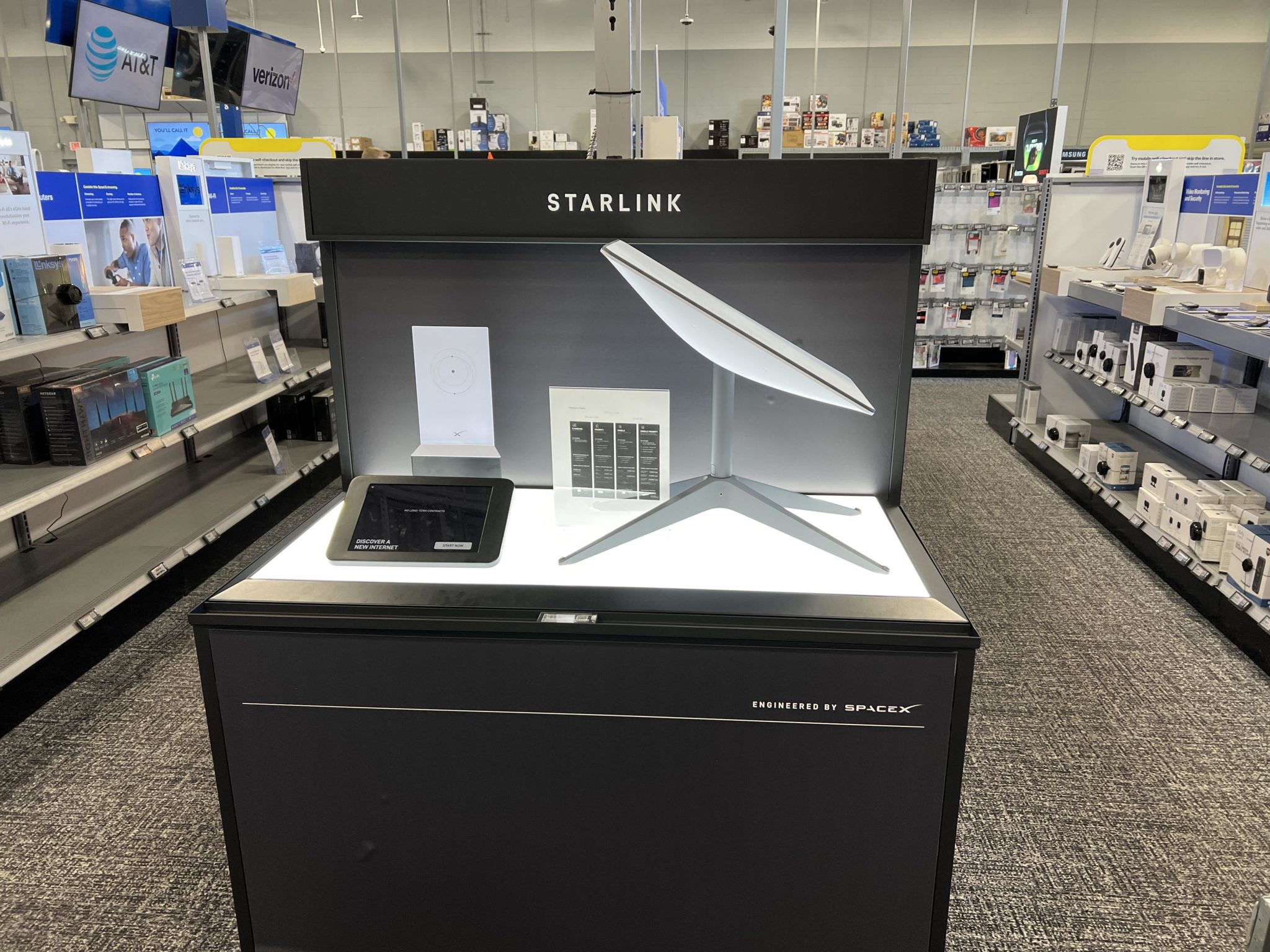 Image source: Reddit
Starlink has decided to allow Kenyans spread the cost of paying for its portable mini internet kit. Instead of paying the full KES27,000 ($209) upfront, customers can pay a smaller amount at checkout, cover activation and shipping, then settle the rest in installments over six months. This is separate from the usual monthly subscription.
Why is Starlink doing this? Kenya’s satellite internet market has moved past the hype phase. Starlink still draws interest, but sign-ups are no longer automatic. In June 2025, its subscriptions dropped by 11%, the first time since its launch in Kenya. Instalments are a way to keep Starlink in the conversation of available internet service providers, especially for people who want reliable internet but can’t justify a lump-sum hardware bill.
How the installment plan works: To get the kit, a customer will pay KES 6,750 ($52) at purchase, absorb a mandatory KES 16,250 ($126) activation charge, and then commit to six monthly hardware payments of KES 4,500 ($35). Internet access only goes live once the kit is activated and the monthly plan is running. Missed installments also don’t lower your data speed.
Would this work? Reducing the friction of payment at once could help Starlink grow its share at the margins. More installs mean more subscriptions, and subscriptions are where long-term value sits. Whether this would work is left to be seen.
insights
Funding Tracker
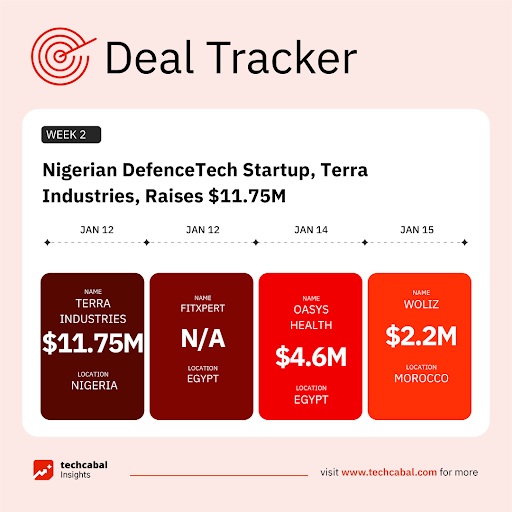 Image source: TechCabal Insights
Terra Industries, a Nigerian defence-tech startup, secured $11.75 million from US investors. The round was led by Silicon Valley firms 8VC, Valour Equity Partners, Lux Capital, SV Angel, Leblon Capital, Silent Ventures, Nova Global, and angel investors, including Micky Malka. (Jan 12)
Here are the other deals for the week:
- FitXpert, an Egyptian SaaS startup, raised an undisclosed seven-figure funding from Foras Investment. (Jan 12)
- Mamy Eyewear, a Kenyan tech-enabled eyecare startup, raised an undisclosed funding from Ikemori Venture Support (IVS). (Jan 13)
- Oasys Health, an Egyptian-founded healthtech startup, raised $4.6 million in funding, including a $4 million seed round led by Pathlight Ventures, with participation from Twine Ventures and Better Ventures, and a $600,000 pre-seed round from 1984 Ventures. (Jan 14)
- Woliz, a Moroccan retail-tech startup, raised $2.2 million in a pre-seed funding round led by Sanlam Maroc. (Jan 15)
Follow us on Twitter, Instagram, and LinkedIn for more funding announcements. Before you go,what’s next for African tech in 2026? Find out here.
CRYPTO TRACKER
The World Wide Web3
Source:

|
Coin Name |
Current Value |
Day |
Month |
|---|---|---|---|
| Bitcoin | $95,372 |
– 0.93% |
+ 10.10% |
| Ether | $3,291 |
– 0.54% |
+ 12.20% |
| BNB | $929 |
– 0.72% |
+ 8.25% |
| XRP | $2.06 |
– 1.61% |
+ 7.81% |
* Data as of 06.16 AM WAT, January 16, 2026.
JOB OPENINGS
- Big Cabal Media — Associate Videographer/Video Editor (full-time); Senior Financial Analyst (full-time); Zikoko Citizen Reporter (full-time); Content Creator (contract); Journalist (contract); Project Associate (contract); Senior Editor (contract); Senior Writer (contract) — Lagos, Nigeria
- Piggyvest — Senior Accounting Associate, Customer Success Intern — Lagos, Nigeria
- Buffer — Senior Engineer, Growth Marketing — Remote
- Moniepoint — Several roles — Remote (Nigeria)
- FirstBank — Business Development Lead, eCommerce & Retail — Lagos, Nigeria
- Wave — Machine Learning Scientist — Nairobi, Kenya
- Pavago — Customer Success Manager — Remote (Kenya)
There are more jobs on TechCabal’s job board. If you have job opportunities to share, please submit them at bit.ly/tcxjobs.
- Delve into AI: Vibe coding is exploding. This Nigerian startup wants to make it safe
- Nigeria ends 2025 with inflation at 15.15% and fewer price shocks U.S. tariff ruling delay prolongs uncertainty for South African online exporters
- Visa rules Nigerians need to know for top travel destinations in 2026
Written by: Emmanuel Nwosu, Opeyemi Kareem, and Success Sotonwa
Edited by: Emmanuel Nwosu & Ganiu Oloruntade
Want more of TechCabal?
Sign up for our insightful newsletters on the business and economy of tech in Africa.
- The Next Wave: futuristic analysis of the business of tech in Africa.
- Francophone Weekly by TechCabal: insider insights and analysis of Francophone’s tech ecosystem
P:S If you’re often missing TC Daily in your inbox, check your Promotions folder and move any edition of TC Daily from “Promotions” to your “Main” or “Primary” folder and TC Daily will always come to you.

You May Also Like

The crypto winners from AI may not be AI coins at all as agents start spending autonomously

Researcher Connects the Dots Between This SWIFT’s Major Announcement and XRP