The post Best Banking Tokens January 2026: Can the Digitap ($TAP) Crypto Presale Outperform $174 Aave? appeared first on Coinpedia Fintech News Banking tokens areThe post Best Banking Tokens January 2026: Can the Digitap ($TAP) Crypto Presale Outperform $174 Aave? appeared first on Coinpedia Fintech News Banking tokens are

Best Banking Tokens January 2026: Can the Digitap ($TAP) Crypto Presale Outperform $174 Aave?
digitap-tap (1)

The post Best Banking Tokens January 2026: Can the Digitap ($TAP) Crypto Presale Outperform $174 Aave? appeared first on Coinpedia Fintech News

Banking tokens are back in the spotlight in 2026 for one simple reason. Crypto rails move money better than legacy rails, and stablecoins are about to eat global payment corridors. Now investors are asking, can Digitap ($TAP) outperform $174 Aave this January?

DeFi’s biggest bank is going head-to-head with one of 2026’s most exciting crypto presales. Both are expected to outperform the market, driven by consumer banking products and value-capture yield opportunities.

But when it comes to upside potential, $TAP ranks as a better altcoin to buy this January. The product is live, demand for better digital-first banking is booming, and $TAP’s tokenomics outclass Aave’s.

This is a new cycle, and that means new winners. Time to dive into why banking tokens are the best cryptos to buy now

Banking Ready to Be Biggest 2026 Trade

Crypto rails are simply better for payments than outdated TradFi rails. This gives banking altcoins to buy a massive structural advantage. And if the next phase of crypto adoption is driven by more Fintech products that abstract away crypto, both $TAP and AAVE could skyrocket this year.

People send money home every week. Freelancers move value across borders every month. Small businesses settle invoices in multiple currencies constantly. Banking tokens can grow in any market condition because the demand driver is real-world behavior.

It is the growth of stablecoins driving this shift. The winners in 2026 will not be faster layer 1s but the apps that make stablecoins accessible for regular people. Aave is moving in that consumer direction, but Digitap was built for it from day one.
aave-us-chart

Aave: DeFi’s Biggest Bank

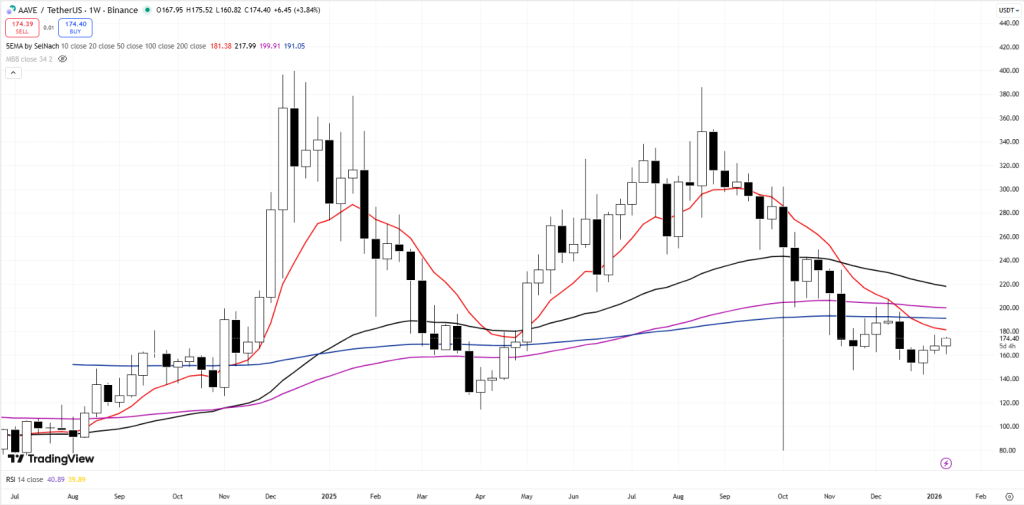
Aave remains the largest and most battle-tested lending protocol in DeFi. Very notable is that, unlike many other altcoins, AAVE never filled the 10/10 wick, indicating far greater strength than 90% of tokens. Aave is simple: it is the bank of DeFi, where users can deposit, borrow, and earn yield on their deposits.

The most recent update is Aave’s consumer push. Aave Labs has been building the Aave App, designed as a savings account-style experience that offers stablecoin yield, available on the App Store. The next major update will be V4.

Aave is already growing beyond DeFi power users and targeting normal savers. This alone makes it an interesting altcoin to buy this year. But when compared to $TAP, the upside potential is simply not the same.

AAVE trading at $175 is a multi-billion dollar project, and it has already had its 100X moment. Now all eyes are on Digitap to see if it can deliver those early returns this year. 

Digitap: The Consumer First Omni-Bank

Digitap is a consumer banking app that uses crypto rails. It is the world’s first omni-bank that effectively erases the line between fiat and crypto. The core idea is simple: give users a dashboard, let stablecoins and blockchains do the heavy lifting under the hood, and make money move in real time for anyone anywhere in the world.

The app is live today and available for download on iOS and Android, supporting over 100 cryptocurrencies and 20 fiat currencies. Digitap explicitly going after non-crypto natives is why it ranks as one of the best cryptos to buy now. Delivering better financial services to users worldwide was crypto’s original mission, and years later, Digitap is solving it.

This crypto presale has already raised more than $4 million, showing that the market believes in it. Thousands of users have signed up for the Visa card, which unlocks real-world spending with crypto assets and heavily upgrades stablecoin’s spendability profile.

The other aspect that is drawing serious attention is the multi-rail design, which unlocks the best of TradFi and DeFi. Instant crypto-to-fiat transactions and hyper-aggressive cross-border pricing. Digitap unlocks cross-border transactions for less than 1%, directly attacking the high fees of global payments—the biggest pain point that exists in modern finance.

This is what the next generation of crypto looks like: better products delivered through a familiar interface.

Best Crypto to Buy Now for 2026 Banking Rally: AAVE vs. $TAP

The big decider in 2026 is tokenomics. Investors want to own the protocol and, more importantly, the revenue it produces. Tokens with a link between token demand and platform activity will underperform this year, and Digitap is leaning into that shift aggressively.

Presale buyers are currently earning 124% APY on staking from a fixed pool, and when this crypto presale launches, 50% of platform profits will be allocated to token burns and staking rewards. Holders win as the platform scales, and this aggressive token flywheel is why $TAP should outperform AAVE this year.

$TAP is currently trading at $0.0427, with a confirmed listing price of $0.14, offering easy gains for anyone buying today. Aave is one of DeFi’s best tokens, and a leading altcoin to buy this year, but $TAP offers more features, has a much smaller market cap, and is leading the new generation of fintech-style products.

$TAP could quickly become a market leader, and that’s why it ranks among the best cryptos to buy now in January for the 2026 banking trade. 

Discover how Digitap is unifying cash and crypto by checking out their project here:

Presale: https://presale.digitap.app

Website: https://digitap.app 

Social: https://linktr.ee/digitap.app 

Win $250K: https://gleam.io/bfpzx/digitap-250000-giveaway 

Market Opportunity
AaveToken Logo
AaveToken Price(AAVE)
$170,77
$170,77$170,77
-%1,80
USD
AaveToken (AAVE) Live Price Chart
Disclaimer: The articles reposted on this site are sourced from public platforms and are provided for informational purposes only. They do not necessarily reflect the views of MEXC. All rights remain with the original authors. If you believe any content infringes on third-party rights, please contact service@support.mexc.com for removal. MEXC makes no guarantees regarding the accuracy, completeness, or timeliness of the content and is not responsible for any actions taken based on the information provided. The content does not constitute financial, legal, or other professional advice, nor should it be considered a recommendation or endorsement by MEXC.

You May Also Like

X to cut off InfoFi crypto projects from accessing its API

X to cut off InfoFi crypto projects from accessing its API

X, the most widely used app for crypto projects, is changing its API access policy. InfoFi projects, which proliferated non-organic bot content, will be cut off
Share
Cryptopolitan2026/01/16 02:50
X Just Killed Kaito and InfoFi Crypto, Several Tokens Crash

X Just Killed Kaito and InfoFi Crypto, Several Tokens Crash

The post X Just Killed Kaito and InfoFi Crypto, Several Tokens Crash appeared on BitcoinEthereumNews.com. X has revoked API access for apps that reward users for
Share
BitcoinEthereumNews2026/01/16 03:42
Google's AP2 protocol has been released. Does encrypted AI still have a chance?

Google's AP2 protocol has been released. Does encrypted AI still have a chance?

Following the MCP and A2A protocols, the AI Agent market has seen another blockbuster arrival: the Agent Payments Protocol (AP2), developed by Google. This will clearly further enhance AI Agents' autonomous multi-tasking capabilities, but the unfortunate reality is that it has little to do with web3AI. Let's take a closer look: What problem does AP2 solve? Simply put, the MCP protocol is like a universal hook, enabling AI agents to connect to various external tools and data sources; A2A is a team collaboration communication protocol that allows multiple AI agents to cooperate with each other to complete complex tasks; AP2 completes the last piece of the puzzle - payment capability. In other words, MCP opens up connectivity, A2A promotes collaboration efficiency, and AP2 achieves value exchange. The arrival of AP2 truly injects "soul" into the autonomous collaboration and task execution of Multi-Agents. Imagine AI Agents connecting Qunar, Meituan, and Didi to complete the booking of flights, hotels, and car rentals, but then getting stuck at the point of "self-payment." What's the point of all that multitasking? So, remember this: AP2 is an extension of MCP+A2A, solving the last mile problem of AI Agent automated execution. What are the technical highlights of AP2? The core innovation of AP2 is the Mandates mechanism, which is divided into real-time authorization mode and delegated authorization mode. Real-time authorization is easy to understand. The AI Agent finds the product and shows it to you. The operation can only be performed after the user signs. Delegated authorization requires the user to set rules in advance, such as only buying the iPhone 17 when the price drops to 5,000. The AI Agent monitors the trigger conditions and executes automatically. The implementation logic is cryptographically signed using Verifiable Credentials (VCs). Users can set complex commission conditions, including price ranges, time limits, and payment method priorities, forming a tamper-proof digital contract. Once signed, the AI Agent executes according to the conditions, with VCs ensuring auditability and security at every step. Of particular note is the "A2A x402" extension, a technical component developed by Google specifically for crypto payments, developed in collaboration with Coinbase and the Ethereum Foundation. This extension enables AI Agents to seamlessly process stablecoins, ETH, and other blockchain assets, supporting native payment scenarios within the Web3 ecosystem. What kind of imagination space can AP2 bring? After analyzing the technical principles, do you think that's it? Yes, in fact, the AP2 is boring when it is disassembled alone. Its real charm lies in connecting and opening up the "MCP+A2A+AP2" technology stack, completely opening up the complete link of AI Agent's autonomous analysis+execution+payment. From now on, AI Agents can open up many application scenarios. For example, AI Agents for stock investment and financial management can help us monitor the market 24/7 and conduct independent transactions. Enterprise procurement AI Agents can automatically replenish and renew without human intervention. AP2's complementary payment capabilities will further expand the penetration of the Agent-to-Agent economy into more scenarios. Google obviously understands that after the technical framework is established, the ecological implementation must be relied upon, so it has brought in more than 60 partners to develop it, almost covering the entire payment and business ecosystem. Interestingly, it also involves major Crypto players such as Ethereum, Coinbase, MetaMask, and Sui. Combined with the current trend of currency and stock integration, the imagination space has been doubled. Is web3 AI really dead? Not entirely. Google's AP2 looks complete, but it only achieves technical compatibility with Crypto payments. It can only be regarded as an extension of the traditional authorization framework and belongs to the category of automated execution. There is a "paradigm" difference between it and the autonomous asset management pursued by pure Crypto native solutions. The Crypto-native solutions under exploration are taking the "decentralized custody + on-chain verification" route, including AI Agent autonomous asset management, AI Agent autonomous transactions (DeFAI), AI Agent digital identity and on-chain reputation system (ERC-8004...), AI Agent on-chain governance DAO framework, AI Agent NPC and digital avatars, and many other interesting and fun directions. Ultimately, once users get used to AI Agent payments in traditional fields, their acceptance of AI Agents autonomously owning digital assets will also increase. And for those scenarios that AP2 cannot reach, such as anonymous transactions, censorship-resistant payments, and decentralized asset management, there will always be a time for crypto-native solutions to show their strength? The two are more likely to be complementary rather than competitive, but to be honest, the key technological advancements behind AI Agents currently all come from web2AI, and web3AI still needs to keep up the good work!
Share
PANews2025/09/18 07:00