The Senate Banking Committee has pulled the scheduled Thursday markup of its crypto asset market structure bill after a late-stage flare-up with Coinbase, freezingThe Senate Banking Committee has pulled the scheduled Thursday markup of its crypto asset market structure bill after a late-stage flare-up with Coinbase, freezing

Crypto Market Structure Bill Paused: Senate Banking Cancels Markup

The Senate Banking Committee has pulled the scheduled Thursday markup of its crypto asset market structure bill after a late-stage flare-up with Coinbase, freezing what had looked like a tightening path toward action. The pause lands at a sensitive moment for Washington’s crypto negotiations: industry heavyweights are publicly splitting over the Senate draft even as lawmakers insist bipartisan talks are still alive.

Senate Banking Committee Chairman Tim Scott (R-S.C.) said Wednesday the committee will postpone the markup “as bipartisan negotiations continue,” framing the delay as tactical rather than terminal. “I’ve spoken with leaders across the crypto industry, the financial sector, and my Democratic and Republican colleagues, and everyone remains at the table working in good faith,” Scott wrote on X. “As we take a brief pause before moving to a markup, this market structure bill reflects months of serious bipartisan negotiations and real input from innovators, investors, and law enforcement.”

Scott positioned the bill as a foundational framework rather than a narrow industry carveout. “The goal is to deliver clear rules of the road that protect consumers, strengthen our national security, and ensure the future of finance is built in the United States,” he added.

Coinbase Breaks Ranks Late

The immediate catalyst was Coinbase CEO Brian Armstrong, who said the exchange “can’t support the bill as written” after reviewing “the Senate Banking draft text over the last 48hrs.”

Armstrong argued the draft contains multiple provisions he says would be “materially worse than the current status quo,” contending that it amounts to “a defacto ban on tokenized equities,” includes “DeFi prohibitions” that expand government access to financial records and erode privacy, and would “stifl[e] innovation” by weakening the CFTC relative to the SEC.

He also pointed to “draft amendments” he said “would kill rewards on stablecoins,” warning the changes could allow banks to “ban their competition.” Armstrong’s bottom line was blunt: “We’d rather have no bill than a bad bill.” Still, he struck a conciliatory note about process and odds of a compromise, adding he was “quite optimistic” that continued work could produce “the right outcome.”

That posture split the difference between hard opposition to the text and support for continued negotiations,an important distinction as the markup process is typically where senators offer and vote amendments.

Crypto Industry Split

Coinbase’s stance quickly triggered a counter-response from other major crypto firms and advocacy groups backing the Senate Banking GOP’s push. Support was voiced by a16z, Circle, Kraken, The Digital Chamber, Ripple, and Coin Center, coalescing into a public front aimed at keeping momentum intact despite the delay.

Ripple CEO Brad Garlinghouse cast the bill as overdue but directionally positive. “While long-overdue, this move by @SenatorTimScott and @BankingGOP on market structure is a massive step forward in providing workable frameworks for crypto, while continuing to protect consumers,” he wrote. He said Ripple would remain engaged, adding: “We are at the table and will continue to move forward with fair debate. I remain optimistic that issues can be resolved through the mark-up process.”

Meanwhile, Tim Draper said Armstrong’s opposition is justified, arguing the Senate compromise “is worse than no bill at all” and suggesting that “the banks have been meddling.”

Ryan Rasmussen, Head of Research at Bitwise Asset Management , called the current CLARITY Act draft broadly harmful, listing tokenization, stablecoins, DeFi, privacy, builders, users, investors, and innovation, and concluded that the industry would “rather have no bill than a bad bill.”

White House Crypto Czar David Sacks urged the industry to treat the delay as a narrow window to align rather than an opening to splinter. “Passage of market structure legislation remains as close as it’s ever been,” Sacks wrote. “The crypto industry should use this pause to resolve any remaining differences. Now is the time to set the rules of the road and secure the future of this industry.”

Galaxy Digitall’s CEO Mike Novogratz struck a more optimistic tone, saying: “While the crypto bill might be delayed to keep working on it, I am very confident that a bill will get done soon. I have spoken to over 10 senators on both sides of the aisle in the past 24 hrs and I believe they all are working in good faith to get something done. Always gets tense at the end.”

At press time, the total crypto market cap stood at $3.22 trillion.
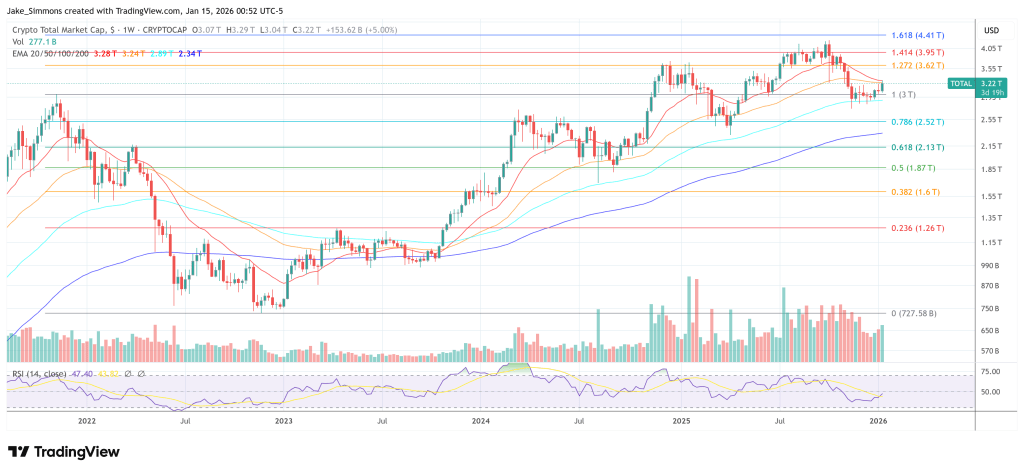
Total crypto market cap chart
Disclaimer: The articles reposted on this site are sourced from public platforms and are provided for informational purposes only. They do not necessarily reflect the views of MEXC. All rights remain with the original authors. If you believe any content infringes on third-party rights, please contact service@support.mexc.com for removal. MEXC makes no guarantees regarding the accuracy, completeness, or timeliness of the content and is not responsible for any actions taken based on the information provided. The content does not constitute financial, legal, or other professional advice, nor should it be considered a recommendation or endorsement by MEXC.

You May Also Like

Top Altcoins To Buy Before The ETF Season Kicks In

Top Altcoins To Buy Before The ETF Season Kicks In

The post Top Altcoins To Buy Before The ETF Season Kicks In appeared first on Coinpedia Fintech News The crypto market is moving into a new phase. With U.S. regulators approving fresh standards for exchange-traded funds (ETFs), a number of leading altcoins are now in line for listings. This could shape how investors position themselves in the months ahead. SEC Approval Opens ETF Path The U.S. Securities and Exchange Commission (SEC) has approved …
Share
CoinPedia2025/09/18 12:09
Unprecedented Surge: Gold Price Hits Astounding New Record High

Unprecedented Surge: Gold Price Hits Astounding New Record High

BitcoinWorld Unprecedented Surge: Gold Price Hits Astounding New Record High While the world often buzzes with the latest movements in Bitcoin and altcoins, a traditional asset has quietly but powerfully commanded attention: gold. This week, the gold price has once again made headlines, touching an astounding new record high of $3,704 per ounce. This significant milestone reminds investors, both traditional and those deep in the crypto space, of gold’s enduring appeal as a store of value and a hedge against uncertainty. What’s Driving the Record Gold Price Surge? The recent ascent of the gold price to unprecedented levels is not a random event. Several powerful macroeconomic forces are converging, creating a perfect storm for the precious metal. Geopolitical Tensions: Escalating conflicts and global instability often drive investors towards safe-haven assets. Gold, with its long history of retaining value during crises, becomes a preferred choice. Inflation Concerns: Persistent inflation in major economies erodes the purchasing power of fiat currencies. Consequently, investors seek assets like gold that historically maintain their value against rising prices. Central Bank Policies: Many central banks globally are accumulating gold at a significant pace. This institutional demand provides a strong underlying support for the gold price. Furthermore, expectations around interest rate cuts in the future also make non-yielding assets like gold more attractive. These factors collectively paint a picture of a cautious market, where investors are looking for stability amidst a turbulent economic landscape. Understanding Gold’s Appeal in Today’s Market For centuries, gold has held a unique position in the financial world. Its latest record-breaking performance reinforces its status as a critical component of a diversified portfolio. Gold offers a tangible asset that is not subject to the same digital vulnerabilities or regulatory shifts that can impact cryptocurrencies. While digital assets offer exciting growth potential, gold provides a foundational stability that appeals to a broad spectrum of investors. Moreover, the finite supply of gold, much like Bitcoin’s capped supply, contributes to its perceived value. The current market environment, characterized by economic uncertainty and fluctuating currency values, only amplifies gold’s intrinsic benefits. It serves as a reliable hedge when other asset classes, including stocks and sometimes even crypto, face downward pressure. How Does This Record Gold Price Impact Investors? A soaring gold price naturally raises questions for investors. For those who already hold gold, this represents a significant validation of their investment strategy. For others, it might spark renewed interest in this ancient asset. Benefits for Investors: Portfolio Diversification: Gold often moves independently of other asset classes, offering crucial diversification benefits. Wealth Preservation: It acts as a robust store of value, protecting wealth against inflation and economic downturns. Liquidity: Gold markets are highly liquid, allowing for relatively easy buying and selling. Challenges and Considerations: Opportunity Cost: Investing in gold means capital is not allocated to potentially higher-growth assets like equities or certain cryptocurrencies. Volatility: While often seen as stable, gold prices can still experience significant fluctuations, as evidenced by its rapid ascent. Considering the current financial climate, understanding gold’s role can help refine your overall investment approach. Looking Ahead: The Future of the Gold Price What does the future hold for the gold price? While no one can predict market movements with absolute certainty, current trends and expert analyses offer some insights. Continued geopolitical instability and persistent inflationary pressures could sustain demand for gold. Furthermore, if global central banks continue their gold acquisition spree, this could provide a floor for prices. However, a significant easing of inflation or a de-escalation of global conflicts might reduce some of the immediate upward pressure. Investors should remain vigilant, observing global economic indicators and geopolitical developments closely. The ongoing dialogue between traditional finance and the emerging digital asset space also plays a role. As more investors become comfortable with both gold and cryptocurrencies, a nuanced understanding of how these assets complement each other will be crucial for navigating future market cycles. The recent surge in the gold price to a new record high of $3,704 per ounce underscores its enduring significance in the global financial landscape. It serves as a powerful reminder of gold’s role as a safe haven asset, a hedge against inflation, and a vital component for portfolio diversification. While digital assets continue to innovate and capture headlines, gold’s consistent performance during times of uncertainty highlights its timeless value. Whether you are a seasoned investor or new to the market, understanding the drivers behind gold’s ascent is crucial for making informed financial decisions in an ever-evolving world. Frequently Asked Questions (FAQs) Q1: What does a record-high gold price signify for the broader economy? A record-high gold price often indicates underlying economic uncertainty, inflation concerns, and geopolitical instability. Investors tend to flock to gold as a safe haven when they lose confidence in traditional currencies or other asset classes. Q2: How does gold compare to cryptocurrencies as a safe-haven asset? Both gold and some cryptocurrencies (like Bitcoin) are often considered safe havens. Gold has a centuries-long history of retaining value during crises, offering tangibility. Cryptocurrencies, while newer, offer decentralization and can be less susceptible to traditional financial system failures, but they also carry higher volatility and regulatory risks. Q3: Should I invest in gold now that its price is at a record high? Investing at a record high requires careful consideration. While the price might continue to climb due to ongoing market conditions, there’s also a risk of a correction. It’s crucial to assess your personal financial goals, risk tolerance, and consider diversifying your portfolio rather than putting all your capital into a single asset. Q4: What are the main factors that influence the gold price? The gold price is primarily influenced by global economic uncertainty, inflation rates, interest rate policies by central banks, the strength of the U.S. dollar, and geopolitical tensions. Demand from jewelers and industrial uses also play a role, but investment and central bank demand are often the biggest drivers. Q5: Is gold still a good hedge against inflation? Historically, gold has proven to be an effective hedge against inflation. When the purchasing power of fiat currencies declines, gold tends to hold its value or even increase, making it an attractive asset for preserving wealth during inflationary periods. To learn more about the latest crypto market trends, explore our article on key developments shaping Bitcoin’s price action. This post Unprecedented Surge: Gold Price Hits Astounding New Record High first appeared on BitcoinWorld.
Share
Coinstats2025/09/18 02:30
[Pastilan] End the confidential fund madness

[Pastilan] End the confidential fund madness

UPDATE RULES. Former Commission on Audit commissioner Heidi Mendoza speaks during a public forum.
Share
Rappler2026/01/16 14:02