President Donald Trump said on Monday any country that does business with Iran will face a tariff of 25 percent on any trade with the US, as Washington weighs aPresident Donald Trump said on Monday any country that does business with Iran will face a tariff of 25 percent on any trade with the US, as Washington weighs a

Trump says nations doing business with Iran face 25% tariff

2026/01/13 14:49
  • Iran facing biggest protests in years
  • Trump has used tariffs throughout second term
  • Trump weighs further options against Iran

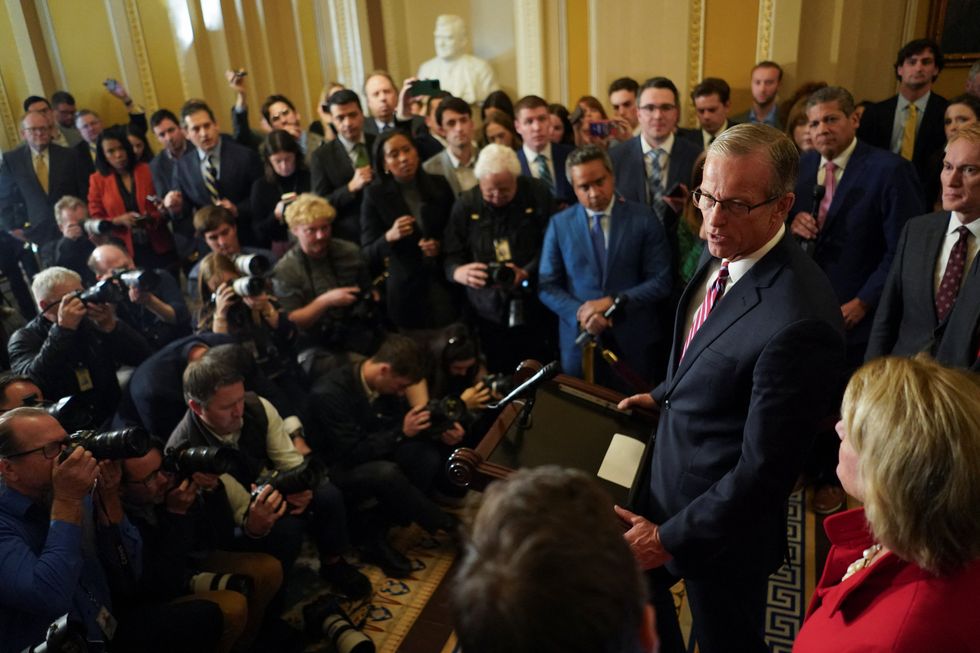
President Donald Trump said on Monday any country that does business with Iran will face a tariff of 25 percent on any trade with the US, as Washington weighs a response to the situation in Iran which is seeing its biggest anti-government protests in years.

“Effective immediately, any Country doing business with the Islamic Republic of Iran will pay a Tariff of 25% on any and all business being done with the United States of America,” Trump said in a post on Truth Social.

Tariffs are paid by US importers of goods from those countries. Iran, a member of the Opec oil producing group, has been heavily sanctioned by Washington for years. It exports much of its oil to China, with Turkey, Iraq, the United Arab Emirates and India among its other top trading partners.

“This Order is final and conclusive,” Trump said without providing any further detail.

There was no official documentation from the White House of the policy on its website, nor information about the legal authority Trump would use to impose the tariffs, or whether they would be aimed at all of Iran’s trading partners. The White House did not respond to a request for comment.

The Chinese embassy in Washington criticised Trump’s approach, saying China will take “all necessary measures” to safeguard its interests and opposed “any illicit unilateral sanctions and long-arm jurisdiction”.

“China’s position against the indiscriminate imposition of tariffs is consistent and clear. Tariff wars and trade wars have no winners, and coercion and pressure cannot solve problems,” a spokesperson for the Chinese embassy said on X.

Japan and South Korea, which agreed on trade deals with the US last year, said on Tuesday they are closely monitoring the development.

“We… plan to take any necessary measures once the specific actions of the US government become clear,” South Korea’s trade ministry said in a statement.

Japan’s deputy chief cabinet secretary Masanao Ozaki told reporters that Tokyo will “carefully examine the specific content of any measures as they become clear, as well as their potential impact on Japan, and will respond appropriately”.

Iran, which had a 12-day war with US ally Israel last year and whose nuclear facilities the US military bombed in June, is seeing its biggest anti-government demonstrations in years.

Trump has said the US may meet Iranian officials and that he was in contact with Iran’s opposition, while piling pressure on its leaders, including threatening military action.

Tehran said on Monday it was keeping communication channels with Washington open as Trump considered how to respond to the situation in Iran, which has posed one of the gravest tests of clerical rule in the country since the Islamic Revolution in 1979.

Demonstrations evolved from complaints about dire economic hardships to defiant calls for the fall of the deeply entrenched clerical establishment. US-based rights group HRANA said it had verified the deaths of 599 people — 510 protesters and 89 security personnel — since the protests began on December 28.

Further reading:

  • Nearly 20 flights between Dubai and Iranian cities cancelled
  • Rock-bottom energy prices, not sanctions, are holding Iran back
  • Iran approves removal of four zeros to curb inflation

While air strikes were one of many alternatives open to Trump, “diplomacy is always the first option for the president”, White House press secretary Karoline Leavitt said on Monday.

During his second term in office, Trump has often threatened and imposed tariffs on other countries over their ties with US adversaries and over trade policies that he has described as unfair to Washington.

Trump’s trade policy is under legal pressure as the US Supreme Court is considering striking down a broad swathe of Trump’s existing tariffs.

Iran exported products to 147 trading partners in 2022, according to World Bank’s most recent data.


Market Opportunity
OFFICIAL TRUMP Logo
OFFICIAL TRUMP Price(TRUMP)
$5.548
$5.548$5.548
-0.23%
USD
OFFICIAL TRUMP (TRUMP) Live Price Chart
Disclaimer: The articles reposted on this site are sourced from public platforms and are provided for informational purposes only. They do not necessarily reflect the views of MEXC. All rights remain with the original authors. If you believe any content infringes on third-party rights, please contact service@support.mexc.com for removal. MEXC makes no guarantees regarding the accuracy, completeness, or timeliness of the content and is not responsible for any actions taken based on the information provided. The content does not constitute financial, legal, or other professional advice, nor should it be considered a recommendation or endorsement by MEXC.

You May Also Like

The Channel Factories We’ve Been Waiting For

The Channel Factories We’ve Been Waiting For

The post The Channel Factories We’ve Been Waiting For appeared on BitcoinEthereumNews.com. Visions of future technology are often prescient about the broad strokes while flubbing the details. The tablets in “2001: A Space Odyssey” do indeed look like iPads, but you never see the astronauts paying for subscriptions or wasting hours on Candy Crush.  Channel factories are one vision that arose early in the history of the Lightning Network to address some challenges that Lightning has faced from the beginning. Despite having grown to become Bitcoin’s most successful layer-2 scaling solution, with instant and low-fee payments, Lightning’s scale is limited by its reliance on payment channels. Although Lightning shifts most transactions off-chain, each payment channel still requires an on-chain transaction to open and (usually) another to close. As adoption grows, pressure on the blockchain grows with it. The need for a more scalable approach to managing channels is clear. Channel factories were supposed to meet this need, but where are they? In 2025, subnetworks are emerging that revive the impetus of channel factories with some new details that vastly increase their potential. They are natively interoperable with Lightning and achieve greater scale by allowing a group of participants to open a shared multisig UTXO and create multiple bilateral channels, which reduces the number of on-chain transactions and improves capital efficiency. Achieving greater scale by reducing complexity, Ark and Spark perform the same function as traditional channel factories with new designs and additional capabilities based on shared UTXOs.  Channel Factories 101 Channel factories have been around since the inception of Lightning. A factory is a multiparty contract where multiple users (not just two, as in a Dryja-Poon channel) cooperatively lock funds in a single multisig UTXO. They can open, close and update channels off-chain without updating the blockchain for each operation. Only when participants leave or the factory dissolves is an on-chain transaction…
Share
BitcoinEthereumNews2025/09/18 00:09
Trading time: Tonight, the US GDP and the upcoming non-farm data will become the market focus. Institutions are bullish on BTC to $120,000 in the second quarter.

Trading time: Tonight, the US GDP and the upcoming non-farm data will become the market focus. Institutions are bullish on BTC to $120,000 in the second quarter.

Daily market key data review and trend analysis, produced by PANews.
Share
PANews2025/04/30 13:50
CEO Sandeep Nailwal Shared Highlights About RWA on Polygon

CEO Sandeep Nailwal Shared Highlights About RWA on Polygon

The post CEO Sandeep Nailwal Shared Highlights About RWA on Polygon appeared on BitcoinEthereumNews.com. Polygon CEO Sandeep Nailwal highlighted Polygon’s lead in global bonds, Spiko US T-Bill, and Spiko Euro T-Bill. Polygon published an X post to share that its roadmap to GigaGas was still scaling. Sentiments around POL price were last seen to be bearish. Polygon CEO Sandeep Nailwal shared key pointers from the Dune and RWA.xyz report. These pertain to highlights about RWA on Polygon. Simultaneously, Polygon underlined its roadmap towards GigaGas. Sentiments around POL price were last seen fumbling under bearish emotions. Polygon CEO Sandeep Nailwal on Polygon RWA CEO Sandeep Nailwal highlighted three key points from the Dune and RWA.xyz report. The Chief Executive of Polygon maintained that Polygon PoS was hosting RWA TVL worth $1.13 billion across 269 assets plus 2,900 holders. Nailwal confirmed from the report that RWA was happening on Polygon. The Dune and https://t.co/W6WSFlHoQF report on RWA is out and it shows that RWA is happening on Polygon. Here are a few highlights: – Leading in Global Bonds: Polygon holds 62% share of tokenized global bonds (driven by Spiko’s euro MMF and Cashlink euro issues) – Spiko U.S.… — Sandeep | CEO, Polygon Foundation (※,※) (@sandeepnailwal) September 17, 2025 The X post published by Polygon CEO Sandeep Nailwal underlined that the ecosystem was leading in global bonds by holding a 62% share of tokenized global bonds. He further highlighted that Polygon was leading with Spiko US T-Bill at approximately 29% share of TVL along with Ethereum, adding that the ecosystem had more than 50% share in the number of holders. Finally, Sandeep highlighted from the report that there was a strong adoption for Spiko Euro T-Bill with 38% share of TVL. He added that 68% of returns were on Polygon across all the chains. Polygon Roadmap to GigaGas In a different update from Polygon, the community…
Share
BitcoinEthereumNews2025/09/18 01:10