Two crypto exchanges registered in the United Kingdom processed approximately $1 billion in transactions linked to Iran’s Islamic Revolutionary Guard Corps whileTwo crypto exchanges registered in the United Kingdom processed approximately $1 billion in transactions linked to Iran’s Islamic Revolutionary Guard Corps while

Iran Used UK Crypto Platforms to Evade Sanctions With $1B in Secret Flows: Report

Two crypto exchanges registered in the United Kingdom processed approximately $1 billion in transactions linked to Iran’s Islamic Revolutionary Guard Corps while publicly operating as conventional trading platforms, blockchain intelligence firm TRM Labs revealed in a January 9 report.

Zedcex and Zedxion facilitated operational financing for the IRGC, with illicit flows accounting for roughly 56% of their total transaction volume and peaking at 87% in 2024.

The exchanges incorporated in the UK between 2021 and 2022 used nominal directors, virtual office addresses, and repeatedly filed dormant accounts despite processing billions in on-chain activity.

Corporate records directly connect Zedcex to Babak Morteza Zanjani, an Iranian sanctions-evasion financier previously sanctioned by the US and EU in 2013 for laundering billions in oil revenue on behalf of regime entities, including the IRGC, before those penalties were lifted under the now-defunct Iran nuclear deal.
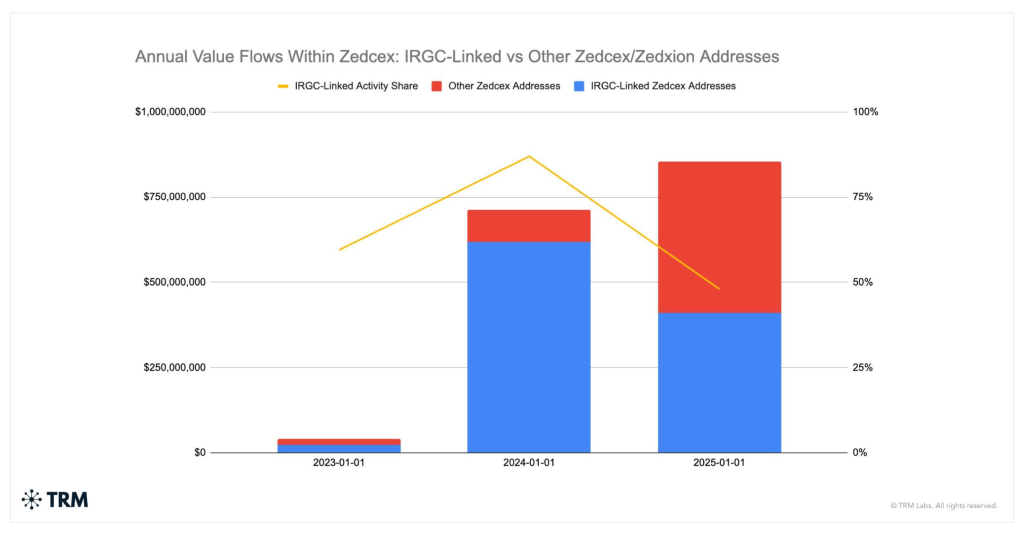
Iran UK Crypto Transactions - Annual Value Flows Within ZedcexSource: TRMLabs

Network Processed Record IRGC Flows Through Shell Structure

IRGC-linked addresses at Zedcex processed $23.7 million in 2023, representing 60% of total activity, before surging to $619.1 million in 2024 when the IRGC share jumped to 87%.

Activity declined to $410.4 million in 2025 as non-IRGC flows increased, reducing the corps’ share to 48%.

The two exchanges operated as a single enterprise despite separate UK incorporation, with both entities sharing directors, addresses, and coordinated timing that indicated continuity rather than independence.

Zanjani’s withdrawal from Zedxion in 2022, followed immediately by Zedcex’s incorporation under the same control structure and address, suggested operational continuity rather than separation.

After being arrested in Iran and sentenced to death for embezzling millions from Iran’s National Oil Company, his sentence was commuted in 2024 after repaying funds, and he re-emerged publicly with proximity to regime-linked economic projects through DotOne Holding Group, a conglomerate spanning cryptocurrency, foreign exchange, logistics, and telecommunications.

Iran UK Crypto Transactions - Report ScreenshotSource: TRMLabs

TRM analysis linked Zedcex wallets directly to addresses designated by Israeli authorities as IRGC property under the Administrative Seizure Order ASO-43/25, issued in September 2025, many of which Tether subsequently blocklisted.

Transfers conducted almost entirely in USDT on the TRON blockchain routed funds between designated IRGC addresses, offshore intermediaries, and domestic Iranian exchanges, including Nobitex, Wallex, and Aban Tether.

Iran UK Crypto Transactions - Zedcex Wallets ConnectionsSource: TRMLabs

The exchanges also integrated with Zedpay, a Turkey-based mobile payment processor that maintains relationships with Turkish financial entities, including Vepara, whose license was later suspended amid money laundering concerns, and Vakif Katilim, a state-owned Islamic bank previously scrutinized for facilitating Iran-linked financial activity.

This integration extended capabilities beyond trading to support fiat settlement and real-world payments for actors under sanctions constraints.

On-chain tracing revealed that over $10 million in USDT transferred directly from wallets dually attributable to Zedcex and the IRGC to addresses controlled by Sa’id Ahmad Muhammad al-Jamal, who is sanctioned by the US Treasury for providing material support to the IRGC and operating smuggling networks that generate revenue for Yemen’s Houthis.

The absence of intermediary routing established Zedcex infrastructure as an active funding rail rather than an incidental touchpoint.

The case emerges as sanctioned nation-states increasingly dominate crypto crime statistics, with Chainalysis reporting illicit addresses received at least $154 billion in 2025, marking a 162% jump from $59 billion in 2024, driven largely by a 694% increase in sanctioned entity activity.

Iran UK Crypto Transactions - waves of crypto crime 2009 to 2025 chartSource: Chainalysis

Stablecoins accounted for 84% of all illicit transaction volume, mirroring broader ecosystem trends in which these assets offer easy cross-border transfers and lower volatility.

Iran’s broader crypto operations have faced mounting pressure throughout 2025, with flows involving Iranian entities falling to $3.7 billion between January and July, a 11% decline from 2024.

The Treasury Department sanctioned two Iranian nationals in September for coordinating over $100 million in cryptocurrency oil sales benefiting the IRGC, while Iran has explored accepting digital currencies for advanced weapons sales, including ballistic missiles and drones marketed through its Ministry of Defense Export Center.

Russia launched its ruble-backed A7A5 token in February 2025, processing over $93.3 billion in transactions in less than a year as Moscow similarly leveraged crypto infrastructure to circumvent Western financial restrictions.

Disclaimer: The articles reposted on this site are sourced from public platforms and are provided for informational purposes only. They do not necessarily reflect the views of MEXC. All rights remain with the original authors. If you believe any content infringes on third-party rights, please contact service@support.mexc.com for removal. MEXC makes no guarantees regarding the accuracy, completeness, or timeliness of the content and is not responsible for any actions taken based on the information provided. The content does not constitute financial, legal, or other professional advice, nor should it be considered a recommendation or endorsement by MEXC.

You May Also Like

The Channel Factories We’ve Been Waiting For

The Channel Factories We’ve Been Waiting For

The post The Channel Factories We’ve Been Waiting For appeared on BitcoinEthereumNews.com. Visions of future technology are often prescient about the broad strokes while flubbing the details. The tablets in “2001: A Space Odyssey” do indeed look like iPads, but you never see the astronauts paying for subscriptions or wasting hours on Candy Crush.  Channel factories are one vision that arose early in the history of the Lightning Network to address some challenges that Lightning has faced from the beginning. Despite having grown to become Bitcoin’s most successful layer-2 scaling solution, with instant and low-fee payments, Lightning’s scale is limited by its reliance on payment channels. Although Lightning shifts most transactions off-chain, each payment channel still requires an on-chain transaction to open and (usually) another to close. As adoption grows, pressure on the blockchain grows with it. The need for a more scalable approach to managing channels is clear. Channel factories were supposed to meet this need, but where are they? In 2025, subnetworks are emerging that revive the impetus of channel factories with some new details that vastly increase their potential. They are natively interoperable with Lightning and achieve greater scale by allowing a group of participants to open a shared multisig UTXO and create multiple bilateral channels, which reduces the number of on-chain transactions and improves capital efficiency. Achieving greater scale by reducing complexity, Ark and Spark perform the same function as traditional channel factories with new designs and additional capabilities based on shared UTXOs.  Channel Factories 101 Channel factories have been around since the inception of Lightning. A factory is a multiparty contract where multiple users (not just two, as in a Dryja-Poon channel) cooperatively lock funds in a single multisig UTXO. They can open, close and update channels off-chain without updating the blockchain for each operation. Only when participants leave or the factory dissolves is an on-chain transaction…
Share
BitcoinEthereumNews2025/09/18 00:09
SUI Price Eyes Breakout, Targets $11 Says Analyst

SUI Price Eyes Breakout, Targets $11 Says Analyst

The post SUI Price Eyes Breakout, Targets $11 Says Analyst appeared on BitcoinEthereumNews.com. SUI price shows a technical setup for a macro breakout with analyst Dan Gambardello targeting $10-$11 levels. Recent partnership with Google’s Agentic Payments Protocol adds fundamental support to the technical analysis as SUI moves closer to potential breakout levels. SUI Price Analysis Points to $10-$11 Breakout Target Dan Gambardello has identified a clear ascending triangle formation on SUI price daily chart with upside targets around $10.79. The analyst simplified this target range to $10-$11 for practical trading purposes. The pattern shows sustained higher lows meeting resistance at current levels before a potential breakout. VanEck maintains more aggressive SUI crypto targets ranging from $13-$25 according to Gambardello’s research. SUI Price Analysis | Source: Dan Gambardello, X The $10 level is a more conservative higher high area for the current cycle. Midterm targets point to $7.50 in the 1.618 Fibonacci extension zone before longer-term objectives. The monthly RSI shows extreme compression that Gambardello describes as “screaming for a macro breakout to the upside.” This momentum oscillator behavior typically precedes major price movements in the crypto market. SUI crypto risk model currently sits at 51 and matches pre-bull market levels seen in coins like Ethereum. Gambardello compared this to Ethereum’s December 2020 reading of 51 before its major breakout. The March 2017 Ethereum reading of 53 preceded that cycle’s parabolic move. The analyst also noted that SUI price trades near the same levels from almost a year ago in November 2024. Bollinger Bands Signal Historic Compression CryptoBullet has identified the tightest Bollinger Bands in SUI’s entire trading history on the weekly chart. The BBW indicator compression reached levels that were historically followed by major price movements. This setup mirrors conditions before SUI’s previous major rallies. Historical data shows SUI price delivered +253% gains between December 2023 and March 2024 following similar compression. SUI…
Share
BitcoinEthereumNews2025/09/18 11:32
How Zero Knowledge Proof Is Changing Blockchain Performance Forever

How Zero Knowledge Proof Is Changing Blockchain Performance Forever

The post How Zero Knowledge Proof Is Changing Blockchain Performance Forever appeared on BitcoinEthereumNews.com. Crypto Projects Learn how Zero Knowledge Proof
Share
BitcoinEthereumNews2026/01/13 04:11